
Quick answer: Yahoo Scout is the first commercial licensee of the new Internet Licensing Collective, which pays member publishers when its AI answers rely on their content. It is a real step toward paying sources. My take: it won’t pay your dental practice or business site anything meaningful, but it confirms that AI answers need trusted sources, and that is where you should compete.
Key takeaways
- The Internet Licensing Collective (ILC) launched on November 12, 2026 as a nonprofit, publisher-led licensing body with more than 3,000 media brands, content owners and publishing platforms.
- Yahoo Scout, Yahoo’s AI answers tool, is its first commercial licensee. Search Engine Roundtable reported on November 13 that Yahoo Scout will pay publishers through the ILC for content used in AI answers.
- No payment rates have been published. The ILC says money is shared under its Allocation Rules, based on how content is used and how often a publisher is relied upon.
- Business websites are not getting paid by this. A practice or company site that publishes to win customers earns its return from being named and chosen, not from licensing fees.
- My opinion: the useful signal here is that AI tools are starting to put a price on good sources. Be the source worth citing, keep your pages open to AI tools, and measure calls and bookings.
What did Yahoo and the Internet Licensing Collective announce?
The Internet Licensing Collective launched on November 12, 2026 with Yahoo Scout as its first commercial partner. Yahoo Scout gets ongoing access to content from member publishers to inform its AI answers, and pays for that access through the collective. The ILC then shares the money among the publishers whose content the answers rely on.
According to the ILC’s launch press release, the collective was formerly the RSL Collective and is built on the Really Simple Licensing (RSL) open standard. It offers AI companies a single blanket license rather than thousands of separate deals. The licensed uses it lists include training, retrieval-augmented generation (RAG), grounding, agentic applications and AI-generated overviews.
A few details stood out to me when I read the release:
- Publishers join at no cost, and taking part is non-exclusive. They keep any direct AI deals they already have and can change which licenses they take part in.
- Payments are meant to reflect the value a publisher contributes, not just how much content it has.
- The ILC projects its operating costs at or below 10%, with the rest going to rights holders.
- The release does not publish any rates or amounts, and neither does the news coverage.
Barry Schwartz covered it at Search Engine Roundtable on November 13, 2026, summing it up plainly: Yahoo Scout will pay publishers through the ILC for using their content in its AI answers.
What is the Internet Licensing Collective?
The Internet Licensing Collective is a nonprofit, publisher-led collective rights organization that licenses web content to AI companies on behalf of its members. Instead of each publisher negotiating with each AI company, the collective sells one license and shares the revenue under published rules. Membership is free for publishers.
Two terms make the story easier to follow:
- Collective licensing works like music royalties. Many rights holders pool their work, one organization licenses it, and payments are split by how much each member’s work was used.
- Really Simple Licensing (RSL) is an open standard announced in September 2025 that extends robots.txt. Robots.txt can only allow or block a crawler. RSL lets a site add machine-readable licensing and payment terms, such as attribution, pay-per-crawl or pay-per-inference.
Yahoo was one of the named supporters of RSL when it launched, alongside Reddit, Ziff Davis, Medium and others. So this isn’t a surprise move from Yahoo. It is the first time a commercial AI answer product has signed up to pay through the collective.
Why do I think this matters?
I think this matters because it puts a price on the thing AI answers can’t work without: good sources. For years, AI tools have taken content and given back very little. A paid, ongoing license is an admission that the answer is only as useful as what feeds it, and that the people who create it have to be paid to keep doing so.
Yahoo said this outright. In the ILC’s press release, Eric Feng, SVP and GM of Yahoo Research Group, put it in one line: “AI answers are only as good as the sources behind them.” I agree with that, and I think it is the most important sentence in the whole announcement for anyone who publishes content to be found.
The other point I like is that this is ongoing, not a one-off payment. Several big publishers have signed one-time deals with AI companies, and plenty of people in the industry think that is a trap. One reaction on X put it bluntly:
“one-time deals just fund the model that replaces them”
Daren Trousdell (@dtrous) on X, November 13, 2026 (source)
A license that pays every time content is relied upon keeps the incentive alive. Whether the amounts are big enough to matter is a separate question, and nobody can answer it yet because no rates have been published.
Will dental practices and small business websites get paid?
No, not in any way I’d plan around. The ILC is built for publishers whose content is the product, such as news sites, reference sites and specialist media. A dental practice or local business publishes content to win customers. Even if a business site signed up, payments are tied to how often its content is relied upon, and no rates exist yet.

I want to be precise here, because I’ve already seen this kind of news turn into “your website could earn money from AI”. The press release says publishers join for free, and it doesn’t set out eligibility rules that I could find. So I’m not saying a small site is barred. I’m saying the economics don’t point to a practice with a few dozen service pages earning anything worth the time.
Here is how I see the difference between the two kinds of site:
| Factor | Publisher | Dental practice or business site |
|---|---|---|
| Why it publishes | Content is the product it sells | Content helps people choose the business |
| How it earns from content | Ads, subscriptions and now licensing | Calls, bookings and enquiries |
| What an AI answer costs it | A lost visit, and lost ad or subscription revenue | Sometimes a lost visit, but a mention can still lead to a booking |
| What it wants from AI tools | Payment and attribution | To be named, cited and recommended |
| Does this ILC news pay it? | Possibly, if it is a member and its content is relied upon | Not in any meaningful way I’d plan for |
For a business, the AI answer is a shop window, not a royalty stream. If Yahoo Scout, ChatGPT or Google’s AI Mode names your practice when someone asks for an implant dentist nearby, that is worth more than any licensing fee your blog could earn.
Should a business block AI crawlers until it gets paid?
I wouldn’t. Blocking AI tools makes sense for a publisher that wants bargaining power in a licensing negotiation. A business site has nothing to negotiate. If you block AI crawlers, you mostly make it harder for AI answers to describe your services accurately and recommend you, which is the opposite of what you published those pages for.
This is where I think business owners and agencies could take the wrong lesson from the news. The headline says “AI will pay publishers”, and the instinct is to protect your content. But your treatment pages, pricing pages and FAQs are marketing. You want them read, summarized and cited by every tool a customer might use.
There is one exception worth a conversation. If an agency has clients who really are publishers, such as a niche magazine or a large reference site, it is fair to tell them the ILC exists and that joining is free and non-exclusive. That is advice for a publisher client, not a reason to change robots.txt on a dental website.
What does this tell us about how AI answers choose sources?
It tells us AI companies care about the quality of what they cite, enough to pay for it. If a licensed answer engine is paying for content and paying more for content it relies on often, it has every reason to favor sources that are accurate, specific and trustworthy. Generic pages that repeat what everyone else says add little.
The ILC’s own framing points the same way. It says payments should reflect value, and that independent and specialized publishers should be rewarded when their content improves an answer. You can read that as a publisher policy, but I read it as a hint about where AI answers are heading: toward sources that add something.
That fits what I’ve said before about AI Overview sources and earning the click, and about why small dental practices can still beat chains in AI search. A small business can’t out-publish a media brand. It can be the clearest, most first-hand source on its own services, prices and location.
What would I do about this as a practice or agency owner?
I’d treat it as a reminder, not a change of plan. Keep your pages open to AI tools, make each important page the best source on its topic, and judge AI visibility by calls and bookings. Agency owners should explain the news honestly to clients and avoid selling licensing income that won’t arrive.
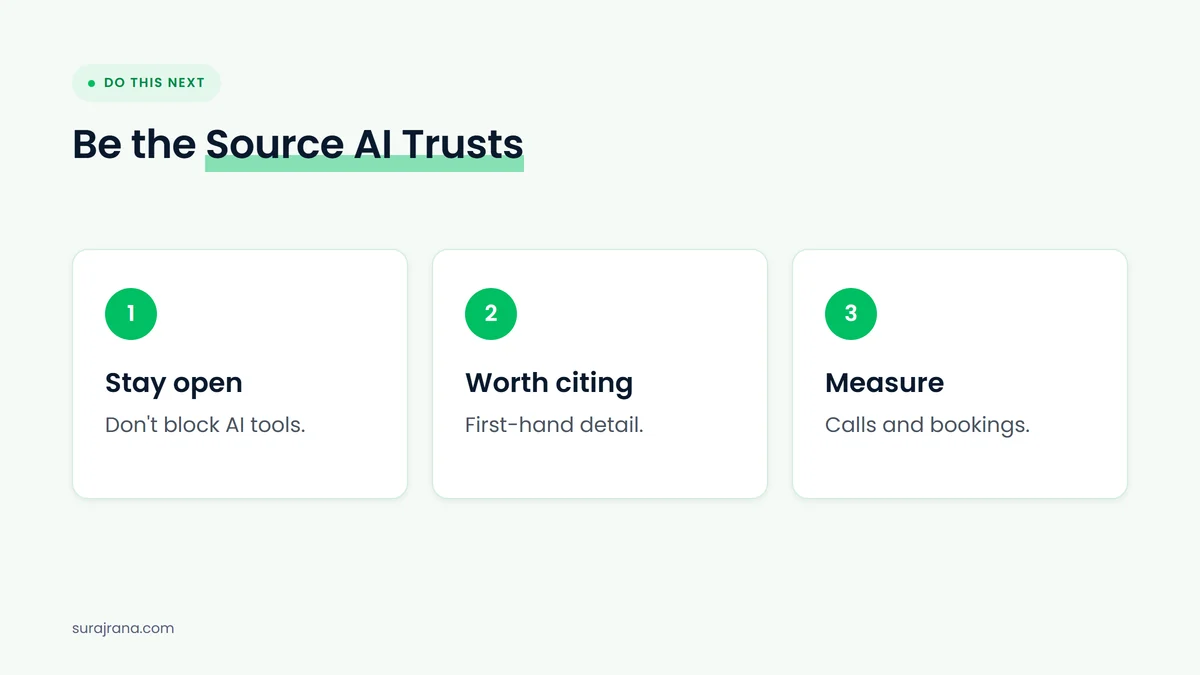
- Leave AI crawlers alone. Check that robots.txt isn’t blocking the tools your customers use. If someone added blanket AI blocks after reading a headline, review that decision.
- Make your key pages worth citing. Treatment and service pages should cover who it suits, how it works, timing, aftercare and how costs are set, written or reviewed by a named expert. Dental Master Media has a guide on writing dental service pages that AI search will cite.
- Add what only you can say. Real prices or price ranges, your own process, your team’s credentials and photos of your own work. That is the kind of first-hand detail AI answers can’t get elsewhere.
- Keep your facts consistent. Name, address, phone, hours and services should match across your site, Google Business Profile and directories, so AI tools describe you correctly.
- Measure outcomes, not mentions. Track clicks, calls, form fills and bookings. Being cited is a start, not the result.
How can you check whether your site is a source AI answers would use?
Ask the questions your customers ask in a few AI tools and see whether your business is named and described correctly. Then check your own pages for direct answers, first-hand details and up-to-date facts. If the AI answer is vague or wrong about you, your pages probably aren’t giving it enough to work with.

- Direct answers: does each service page answer the main question in the first paragraph?
- First-hand detail: is there anything on the page a competitor couldn’t copy word for word?
- Named expertise: can a reader see who wrote or reviewed it, and why they are qualified?
- Current facts: are prices, hours, services and team members up to date?
- Crawler access: can AI tools and search engines reach the pages at all?
If you want a deeper look at this for a dental practice, Dental Master Media has written about what an AI search visibility audit reveals.
Frequently asked questions
Is Yahoo paying websites for using their content in AI answers?
Yahoo Scout is paying publishers that are members of the Internet Licensing Collective, through a blanket license. The ILC shares the money under its Allocation Rules, based on how content is used and how often it is relied upon. No rates have been published.
Can a small business website join the Internet Licensing Collective?
The ILC says publishers can sign up for free and that membership is non-exclusive. Its press release doesn’t set out eligibility rules for small sites. In my opinion, a business site that publishes marketing content shouldn’t expect meaningful income from it.
What is Yahoo Scout?
Yahoo Scout is Yahoo’s AI answers tool. It is the Internet Licensing Collective’s first commercial licensee, which gives it ongoing access to content from member publishers to inform its AI answers.
Should I block AI crawlers on my business website?
For most businesses, no. Blocking AI crawlers can make it harder for AI tools to describe and recommend your business accurately. Publishers negotiating licensing deals have reasons to block. A dental practice or local business usually wants its service pages read and cited.
Does this change how I should do SEO?
Not directly. It reinforces what already works: accurate, specific, first-hand pages that answer real customer questions, consistent business details everywhere, and measuring results by calls and bookings rather than mentions.
My bottom line on Yahoo paying publishers for AI answers
This is good news for publishers and a healthy sign for the web. Paying sources on an ongoing basis is better than taking content for free or signing one-time deals. But it isn’t a new income stream for dental practices or small businesses, and nobody should sell it to them as one.
The real lesson is in Yahoo’s own words: AI answers depend on their sources. For a business, the payoff from AI search is being the source that gets named when a customer asks. That is how I approach dental SEO for practices, and it is what my team delivers through Dental Master Media’s dental SEO services. You can read more about my work on surajrana.com.
Want to know if AI answers can rely on your website?
I’m Suraj Rana. If you’re not sure whether AI tools are naming your practice, or your clients’ businesses, when customers ask, I’m happy to look at it with you and tell you what I’d fix first. Through my dental SEO work and Dental Master Media, my team and I help businesses become the source AI answers trust.
Sources
- Internet Licensing Collective, “The Internet Licensing Collective (ILC) Launches with Yahoo Scout as First Commercial Partner”, November 12, 2026. https://internetcollective.org/press/ilc-launch-2026
- Search Engine Roundtable (Barry Schwartz), “Yahoo Scout To Pay Publishers Through The ILC For Using Content In AI Answers”, November 13, 2026. https://www.seroundtable.com/ilc-yahoo-42528.html
- RSL Standard, “New RSL Web Standard and Collective Rights Organization Automate Content Licensing for the AI-First Internet”, September 10, 2025. https://rslstandard.org/press/rsl-standard
- Daren Trousdell (@dtrous) on X, post on one-time AI content deals, November 13, 2026. https://x.com/dtrous/status/2121221791972577702

My name is Suraj Rana, and I am a seasoned Dental SEO Expert with extensive experience in the Dental SEO industry. Leveraging my deep knowledge and expertise, I help dental practices enhance their online visibility and attract more patients.
