
Quick answer: I think SEO agencies should automate the repeatable, checkable work: data pulls, crawl monitoring, keyword clustering, first-draft briefs, metadata drafts and pre-publish checks. They should never automate strategy, the final fact-check and approval of anything published under a client’s name, or the client relationship itself. Google allows AI help, but not unreviewed scale.
Key takeaways
- My rule of thumb: automate work where a mistake is cheap, easy to spot and easy to undo. Keep humans on work where a mistake is public, expensive or personal.
- Google says appropriate use of AI or automation is not against its guidelines, but generating many pages without adding value for users can count as scaled content abuse.
- Google’s own generative AI guidance says AI is useful for research and for structuring content, and that every AI-generated page, title and description should be fact-checked by a person.
- Most SEO teams already work this way. In a 2026 Keyword.com survey of 97 SEO professionals, only one respondent described their AI use as fully automated.
- I think the agencies that do well from here will automate the busywork and spend the time saved on judgment, not on publishing more pages.
What do I mean by automating SEO agency work?
When I say an agency automates a task, I mean software or AI does it from start to finish, or produces a first draft that a person only checks. That differs from AI-assisted work, where a person does the job with AI as a helper. The question is which tasks can safely run without a person deciding the outcome.
The reason this matters now is that the cost of automating has collapsed. Tasks that used to need a junior analyst for a day can be scripted or handed to an AI model in minutes. That pushes every agency owner toward the same question: if we can automate almost anything, what should we refuse to automate?
Plenty of people in the industry feel the shift. One SEO on X put it bluntly at the end of October, writing that if you do SEO for a living:
“you are watching the job split in two”
@ChadSE0 on X, October 31, 2026 (source)
I agree with that framing. One half of the job is production, and most of it can now be automated. The other half is judgment, and I don’t think it can.
What does Google say about using AI and automation for SEO work?
Google does not ban AI or automation. Its position is that appropriate use is fine, and that the problem is producing large amounts of unoriginal content mainly to manipulate rankings, however it is made. Its current guidance also says people should fact-check and review AI-generated content, including titles, descriptions and structured data, before it goes live.
The facts behind my list come from Google’s own pages:
- In February 2023, Google’s Search Liaison Danny Sullivan and Chris Nelson wrote that appropriate use of AI or automation is not against Google’s guidelines, and pointed out that automation has long produced helpful content such as sports scores and weather forecasts.
- In March 2024, Google introduced its scaled content abuse policy, which applies whether content is produced through automation, human effort or a mix of both.
- Google’s spam policies list “using generative AI tools or other similar tools to generate many pages without adding value for users” as an example of scaled content abuse.
- Google’s guidance on using generative AI content, last updated in October 2026, says AI can be useful when researching a topic and adding structure to original content, and that it is critical to fact-check and review AI output manually. It applies the same review to title elements, meta descriptions, structured data and image alt text.
Danny Sullivan made the same point in a discussion reported by Search Engine Journal in April 2025, saying Google doesn’t care whether scaled content comes from AI, automation or people. That is the line I build my list around. Google judges the output and the intent, not the tool.
Which 6 SEO agency tasks do I think are safe to automate?
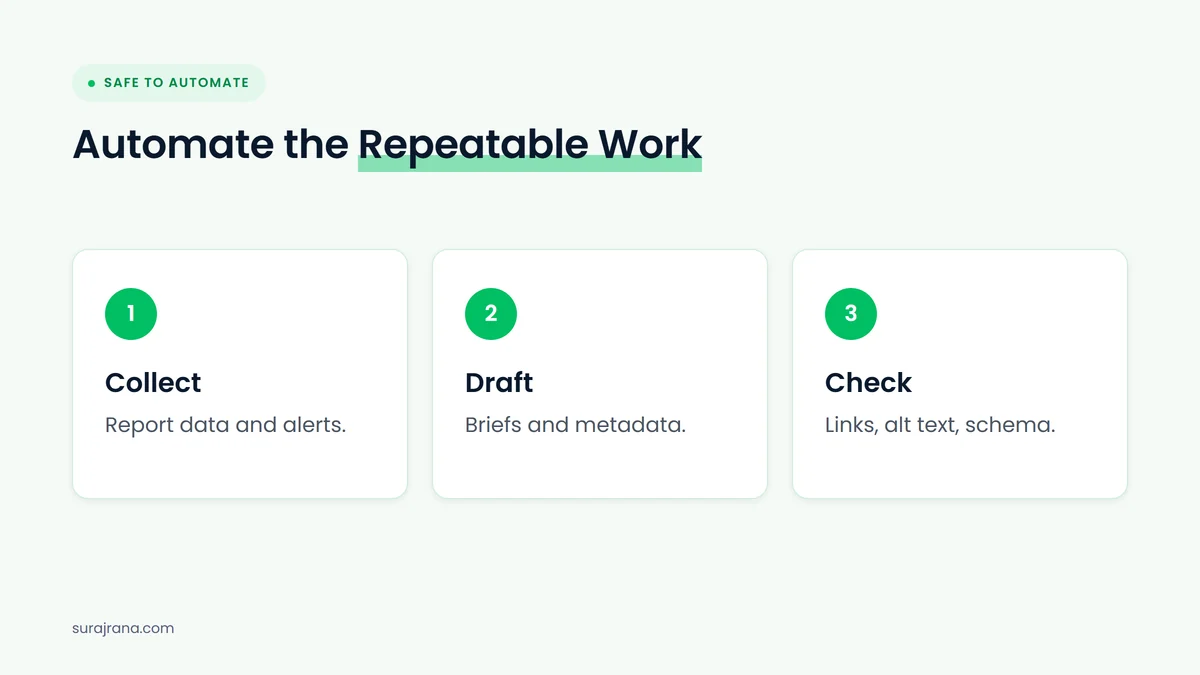
I think the safe tasks share three traits. The output can be checked against a clear rule, a mistake is cheap and easy to undo, and nothing goes live under the client’s name without a person seeing it. Data collection, monitoring, first-pass research, draft briefs, draft metadata and automated quality checks all fit that description.
1. Rank tracking and report data collection
I would automate every part of reporting that is just moving numbers from one place to another. Pulling rankings, Search Console clicks, analytics sessions and conversions into one report each month is repetitive, rule-based and easy to verify. A person adds nothing by copying figures by hand, and copying by hand introduces errors.
The limit is interpretation. A tool can show that clicks fell. It can’t tell the client whether that came from a seasonal dip, an AI Overview appearing on their main query or a broken page. That explanation stays with a person, which is item 9 on this list.
2. Technical crawl monitoring and alerts
Scheduled crawls that flag new broken links, redirect chains, accidental noindex tags, missing canonicals or a sudden jump in 404 errors are the clearest case for automation. Machines are better than people at noticing that something changed overnight across thousands of URLs, and an alert costs almost nothing when it turns out to be harmless.
What I wouldn’t automate is the fix on a live client site. An alert that a page went noindex is useful. A script that removes noindex tags on its own could undo a decision someone made on purpose.
3. Keyword research expansion and clustering
The first pass of keyword research is a good fit for automation and AI. Expanding a seed list, grouping terms by topic and matching them to existing pages is slow by hand and quick for software. It is also the kind of research help Google itself describes as a reasonable use of generative AI.
The limitation is relevance. An automated cluster doesn’t know which services make the client money, which areas they actually serve or which topics they don’t want to be known for. Someone who knows the business has to cut the list before it turns into a plan.
4. Content brief and outline first drafts
I think AI is genuinely good at a first-draft brief: the questions a page should answer, a sensible heading order, related topics and what competing pages cover. Google’s guidance names adding structure to original content as a useful job for AI, and a brief is exactly that. It saves a strategist time without publishing anything.
The weak spot is originality. An AI brief tends to describe what already ranks, so following it blindly produces the same page as everyone else. The writer or strategist still has to add what only the client knows, such as their process, their prices and their experience.
5. Metadata, alt text and schema drafts
Drafting title tags, meta descriptions, image alt text and structured data across hundreds of pages is repetitive work where automation saves real time. The rules are well known, the output is short and checking a draft is much faster than writing one. I’d let AI or templates produce the first version for every page.
The catch is that these are public. Google’s generative AI guidance specifically says titles, meta descriptions, structured data and alt text need the same human review as body content, and that structured data should be validated. Draft automatically, but approve by hand.
6. Pre-publish quality checks
Automated checks before anything goes live are, in my view, the most underrated thing an agency can automate. A script can confirm that every link resolves, every image has alt text, the schema is valid, the meta title fits and banned phrases are absent. Those checks are boring for people and perfectly suited to software.
The trap is treating a passed checklist as approval. Software can confirm that a page is well formed. It can’t confirm that the advice on it is right, which is why the final sign-off sits on the “never automate” list below.
The time these six tasks free up is also why I’ve argued that SEO agencies should price by scope, not hours. When automation makes the work faster, hourly billing turns that efficiency into lost revenue.
Which 3 SEO agency tasks should never be automated?
I think three jobs should always stay with a person: deciding the strategy, giving the final fact-check and approval before anything is published under a client’s name, and handling the client relationship. Each one involves judgment, accountability or trust, and in each one a mistake is public, expensive or hard to take back.
7. Strategy and priorities
Strategy means deciding what to work on first, what to ignore and what success looks like for this particular client. It depends on their margins, their capacity, their competitors and their goals, much of which never appears in any dataset. An AI can suggest options, but choosing between them is the job a client is paying for.
An SEO on X made the same point in November, in a post encouraging people to use AI for repetitive SEO tasks:
“But don’t let it run your entire SEO strategy.”
@EDAN_SEO on X, November 9, 2026 (source)
I’d go further. If a tool sets your client’s strategy, the client will eventually ask why they need you, and they will have a fair point.
8. Final fact-check and publishing approval
Nothing should go live under a client’s name until a person who understands the subject has read it and approved it. This is where AI is weakest, because models predict likely wording rather than look up facts, so they can state wrong things confidently. Google’s guidance calls manual fact-checking of AI content critical for exactly that reason.
It matters even more for clients in health, legal or finance, where a wrong claim can hurt a reader as well as a ranking. Publishing many unreviewed pages also drifts toward the pattern Google’s spam policies describe as scaled content abuse. I’ve written about how that played out for dental websites in Google’s spam update and scaled content, and Whitelabel SEO covers the process side in its piece on AI content governance.
9. Client conversations and explaining results
The client relationship is the part of an agency that can’t be handed to a machine. Explaining why traffic dropped, delivering bad news, resetting expectations and deciding what to promise all need someone who understands the client and is accountable for what they say. Automated emails and AI-written report summaries can’t carry that responsibility.
This is also where agencies get into trouble with promises. An automated sales sequence that promises rankings is still a promise from you, and I’ve explained elsewhere why ranking promises are an SEO red flag. A person should own every commitment made to a client.
How do the tasks to automate compare with the tasks to keep human?
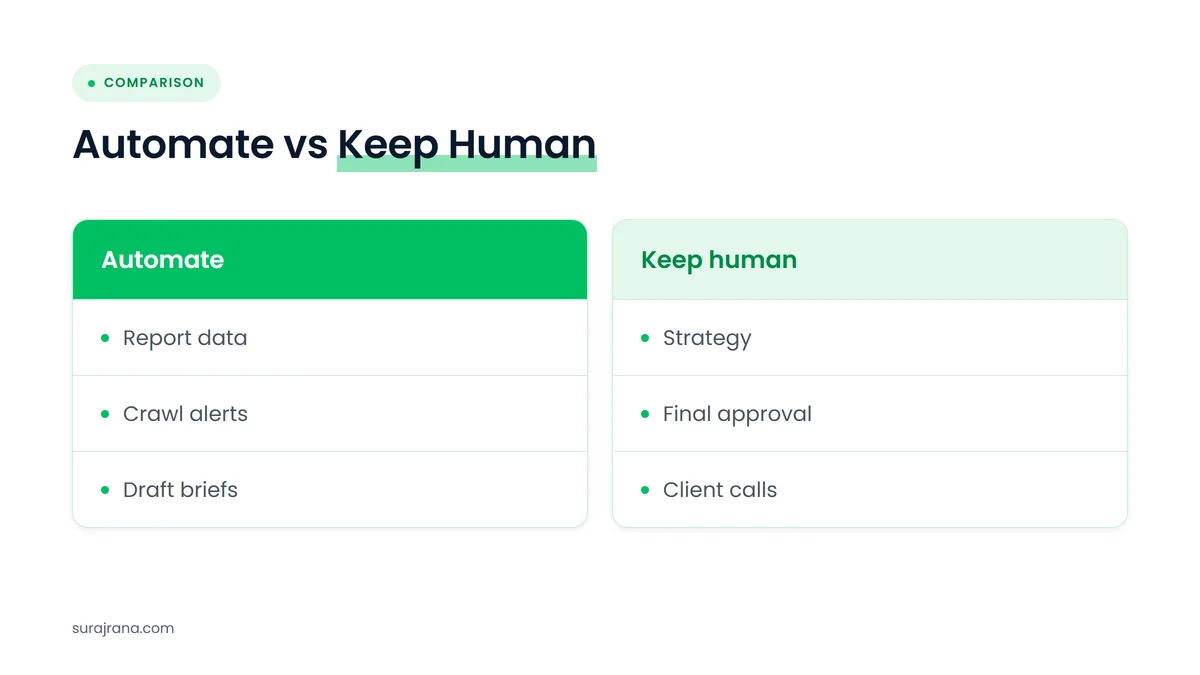
The tasks I’d automate are about collecting, drafting and checking, where output can be verified and mistakes are cheap. The tasks I’d keep human are about deciding, approving and explaining, where mistakes are public and someone has to be accountable. This table sets out how I see the difference, task by task.
| Task | My call | Why | Where a person still steps in |
|---|---|---|---|
| Rank tracking and report data | Automate | Repetitive and easy to verify | Explaining what the numbers mean |
| Crawl monitoring and alerts | Automate | Software spots changes faster | Deciding and applying the fix |
| Keyword expansion and clustering | Automate | Slow by hand, quick for software | Cutting terms that don’t fit the business |
| Content brief first drafts | Automate | Structure is a good AI job | Adding what only the client knows |
| Metadata, alt text and schema drafts | Automate | Rule-based and short | Approving before it goes live |
| Pre-publish quality checks | Automate | Boring for people, ideal for scripts | Reading the content itself |
| Strategy and priorities | Keep human | Depends on context no dataset holds | Always |
| Fact-check and publishing approval | Keep human | AI can be confidently wrong | Always |
| Client conversations | Keep human | Trust and accountability | Always |
Do most SEO teams already keep humans in the loop?
Yes, if the survey data is a fair guide. In Keyword.com’s 2026 survey of SEO agencies, in-house teams and freelancers, almost nobody described their AI use as fully automated. Most said people review AI output or that AI only assists them. The tasks respondents were least willing to fully automate were content writing and link building.
The State of AI and Automation in SEO 2026 report had 97 usable responses. Of 96 people who answered, 44% said humans review AI-generated work, 31% described their use as AI-assisted and 24% said it depends on the task. Only one respondent, 1%, said their use was fully automated. Among 88 respondents, 58% said they won’t fully automate content writing and 51% said the same of link building.
Two caveats are worth stating. The sample is small and skews toward small teams, and Keyword.com sells rank-tracking software, so this is a vendor survey rather than independent research. I treat it as a sign of how practitioners behave, not as proof of what works.
What is the strongest case against my list?
The strongest case against my list is that AI is improving fast, so tasks that need a person today, such as briefs, fact-checking and even first-draft strategy, may not need one in a year or two. Agencies that automate aggressively now could build a cost advantage that careful agencies can’t match. I take that argument seriously.
Here is where I think it is right, and where I think it goes wrong:
- It is right that the “safe” list will grow. I expect more of the drafting and research work to move to automation, and I’d rather an agency test that early than late.
- It is right about cost. An agency that still pulls report data by hand is paying people to do work software does better.
- It is wrong about accountability. Better AI doesn’t change who is responsible when a client’s page says something false. Google’s policies judge the published result, not the tool, and the client blames the agency, not the model.
- It is wrong about value. If everything an agency does can be automated, a client can buy the same automation directly. The part they can’t buy is someone who understands their business and makes the calls.
So my view is that the line will move, but the three tasks on my “never” list are not about capability. They are about who is accountable, and that doesn’t automate.
How would I decide whether a new task is safe to automate?
I’d decide with a short test. If a task’s output can be checked against a clear rule, a mistake is cheap and easy to undo, and nothing reaches the public or the client without a person seeing it first, I’d automate it. If any of those answers is no, I’d keep a person responsible for the result.
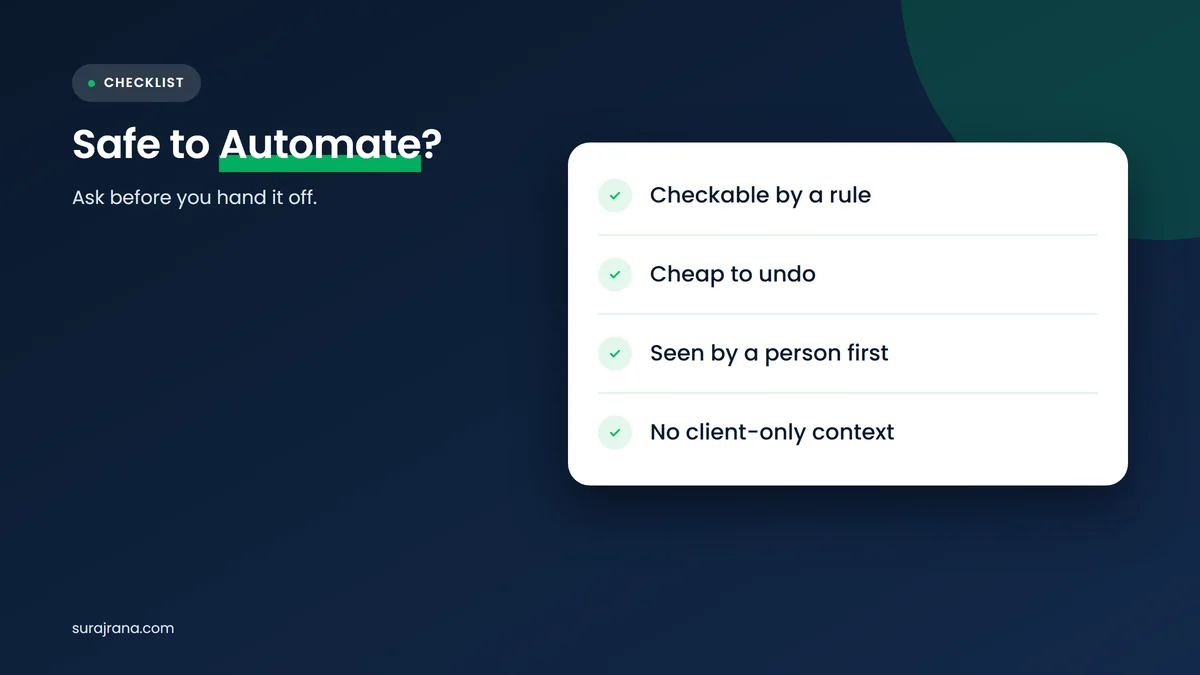
- Can the output be checked against a clear rule? A valid schema or a resolving link can. “Good advice” can’t.
- Is a mistake cheap and easy to undo? A wrong alert costs a minute. A wrong claim on a live page costs trust.
- Does a person see it before the public or the client does? If not, it isn’t safe to automate yet.
- Does it need context only the client can give? If it does, automation can draft it but a person has to finish it.
- Would it create many pages with little added value? If yes, it fits Google’s description of scaled content abuse, and I wouldn’t do it at all.
Frequently asked questions
Is AI-generated SEO content against Google’s guidelines?
No, not on its own. Google says appropriate use of AI or automation is not against its guidelines. What its spam policies target is generating many pages without adding value for users, mainly to manipulate rankings. Google also says AI-generated content should be fact-checked and reviewed by a person before it is published.
What SEO tasks can be fully automated?
In my view, the tasks that can run with little oversight are data collection for reports, rank tracking, scheduled crawl monitoring and automated pre-publish checks. Keyword clustering, content briefs and metadata drafts can be automated too, but a person should review the output before it is used or published.
Will AI replace SEO agencies?
I don’t think so, but I think it will replace agencies that only sell production. If an agency’s value is pulling data and producing pages, clients can buy that automation directly. Agencies that sell judgment, strategy and accountability for what gets published are much harder to replace.
Should an SEO agency tell clients it uses AI?
I think it should. Google’s own guidance encourages telling readers how content was created when automation was involved. With clients, being open about which tasks are automated and which are reviewed by people builds more trust than hoping they never ask.
How do you keep AI-assisted SEO work at a high standard?
Put a named person in charge of approving everything that goes live, fact-check every claim against a primary source, and run automated checks for links, alt text and schema before that final review. Never publish large batches of pages that nobody has read.
My bottom line on automation in SEO agencies
I think the right split is simple. Automate the work of collecting, drafting and checking, and keep people on the work of deciding, approving and explaining. Agencies that automate the first half will have more time and better margins. Agencies that automate the second half will eventually publish something wrong under a client’s name, and no tool will take the blame for them.
If you run an agency, list every task your team does in a month and run each one through the test above. You’ll probably find more to automate than you expected, and one or two things you’ve automated that a person should own again. I’ve shared more on the business side in what white label taught me about agency margins. You can see how I approach SEO work through my dental SEO services on surajrana.com, and if you’d rather have SEO delivered behind your own brand with people reviewing every deliverable, look at Whitelabel SEO’s white-label SEO services.
Want a second opinion on what your agency automates?
I’m Suraj Rana. If you’re trying to work out which parts of your SEO delivery to automate and which to keep with your team, I’m happy to talk it through with you. My team and I work with dental practices and with agencies that resell SEO.
Sources
- Google Search Central, “Google Search’s guidance on using generative AI content on your website”, last updated October 1, 2026. https://developers.google.com/search/docs/fundamentals/using-gen-ai-content
- Google Search Central, “Spam policies for Google web search”, last updated August 28, 2026. https://developers.google.com/search/docs/essentials/spam-policies
- Google Search Central Blog (Danny Sullivan and Chris Nelson), “Google Search’s guidance about AI-generated content”, February 8, 2023. https://developers.google.com/search/blog/2023/02/google-search-and-ai-content
- Google Search Central Blog (Chris Nelson), “What web creators should know about our March 2024 core update and new spam policies”, March 5, 2024. https://developers.google.com/search/blog/2024/03/core-update-spam-policies
- Search Engine Journal (Roger Montti), “Google On Scaled Content: ‘It’s Going To Be An Issue'”, April 1, 2025. https://www.searchenginejournal.com/google-on-scaled-content-its-going-to-be-an-issue/543308/
- Keyword.com, “The State of AI and Automation in SEO 2026”, 2026. https://keyword.com/reports/state-of-ai-and-automation-in-seo/
- @EDAN_SEO on X, post on using AI for repetitive SEO tasks, November 9, 2026. https://x.com/EDAN_SEO/status/2119838312399523896
- @ChadSE0 on X, post on the SEO job splitting in two, October 31, 2026. https://x.com/ChadSE0/status/2116594328621432950

My name is Suraj Rana, and I am a seasoned Dental SEO Expert with extensive experience in the Dental SEO industry. Leveraging my deep knowledge and expertise, I help dental practices enhance their online visibility and attract more patients.