
Quick answer: When new-patient numbers fall, I’d start with measurement, not more spending. First make sure you can see where every new patient comes from, then fix how calls and messages are answered, then your Google Business Profile, reviews and key treatment pages. Only once those work would I add ads or content.
Key takeaways
- My position: most struggling practices don’t have a traffic problem first. They have a measurement and follow-up problem, and more ad spend only makes it more expensive.
- Fix tracking before anything else. Without call tracking, tagged profile links and key events in Google Analytics, every other decision is a guess.
- Google Business Profile now has a Message button on Maps and booking links that send patients straight to a booking page, so the profile is a front desk, not just a listing.
- AI Overviews and AI Mode don’t need a special trick. Google says pages only need to be indexed and eligible for a normal snippet, so the basics matter more than ever.
- Ads and new content come last on my list, after you can prove which channel books patients.
What do I mean by a struggling practice’s marketing?
By a struggling practice’s marketing, I mean a practice where new-patient numbers have dropped or stalled while the marketing bill stays the same or grows. Nobody can say clearly which channel books patients, calls go unanswered or untracked, and the usual response is to buy more ads or more content.
The symptoms tend to look the same from practice to practice:
- The monthly report shows rankings, impressions or clicks, but not new patients by source.
- The front desk is busy, so calls during lunch, evenings and weekends go to voicemail.
- The Google Business Profile was set up years ago and nobody has checked it since.
- Treatment pages for the highest-value services are thin or generic.
- The plan for fixing all this is “spend more on Google Ads”.
None of these is unusual, and none of them is fixed by a bigger budget. That is the whole argument of this list.
What are the 9 things I’d fix first?
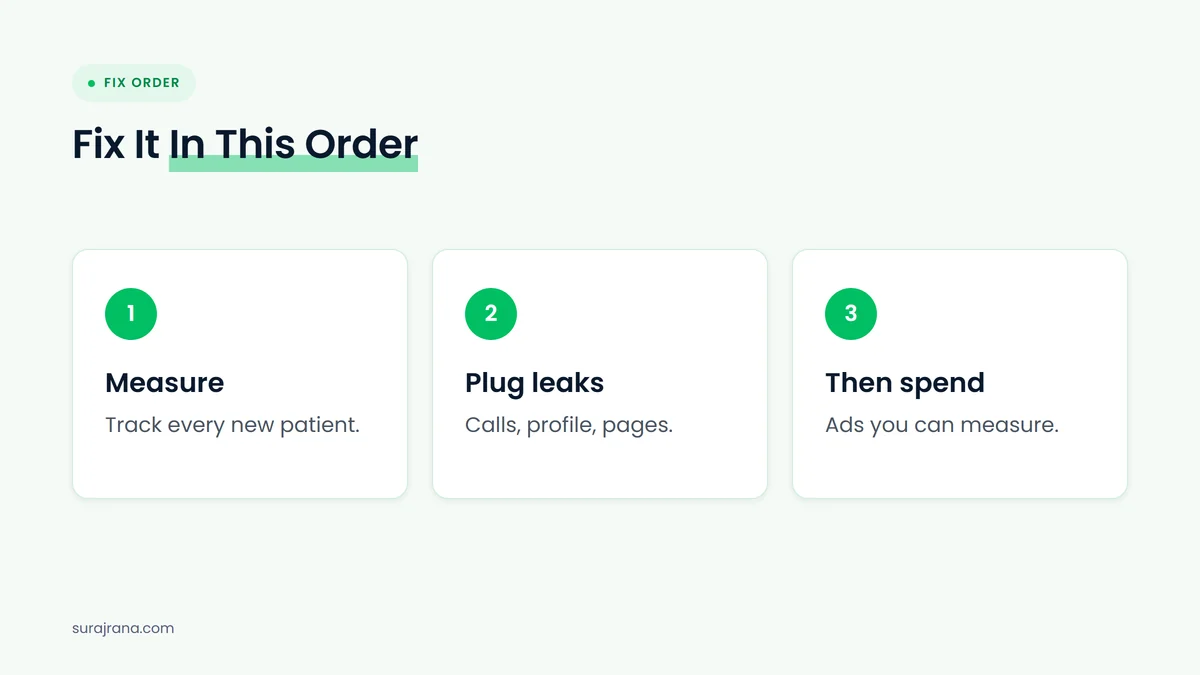
These are the nine fixes I’d make first, in the order I’d make them. The order matters more than the list. Each step either tells you something you need for the next one or stops patients leaking out before they book. Most of them cost time and attention, not a bigger monthly budget.
1. Tracking that shows where new patients come from
The first thing I’d fix is tracking, because every other decision depends on it. If you can’t say how many new patients came from Google Business Profile, the website, ads and referrals last month, you can’t tell which channel is failing. You end up cutting the one that works and paying more for the one that doesn’t.
At a minimum I want three things in place:
- Call tracking on the website and ads. Google Ads can show a Google forwarding number on your site and count calls longer than a minimum length you set as conversions, according to Google Ads Help. Third-party call tracking works too, but it needs careful setup.
- Key events in Google Analytics. Mark the actions that matter, such as a booking confirmation page or a form submission, as key events. Google Analytics Help shows how to create one from a thank-you page without code.
- Tagged links on your profile. Add UTM parameters to the website and booking links on your Google Business Profile. Google Analytics Help says to always use utm_source, utm_medium and utm_campaign, so profile visits stop hiding inside generic Google traffic.
Then ask the front desk to record how each new patient heard about you. It is low-tech, but it catches word of mouth and AI recommendations that software misses. Dental Master Media has a step-by-step guide to tracking calls and bookings from a dental website if you want the setup in detail.
2. How calls and messages are answered
The second fix is the phone, because a missed call from a new patient is marketing money you already spent and then threw away. Before buying more leads, I’d check how many calls go unanswered, how voicemails are followed up, and how quickly someone replies to a web form or a message.
Call tracking from step one usually makes this visible for the first time. Listen to a sample of recorded calls if your system allows it and your local rules permit it. Look for calls that ring out at lunch, callers who ask about a treatment and never get offered a time, and messages that wait until the next day.
This isn’t a marketing agency’s job, and I think that is exactly why it gets skipped. It is often the cheapest fix on this list: a lunch cover rota, a call-back rule for voicemails and one person who owns the inbox.
3. The Google Business Profile basics
The third fix is the Google Business Profile, because for many local searches it is the first thing a patient sees, before your website. I’d check that the name, address, phone number, hours, primary category, services and photos are complete, accurate and match the website.
Google is direct about why this matters. Its own guidance on local ranking says businesses with complete and accurate information are more likely to show up in local results, and that local ranking depends on relevance, distance and prominence. Distance you can’t change. The other two you can.
Pay particular attention to the services list and the holiday hours, and remove anything out of date. I’ve argued before that your Google Business Profile services list decides if AI recommends you, and I still think that is the most overlooked field on the profile.
4. Messaging and booking links on the profile
The fourth fix is turning the profile into a place patients can act, not just read. Google now puts a Message button next to Call on Maps, and booking links can send patients straight to a booking page. If those aren’t set up and answered, patients who prefer not to phone have nowhere to go.
The changes are recent. Search Engine Roundtable reported on November 6, 2026 that Google expanded business messaging to Google Maps on Android and iOS, with the Message button beside the Call button, routing chats to WhatsApp or text depending on what is linked. Google’s help page on chat says only claimed and verified profiles can add it, and it is available in select regions.
Search Engine Roundtable also reported in October 2026 that AI-powered messaging for Business Profiles is expanding, with an AI agent answering routine questions and handing the rest to the business. That makes accurate hours and services even more important, because the agent answers from them.
For booking, Google Business Profile Help lets you add booking links and mark one as preferred. Dental Master Media has written up how the Maps Message button and booking links work for practices.
5. A steady flow of reviews, with replies
The fifth fix is reviews, because patients compare practices on them and Google uses them as part of prominence. I’d look less at the star rating and more at whether new reviews arrive every month, whether they mention treatments, and whether every review, good or bad, gets a thoughtful reply.
Google’s local ranking guidance says more reviews and positive ratings can help a business’s local ranking, and that replying to reviews shows you value feedback. A practice that asked for reviews once, years ago, and then stopped often looks inactive next to a competitor that asks every week.
The fix is a habit, not a campaign: ask at the end of a good appointment, send one follow-up message with the review link, and reply within a few days. Keep replies free of patient details, since a review reply is public.
6. Treatment pages for the services that pay the bills
The sixth fix is the website pages for your most valuable treatments, such as implants, clear aligners or emergency care. If those pages are thin, generic or missing costs and next steps, patients who are close to booking leave. I’d rewrite these before adding a single blog post.
A good treatment page answers the whole decision: who it suits, what happens, how long it takes, how costs are structured, what insurance or financing covers and how to book. It is reviewed by a dentist and links to the booking or contact page.
I’ve made the longer case in why I think most dental blogs are a waste of money, so I won’t repeat it here. The short version: one complete implant page usually does more for a struggling practice than a month of generic posts.
7. The website’s path from visit to booking
The seventh fix is the route a patient takes from landing on the site to booking. On a phone, can they tap to call in one step? Is the booking button visible without scrolling? Does the form work? I’d test it myself on a phone before paying for any more traffic to the site.
The checks are simple and anyone at the practice can run them:
- Open the site on your phone and try to book a new-patient appointment. Time how long it takes.
- Tap the phone number on every key page. It should dial, and it should be the tracked number.
- Submit the contact form and check that someone at the practice actually receives it.
- Check that opening hours on the site match the Google Business Profile.
If the site fails these checks and you can’t change it without your web company’s permission, that is a separate problem. I explain why I think every dental practice should own its website, and this is one of the moments where it matters.
8. How the practice shows up in AI Overviews and AI Mode
The eighth fix is checking how the practice appears when patients ask Google’s AI features or a chatbot about local dentists and treatments. I’d do this after the basics because the same basics feed it: an accurate profile, clear treatment pages, reviews and consistent details across the web.
Google’s guidance on AI features and your website says there are no extra technical requirements to appear in AI Overviews or AI Mode. A page needs to be indexed and eligible to show with a snippet, and traffic from these features is counted in Search Console’s Performance report under Web.
It still matters who gets cited. Seer Interactive’s April 2026 study found AI Overviews on 36% of informational queries but 8% of commercial and 5% of transactional ones, and brands cited in an AI Overview earned more organic clicks than those that weren’t. Pew Research Center found in July 2025 that users clicked a traditional result in 8% of visits with an AI summary, against 15% without one.
So run the searches your patients would run, note who gets named, and compare their profiles and pages with yours. I’ve written about why small dental practices can still beat chains in AI search, and the reasons start with getting these basics right.
9. Ad spend, but only once you can measure it
The ninth fix is paid advertising, and it is last on purpose. Once tracking shows which campaigns and keywords lead to calls and bookings, I’d cut the spend that produces nothing and only then consider raising budgets. Spending more before that point usually buys more of whatever is already broken.
Ads aren’t the enemy. For a new practice, a new location or a treatment you need to fill quickly, they can be the fastest lever you have. My objection is to using them as the first answer to falling numbers when calls go unanswered and the landing page doesn’t convert.
When you do review the ads, judge them on booked patients, not clicks. The same thinking is why I wrote about why I stopped selling keyword rankings: the number that matters is the one that pays the practice.
How does fixing the basics compare with spending more?
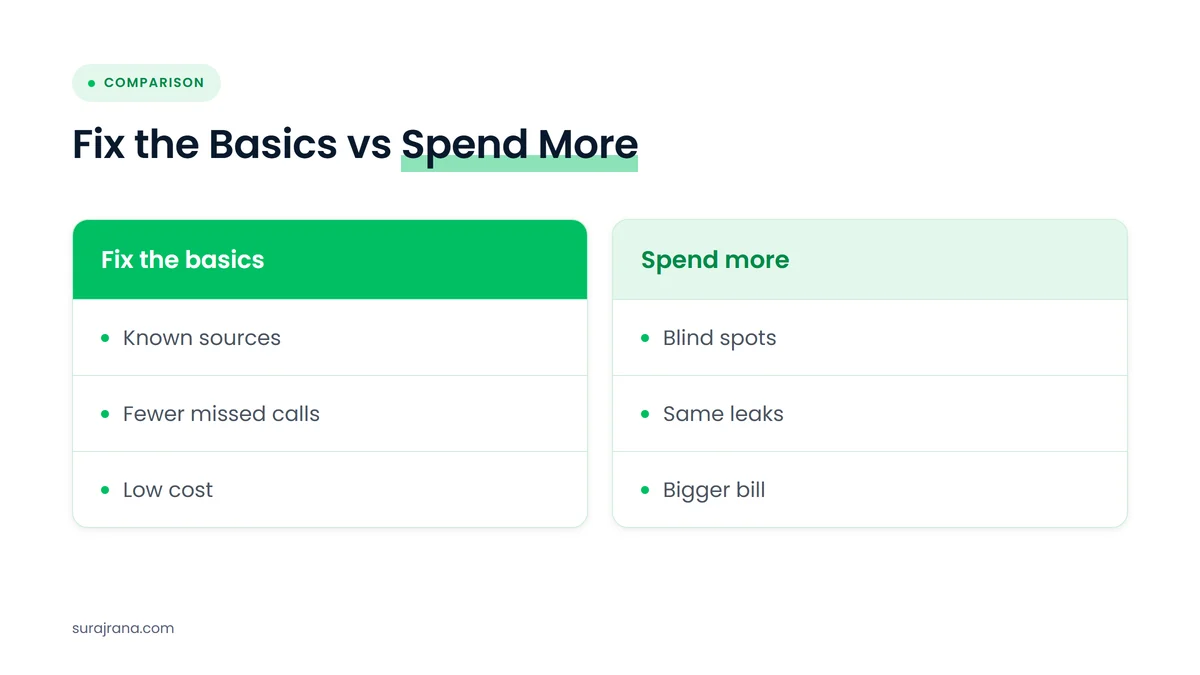
Fixing the basics improves what happens to the patients you already reach, while spending more only increases how many you reach. When calls are missed, the profile is out of date and nothing is tracked, extra spend pours more people into the same leaks. This table shows how I weigh the two.
| Fix | Main cost | What it tells you or saves | Do it before more spend? |
|---|---|---|---|
| 1. Tracking | Setup time | Which channel books patients | Yes, first |
| 2. Calls and messages | Staff time and rules | Stops paid leads going to voicemail | Yes |
| 3. Business Profile basics | An afternoon, then monthly checks | More complete local listing | Yes |
| 4. Messaging and booking links | Setup plus someone to reply | A way to book without phoning | Yes |
| 5. Reviews and replies | A weekly habit | Fresh proof for patients and Google | Yes |
| 6. Treatment pages | Writing and dentist review | Better pages for close-to-booking patients | Yes, for top services |
| 7. Visit-to-booking path | Testing and small fixes | Fewer drop-offs on phones | Yes |
| 8. AI search check | A few hours of searching | Who gets named instead of you | Alongside the rest |
| 9. Ad spend | Monthly budget | Growth, once the rest works | This is the spend |
When would I spend on ads before fixing the basics?
I would spend on ads before finishing the basics when a practice needs patients this month to stay afloat, has just opened, or has a new dentist with an empty schedule. In those cases ads buy time. I’d still put basic call tracking in place first, because it takes days, not months.
Here is the fair case for the other side:
- Ads are fast. Most of the fixes above take weeks to show results. A campaign can produce calls within days.
- Some markets are crowded. In a competitive area, a practice with perfect basics may still need paid visibility to be seen at all.
- Ads test demand. A short campaign can show whether people in your area search for a treatment before you build pages for it.
All three are true. None of them changes the order for a practice whose numbers are falling and whose tracking is missing. Fast spending without measurement is still guessing, just more quickly.
How do you know your tracking is good enough?
Your tracking is good enough when you can answer one question from your own data: how many new patients came from each channel last month? If the answer needs guesswork, a call to your agency or a spreadsheet nobody updates, it isn’t ready, and I wouldn’t raise any budget until it is.
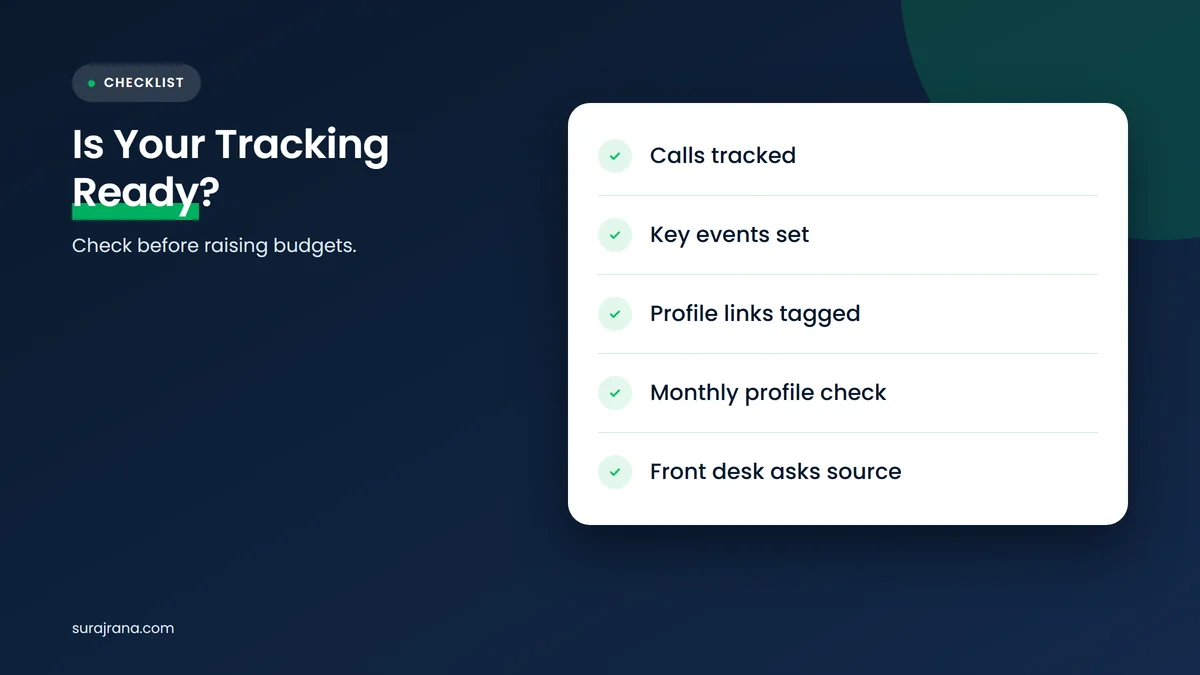
- Calls from the website and ads are tracked, with a minimum call length so wrong numbers don’t count.
- Bookings and form submissions are marked as key events in Google Analytics.
- Website and booking links on the Google Business Profile carry UTM parameters.
- Profile calls, messages, bookings and website clicks are checked monthly in the Business Profile performance report, which Google Business Profile Help says includes all four.
- The front desk records how each new patient heard about the practice.
If you’d like a second pair of eyes on all this, Dental Master Media offers a free dental SEO audit that looks at the profile, the site and what is being tracked.
Frequently asked questions
Why are my new dental patients down when my rankings look fine?
Rankings can hold steady while new patients fall because rankings measure visibility, not bookings. Calls may be going unanswered, the profile may send people to an outdated page, AI answers may be naming other practices, or ads may be pulling budget from what works. Tracking by source is how you find out which.
Should I increase my Google Ads budget when new patients drop?
Not until you can see which campaigns produce booked patients. If calls and bookings from ads aren’t tracked, a bigger budget usually buys more of the same result. Set up call tracking and key events first, cut what produces nothing, and then decide whether more spend makes sense.
What is the cheapest fix for a struggling dental practice’s marketing?
The cheapest fix is usually how calls and messages are answered. Covering lunch breaks, returning voicemails the same day and replying to profile messages quickly costs staff attention rather than a bigger budget, and it stops leads you already paid for from going elsewhere.
Do I need to do anything special to appear in Google AI Overviews or AI Mode?
No special markup or files are required. Google says a page needs to be indexed and eligible to show with a snippet. What helps is the same work as normal local SEO: a complete Google Business Profile, clear treatment pages, steady reviews and consistent practice details across the web.
How long does it take to see results from fixing the basics?
Some fixes show results within weeks, such as answering missed calls or adding a booking link. Others, like stronger treatment pages and a steady flow of reviews, build over months. Tracking pays off immediately, because it shows you which fixes are working.
My bottom line on fixing a struggling practice’s marketing
When new-patient numbers fall, I don’t think the first question is “where do we spend more?” It is “where are we losing the patients we already reach?” Measure first, plug the leaks in the phone, the profile and the key pages, and only then decide where extra money should go.
That order isn’t exciting, and it rarely makes a good sales pitch. It is still the one I’d follow with my own money. If you want to see how I approach this work, read about my dental SEO services on surajrana.com.
Want me to look at where your patients are leaking?
I’m Suraj Rana, founder of Dental Master Media. If your new-patient numbers have dropped and nobody can tell you why, I’m happy to look at your tracking, profile and key pages with you and tell you plainly what I’d fix first.
Sources
- Google Ads Help, “Set up Tracking calls to a phone number on a website”, accessed November 9, 2026. https://support.google.com/google-ads/answer/6095883?hl=en
- Google Analytics Help, “Create or modify key events”, accessed November 9, 2026. https://support.google.com/analytics/answer/12844695?hl=en
- Google Analytics Help, “URL builders: Collect campaign data with custom URLs”, accessed November 9, 2026. https://support.google.com/analytics/answer/10917952?hl=en
- Google Business Profile Help, “Tips to improve your local ranking on Google”, accessed November 9, 2026. https://support.google.com/business/answer/7091
- Search Engine Roundtable (Barry Schwartz), “Google Expands Business Messaging To Google Maps On iOS & Android”, November 6, 2026. https://www.seroundtable.com/google-maps-messaging-android-ios-42472.html
- Google Business Profile Help, “Chat with customers from your Business Profile”, accessed November 9, 2026. https://support.google.com/business/answer/15013580
- Search Engine Roundtable (Barry Schwartz), “Google Business Profiles AI-Powered Messaging Expands”, October 29, 2026. https://www.seroundtable.com/google-business-profiles-ai-powered-messaging-42419.html
- Google Business Profile Help, “Manage your local business links”, accessed November 9, 2026. https://support.google.com/business/answer/6218037?hl=en
- Google Search Central, “AI features and your website”, accessed November 9, 2026. https://developers.google.com/search/docs/appearance/ai-features
- Seer Interactive, “AIO Impact on Google CTR: 2026 Update”, April 24, 2026. https://www.seerinteractive.com/blog/aio-impact-on-google-ctr-2026-update
- Pew Research Center, “Google users are less likely to click on links when an AI summary appears in the results”, July 22, 2025. https://www.pewresearch.org/short-reads/2025/07/22/google-users-are-less-likely-to-click-on-links-when-an-ai-summary-appears-in-the-results/
- Google Business Profile Help, “Understand your Business Profile performance & insights”, accessed November 9, 2026. https://support.google.com/business/answer/9918094?hl=en

My name is Suraj Rana, and I am a seasoned Dental SEO Expert with extensive experience in the Dental SEO industry. Leveraging my deep knowledge and expertise, I help dental practices enhance their online visibility and attract more patients.