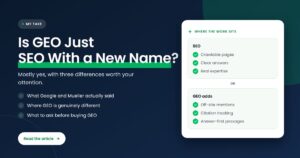

Quick answer: I don’t think GEO is a separate discipline. Most of what gets sold as generative engine optimization is SEO done properly: crawlable pages, clear answers, real expertise and a brand people talk about. Three things are genuinely different, though: earning off-site mentions, measuring citations instead of clicks, and writing passages an AI can lift cleanly.
Key takeaways
- My position: GEO is SEO with a wider scoreboard, not a new profession. If your SEO is weak, no GEO package will rescue it.
- Google says it plainly in its own AI optimization guide: optimizing for generative AI search is still SEO, and you don’t need llms.txt files, special schema or content “chunking”.
- On November 2, 2026, Search Engine Journal reported John Mueller saying AI systems build on SEO and that AI crawling is another flavor of technical SEO.
- Microsoft, on the other hand, uses the GEO label for its new Bing Webmaster Tools citation reports, so the name isn’t going away.
- The real differences are narrow: off-site brand mentions, citation-based measurement and answer-first writing. Those deserve attention, not a separate retainer built on jargon.
What is GEO, and where did the term come from?
GEO, or generative engine optimization, is the work of making your content more likely to be used and cited in answers written by AI systems such as Google’s AI Overviews and AI Mode, ChatGPT, Perplexity and Microsoft Copilot. The goal is to be named or linked inside the answer, not only to rank in a list of results.
The term comes from a 2023 research paper by a team from Princeton and other institutions, titled “GEO: Generative Engine Optimization”, which was later accepted at KDD 2024. The authors tested ways of rewriting content and reported visibility gains of up to 40% in generative engine responses on their benchmark. Since then the label has spread, alongside close cousins like AEO (answer engine optimization), LLMO and “AI SEO”.
That history matters to my argument. GEO started as a research framing for a new kind of results page. It became a sales category much later, and those are not the same thing.
Is GEO a separate discipline or part of SEO?
I land firmly on “part of SEO”. The systems that write AI answers mostly pull from pages that search engines already crawl, index and judge for quality. The skills that earn those citations, technical access, clear content, topical depth and trust, are the same skills good SEO always needed. GEO adds a few new tasks, not a new foundation.
What does Google say about GEO?
Google says optimizing for its generative AI features is still SEO. Its guide for site owners lists no extra requirements for AI Overviews or AI Mode beyond being indexed and eligible for a snippet, and it directly debunks several popular “AEO/GEO” tactics, including special AI text files, chunking content and chasing inauthentic mentions.
Google’s guide on optimizing your website for generative AI features, announced by John Mueller on May 15, 2026, puts it in one line: optimizing for generative AI search “is optimizing for the search experience, and thus still SEO.” Its AI features documentation adds that SEO best practices remain relevant, and that there is no special schema.org markup you need to add.
The guide’s mythbusting section is worth reading in full if anyone has pitched you GEO. According to Google, you don’t need:
- llms.txt files, AI text files or Markdown versions of your pages to appear in Google Search.
- To break your content into tiny chunks so AI can understand it.
- To rewrite your content in a special style for generative AI.
- Special structured data, although markup that matches the visible page is still good practice.
It also warns that seeking inauthentic mentions across the web “isn’t as helpful as it might seem”, and tells site owners weighing third-party AEO or GEO services to review its guidance on evaluating SEO advice.
What did John Mueller say this month?
In an interview reported by Search Engine Journal on November 2, 2026, John Mueller was asked by David Iwanow whether AEO and GEO are dead. He didn’t answer with a yes or no. Instead he said AI systems build on SEO, that technical SEO will stay very relevant, and that AI crawling is another flavor of technical SEO.
In Roger Montti’s write-up, Mueller says “a lot of the AI systems, they build on SEO,” and notes that AI systems crawl slightly differently, calling it “another flavor of technical SEO.” He also warned that shady tactics like keyword stuffing, familiar from classic SEO, are now showing up in AI SEO, and advised businesses to watch closely what any vendor is actually doing.
I read that as the most honest framing anyone at Google has offered. It doesn’t say nothing has changed. It says what changed sits inside the craft, not outside it.
Why do I think most GEO is just SEO done properly?
I think most GEO is SEO done properly because when you list what GEO consultants actually deliver, nearly every item was already on a good SEO checklist: let crawlers in, answer questions clearly, show who wrote it, cover a topic in depth, keep facts current and build a reputation. The new name often repackages work that many sites simply never did.
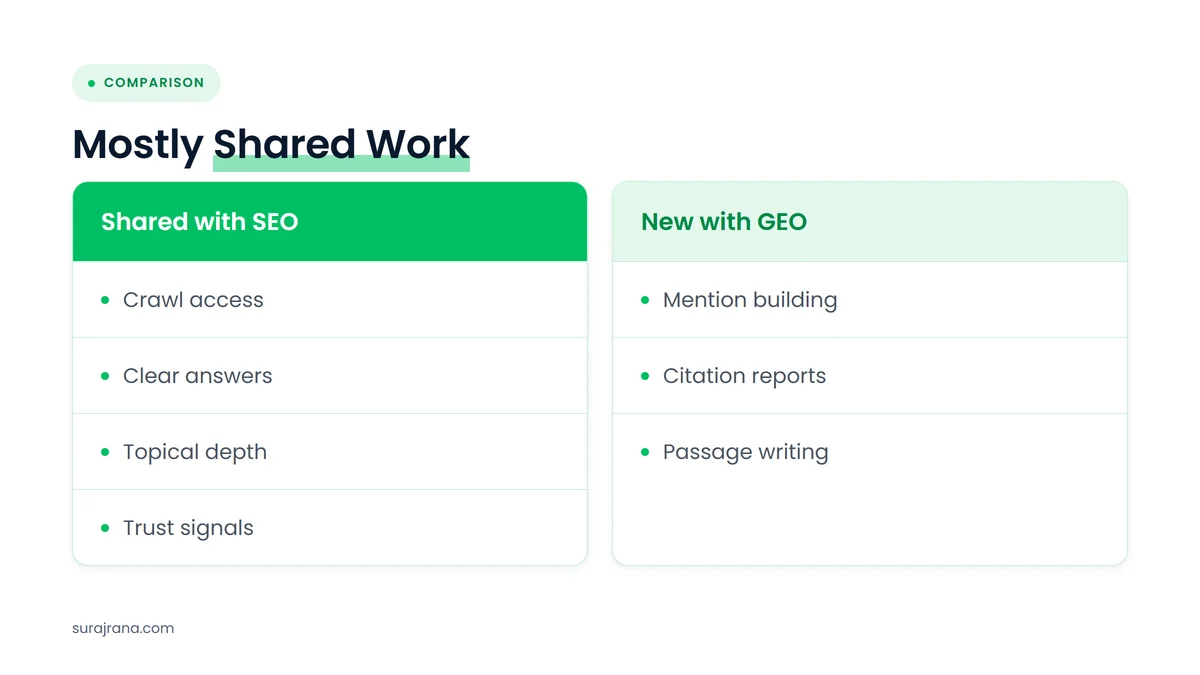
Here’s how I map the usual GEO promises against the SEO work underneath them:
| What a GEO pitch promises | The SEO work underneath it | Genuinely new? |
|---|---|---|
| Make sure AI can read your site | Crawlability, robots.txt, rendering, important content in text | Partly: more crawlers to manage, each behaving a little differently |
| Get quoted in AI answers | Clear, direct answers to real questions near the top of a section | Partly: passages now get lifted on their own |
| Become a trusted entity | Consistent brand details, author pages, expertise, reviews | No |
| Cover the topic fully | Topical depth and internal linking | No, though query fan-out rewards it more |
| Get mentioned across the web | Digital PR, earned coverage, community presence | Partly: unlinked mentions now matter more than they did |
| Add AI schema and llms.txt | Ordinary structured data that matches the page | No. Google says no special files or markup are needed |
| Report AI visibility | Search Console and analytics reporting | Yes: citations and AI impressions are new metrics |
That table is why I’m skeptical whenever GEO is sold as a standalone product. If a site has slow, hard-to-crawl pages, vague service pages and no reputation beyond its own domain, the GEO problem and the SEO problem are the same problem. I made a similar point when I explained why I stopped selling keyword rankings: the label on the report matters less than whether the work changes what customers see.
Where is GEO genuinely different from SEO?
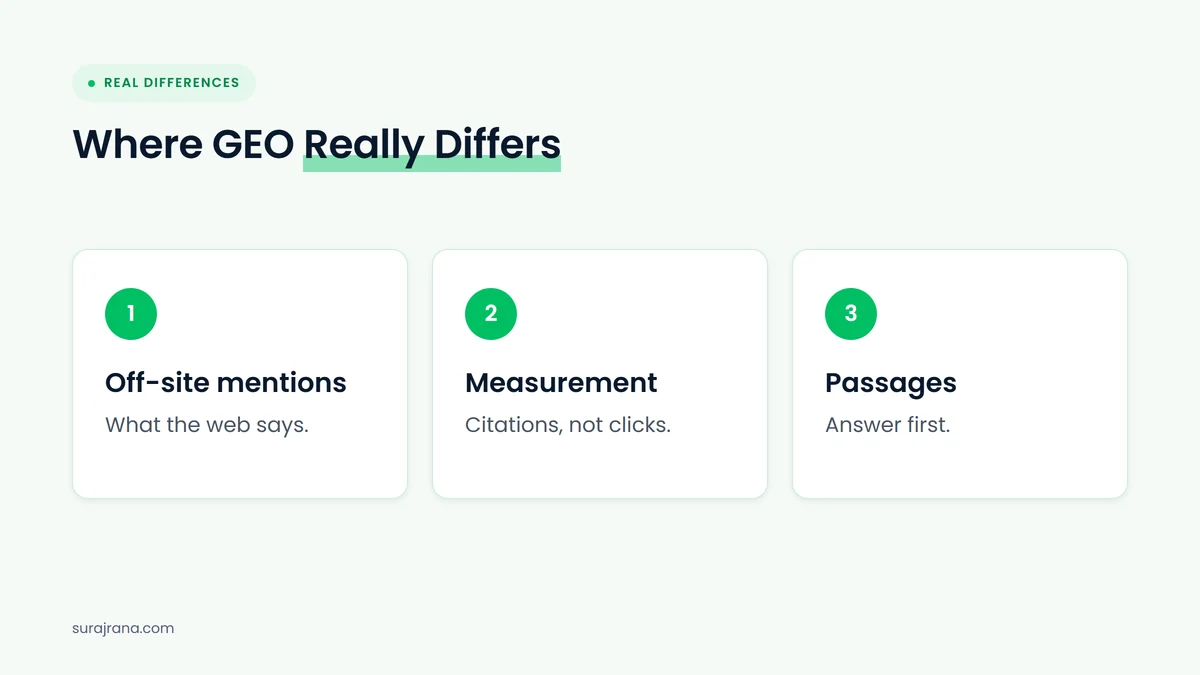
GEO is genuinely different in three places. Off-site mentions carry more weight because AI answers summarize what the web says about you. Measurement moves from clicks and positions to citations and AI impressions. And writing has to work at the passage level, because an AI may lift one paragraph without the rest of the page.
Why do off-site mentions matter more for AI answers?
Off-site mentions matter more because AI answers often describe what is being said about a business or product across the web, not just what its own website claims. If reviews, news coverage, forums and industry lists rarely mention you, an AI system has little outside evidence to repeat, however good your own pages are.
Google’s guide acknowledges this directly, noting that its generative AI features can show what is being said about products and services across the web. The same guide warns against inauthentic mentions, which is the important part. The answer is real digital PR, real reviews and real participation in your industry, which is old-fashioned reputation work rather than a GEO trick.
Why does measuring GEO look different?
Measuring GEO looks different because the outcome is often a citation or an impression inside an answer, not a click. Google’s Search Console report for generative AI features shows impressions, not clicks, and Bing’s AI Performance report counts citations. Traditional rank tracking misses most of this, so reporting has to change.
Google launched its Search Generative AI performance reports on June 3, 2026, showing how often your URLs appeared in AI Overviews, AI Mode and generative AI features in Discover, and says they reached all websites by August 31, 2026. I’ve written about what that Search Console report shows in more detail. Microsoft’s AI Performance report in Bing Webmaster Tools, released in public preview on February 10, 2026, counts total citations across Copilot and Bing’s AI summaries and shows the grounding queries behind them. Microsoft explicitly calls it an early step toward GEO tooling.
This is the strongest argument for keeping the GEO label, and I accept it. The scoreboard really has changed. But a new scoreboard is a reporting change, not a new sport.
Why does answer-first writing matter more now?
Answer-first writing matters more because AI systems pull individual passages to answer specific questions, including follow-up questions they generate themselves. A paragraph that states the answer plainly in its first sentence, and makes sense without the rest of the page, is easier to use and cite than an answer buried under three paragraphs of preamble.
I want to be careful here, because Google says you don’t need to write in a special way for AI or chop pages into tiny chunks. I agree. Answer-first writing isn’t a new technique. It’s what good editors have always asked for, and it helps human readers as much as machines. Google’s guide also describes query fan-out, where its systems run several related searches to build one answer, which rewards pages that cover a topic thoroughly rather than one keyword at a time.
Should you buy GEO as a separate service?
For most businesses, no. I’d buy good SEO that already includes AI visibility: technical access for search and AI crawlers, answer-first content, real off-site reputation work and reporting that covers AI citations. A separate GEO retainer makes sense only when your SEO foundation is already strong and the extra work is clearly defined.
Before you pay anyone for GEO, I’d ask these questions:
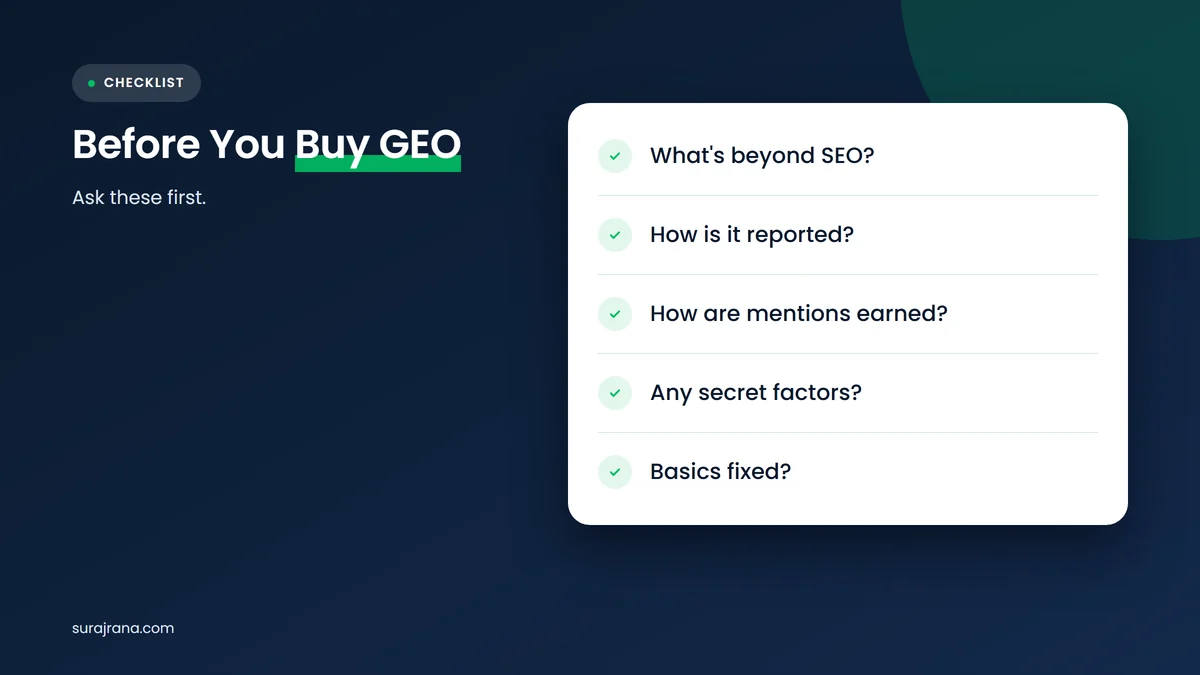
- What will you do that my SEO doesn’t already cover? If the answer is “schema and llms.txt”, Google has already said those aren’t needed for its AI features.
- How will you report results? Look for AI impressions from Search Console, citations from Bing Webmaster Tools and leads, not a vague “AI visibility score” with no explained method.
- How will you earn mentions? Real coverage, reviews and expert commentary are fine. Planted mentions on low-quality sites are what Google calls inauthentic.
- Do you claim access to secret AI ranking factors? Google tells site owners to be wary of tools claiming to use internal Google metrics.
- Are my basics fixed? If your pages are slow, thin or hard to crawl, start there. Every AI system still needs to read the page first.
If you run an agency and clients are asking for GEO, the same logic applies to what you sell. White Label SEO has a practical guide on how agencies can sell generative engine optimisation without hiring experts, and I’d frame it to clients as an extension of SEO, not a replacement.
What should you do about AI crawlers and the new training opt-out?
Treat AI crawlers as a technical SEO decision, exactly as Mueller described. Decide which bots may crawl your site for search and AI answers, and separately whether you allow your content to be used for AI training. Those are now different controls, and blocking the wrong one can remove you from AI answers you want to appear in.
This got more concrete on November 1, 2026, when Search Engine Journal reported that Google, Microsoft and OpenAI plan to honor a shared robots.txt group, __usage_ai-training, for opting out of AI training, based on an IETF draft submitted by Anthropic’s Kevin Kelley. None of the three supports it yet, and Google aims for 2027. The report notes Google will treat the shared opt-out like a Google-Extended block, which doesn’t affect inclusion in Google Search. This is the kind of “new” GEO work I take seriously, and it’s pure technical SEO.
Frequently asked questions
Is GEO the same as AEO?
Mostly, yes. Both describe work aimed at appearing in AI-written answers rather than only in ranked links. Some people use AEO for direct answers and assistants and GEO for AI search engines, but the overlap is large. Google treats both terms as describing work that is still SEO.
Does Google say GEO is dead?
No. Google hasn’t declared GEO dead. Its AI optimization guide says optimizing for generative AI search is still SEO and debunks several GEO tactics. When asked directly in a November 2026 interview, John Mueller said AI systems build on SEO and that technical SEO will stay very relevant.
Do I need an llms.txt file for AI search?
Not for Google. Google’s AI optimization guide says you don’t need new machine readable files, AI text files, markup or Markdown to appear in Google Search, including its AI features. Other AI platforms set their own rules, so check their documentation before relying on any special file.
How do I measure GEO results?
Use the Search Generative AI performance report in Google Search Console for impressions in AI Overviews, AI Mode and Discover, and the AI Performance report in Bing Webmaster Tools for citations in Copilot and Bing. Pair both with leads and calls, because visibility without enquiries isn’t the goal.
Will SEO still matter if AI answers replace search results?
Yes. AI answers are built from content that crawlers can access and systems trust, which is what SEO has always worked on. Google says its SEO best practices remain relevant for AI features, and Mueller said AI systems build on SEO. The format of results is changing faster than the fundamentals.
Where I land on GEO vs SEO
GEO is SEO with a wider scoreboard. I’d keep the word, because clients use it and because citations, AI impressions and off-site mentions really are worth tracking. I’d drop the idea that it is a separate discipline you can buy without doing the SEO underneath. When a GEO pitch can’t explain what it adds beyond good SEO, it probably adds nothing.
If you’re a dental practice owner, my earlier piece on GEO vs SEO for dentists covers what this means for a clinic, and you can see how I approach it in my dental SEO services on surajrana.com.
Not sure if you need GEO or better SEO?
I’m Suraj Rana. If someone has pitched you GEO and you can’t tell what it adds, I’m happy to look at your site and tell you honestly where the gaps are, whether that’s technical access, content or reputation.
Sources
- Search Engine Journal (Roger Montti), “Google Says Technical SEO Remains Key For AI SEO”, November 2, 2026. https://www.searchenginejournal.com/google-says-technical-seo-remains-key-for-ai-seo/595550/
- Google Search Central, “Optimizing your website for generative AI features on Google Search”, 2026. https://developers.google.com/search/docs/fundamentals/ai-optimization-guide
- Google Search Central Blog (John Mueller), “A new resource for optimizing for generative AI in Google Search”, May 15, 2026. https://developers.google.com/search/blog/2026/05/a-new-resource-for-optimizing
- Google Search Central, “AI features and your website”, 2026. https://developers.google.com/search/docs/appearance/ai-features
- Google Search Central Blog (Hillel Maoz and Moshe Samet), “Introducing Search Generative AI performance reports in Search Console”, June 3, 2026. https://developers.google.com/search/blog/2026/06/gen-ai-performance-reports
- Microsoft Bing Webmaster Blog, “Introducing AI Performance in Bing Webmaster Tools Public Preview”, February 10, 2026. https://blogs.bing.com/webmaster/February-2026/Introducing-AI-Performance-in-Bing-Webmaster-Tools-Public-Preview
- Search Engine Journal (Matt G. Southern), “Google, Microsoft & OpenAI Plan To Honor Shared AI Training Opt-Out”, November 1, 2026. https://www.searchenginejournal.com/google-microsoft-openai-shared-ai-training-opt-out/595387/
- Aggarwal et al., “GEO: Generative Engine Optimization”, arXiv, November 16, 2023 (KDD 2024). https://arxiv.org/abs/2311.09735

My name is Suraj Rana, and I am a seasoned Dental SEO Expert with extensive experience in the Dental SEO industry. Leveraging my deep knowledge and expertise, I help dental practices enhance their online visibility and attract more patients.