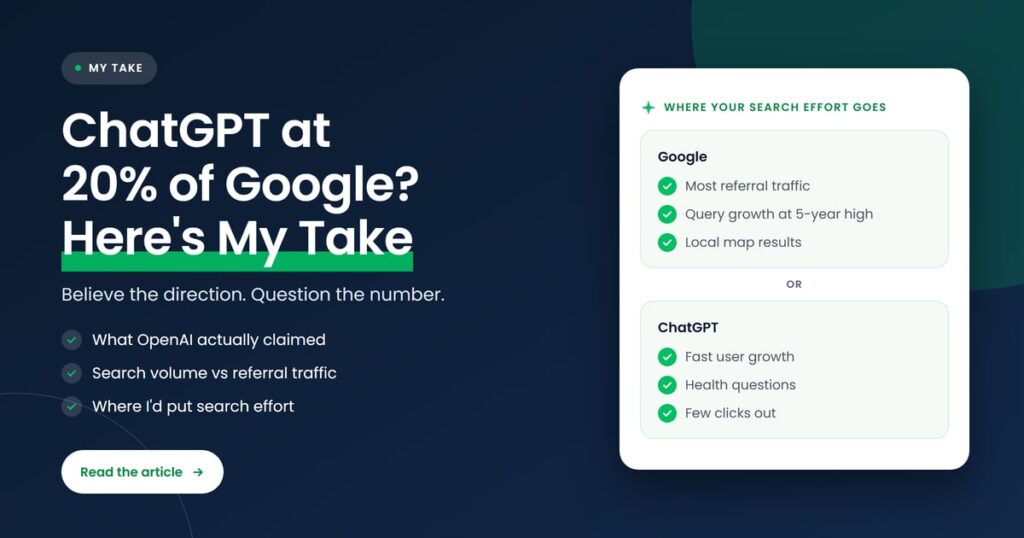
Quick answer: Yes, take OpenAI’s claim seriously as a sign of where search behavior is heading, but don’t move your search effort away from Google because of it. The 20% figure counts questions that trigger a ChatGPT web search, not visits sent to websites, and Google still sends far more traffic. The work that earns Google rankings and ChatGPT citations largely overlaps.
Key takeaways
- My position: ChatGPT is now a real search channel, but it is an addition to Google, not a replacement for it. Don’t split your budget in a panic.
- OpenAI’s Adam Fry said ChatGPT handles roughly one-fifth of Google’s volume of search-like queries, and that ChatGPT grew from 1 billion to 1.2 billion weekly users in about two months.
- OpenAI counts a search every time a question sends ChatGPT to the web. It hasn’t said which Google figure, time period or regions it compared against.
- Referral data tells a different story: in Ahrefs’ October tracking, Google sent 24.74% of traffic across the sites it measured, and ChatGPT sent 0.36%.
- Google reported its strongest year-over-year query growth in five years in Q3 2026, so ChatGPT’s growth hasn’t shown up as a fall in Google searching.
- The pages that win in both places are the same: clear, specific, trustworthy answers on a site and profile that tell one consistent story.
What did OpenAI actually say about ChatGPT and Google?
OpenAI’s consumer product lead for ChatGPT, Adam Fry, said ChatGPT now handles roughly one-fifth as many search-like queries as Google. He made the claim in a fireside chat with Alex Kantrowitz at an OpenAI dinner in New York, and Big Technology published the conversation on November 3, 2026.
A few details matter here. According to Big Technology’s write-up, Fry said ChatGPT’s weekly active users grew from 1 billion to 1.2 billion in about 60 days, roughly 100 million new users in each 30-day stretch. He also said around 250 million people use voice with ChatGPT each week.
Fry explained that people first used ChatGPT mostly for writing and coding help, which nobody would have typed into Google. Over the past year, he said, they have increasingly asked about people, places and things that need current information, and about finance and health, where ChatGPT now goes to the web to get facts right.
The reaction was quick. Glenn Gabe summarized the interview on X and asked whether that makes ChatGPT bigger than Bing. Kantrowitz noted on X that Bing’s share is around 5%. Barry Schwartz at Search Engine Roundtable called the claim surprising, given that Google says its own search volume is at an all-time high.
What does “search volume” mean in OpenAI’s claim?
In OpenAI’s claim, a search is any question that makes ChatGPT look something up on the web. It is not a count of every prompt, and it is not a count of clicks to websites. Fry described the category as anything a user would once have taken to a traditional search engine.
That definition is reasonable, but it is OpenAI’s own, and it makes comparisons hard. As Search Engine Journal pointed out, Fry didn’t say which Google number he used, which time period it covered or which countries were included. Google reports query growth as a rate rather than a total, so there is no recent official Google count to check against.
It also isn’t clear whether one long conversation with several web lookups counts as one search or several. That question decides how the ratio should be read, and the public part of the interview doesn’t answer it.
Should businesses take the 20% claim seriously?
I take it seriously as a direction, not as a precise number. The trend is real: more people now ask an AI assistant questions they used to type into Google, including health questions. But the figure comes from OpenAI, uses OpenAI’s own definition, and hasn’t been checked against a stated Google baseline.
Here’s why I don’t dismiss it. Outside estimates point the same way, just less dramatically. SEJ reported that an earlier Ahrefs estimate, built from a Harvard and OpenAI study of ChatGPT prompts and Google’s announced figure of over 5 trillion searches a year, put ChatGPT at about 12% of Google’s volume. Twelve percent and twenty percent are different numbers, but neither is small.
And here’s why I don’t treat it as gospel. A company that sells ads and subscriptions has every reason to frame its product as a search engine. When a number arrives without its baseline, I read it as a claim, not a measurement.
Does the claim mean people are searching Google less?
No, not on the evidence we have. Google says query growth is at its strongest in five years, and its search revenue keeps rising. ChatGPT’s growth seems to be adding new searching on top of Google, at least for now, rather than taking an equal amount away from it.
In its Q3 2026 earnings, Google reported search revenue of about $63 billion, up 12% year over year, and said query growth was the highest in five years, including more commercial searches, according to SEJ’s coverage of the call. That doesn’t prove ChatGPT is harmless to Google. It does mean anyone telling you Google search is collapsing is getting ahead of the data.
How do search volume and referral traffic compare?
They measure different things, and that is where most of the confusion comes from. Search volume counts questions asked. Referral traffic counts visits that actually reach a website. ChatGPT can answer a huge number of questions while sending relatively few people to the sites it drew on.
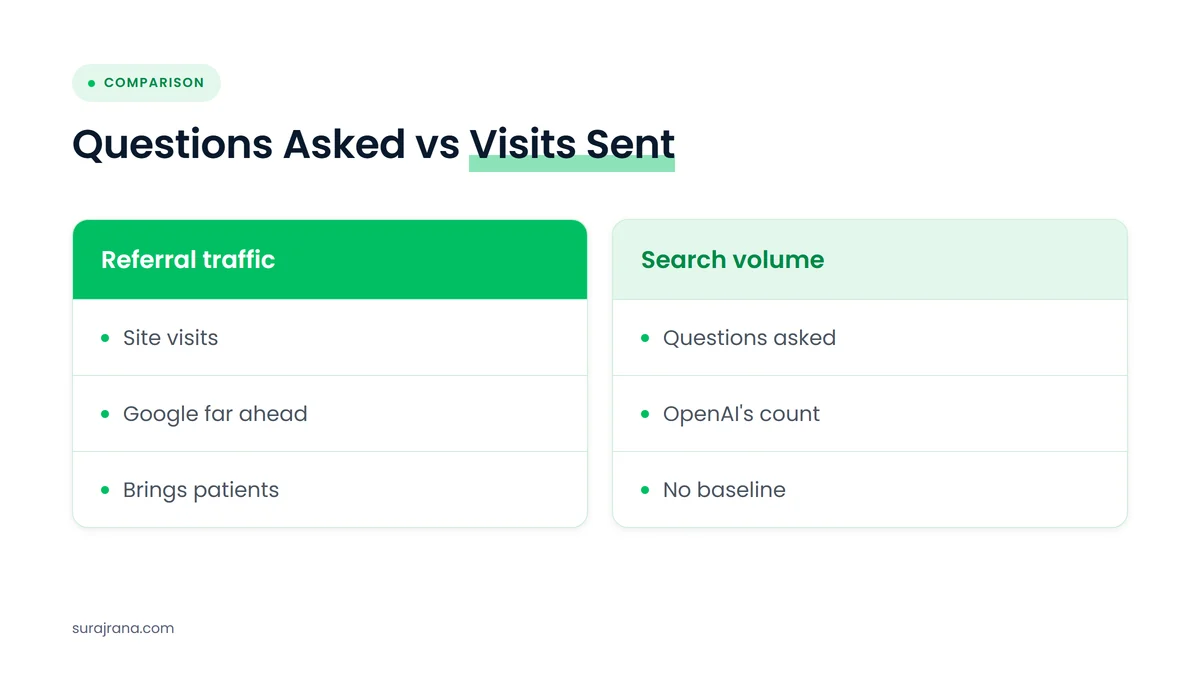
SEJ cited Ahrefs’ referral tracker, which measures where visits come from across 118,671 sites using its free analytics tool. In October 2026, Google accounted for 24.74% of tracked traffic and ChatGPT for 0.36%. Here is how the three numbers in this story line up:
| Measure | What it counts | ChatGPT vs Google | Source |
|---|---|---|---|
| OpenAI’s search-like queries | Questions that send ChatGPT to the web | About 20% of Google | Adam Fry, OpenAI, via Big Technology (Nov 2026) |
| Ahrefs prompt-based estimate | Prompts classified as Google-style queries | About 12% of Google | Ahrefs, via SEJ (Feb 2026) |
| Ahrefs referral tracker | Visits sent to websites | 0.36% vs 24.74% of tracked traffic | Ahrefs, via SEJ (Oct 2026) |
For a dental practice or an agency, the referral row is the one that pays the bills today. The query row is the one that tells you where attention is moving. You need to watch both, and you should never mix them up in a report.
Does this change where businesses should put their search effort?
It changes the shape of the effort more than where the money goes. Google is still where most patients and buyers click through to a website, so it stays the priority. What changes is the standard your pages have to meet, because the same page now needs to rank on Google and be worth quoting in an AI answer.
My honest view is that “Google or ChatGPT” is the wrong question. The work that earns a ranking and the work that earns a citation overlap heavily. A page that answers a real question directly, with clear facts and a named expert behind it, tends to do well in both. A thin page tends to fail in both.
Where I’d draw the line is splitting a small budget into a separate “AI SEO” project that duplicates the core work. For most practices, that money is better spent making the pages they already have the clearest answer in their area.
What does it mean for dental practice owners?
For dental practices, the useful part of Fry’s comments is that health questions now trigger web searches inside ChatGPT. Patients are asking it about treatments, costs and what to expect, which means your treatment pages and Google Business Profile can be the source an answer draws on.
That doesn’t call for new tactics. It calls for the basics done properly: treatment pages that answer the questions patients ask before they book, honest information about cost, reviewed content with a real dentist’s name on it, and business details that match everywhere they appear. I’ve written before about how to get ChatGPT to recommend your dental clinic, and none of that advice changes because of a new number.
What does it mean for agency owners?
For agencies, the main change is in reporting. Clients will see the 20% headline and ask what you’re doing about ChatGPT. The honest answer is to report AI visibility and referral traffic as separate measures, each with a clear definition, rather than folding them into one vague “AI” number.
That was SEJ’s advice too: name the measure you cite, and track query share and referral traffic separately. Agencies that can explain the difference calmly will keep client trust better than those that either dismiss ChatGPT or oversell it.
What would I do now if I ran a dental practice or an agency?
I would keep Google as the main channel, raise the quality bar on the pages that matter most, and start measuring ChatGPT separately so decisions are based on your own data rather than a headline. None of this needs a new budget line. It needs better priorities.
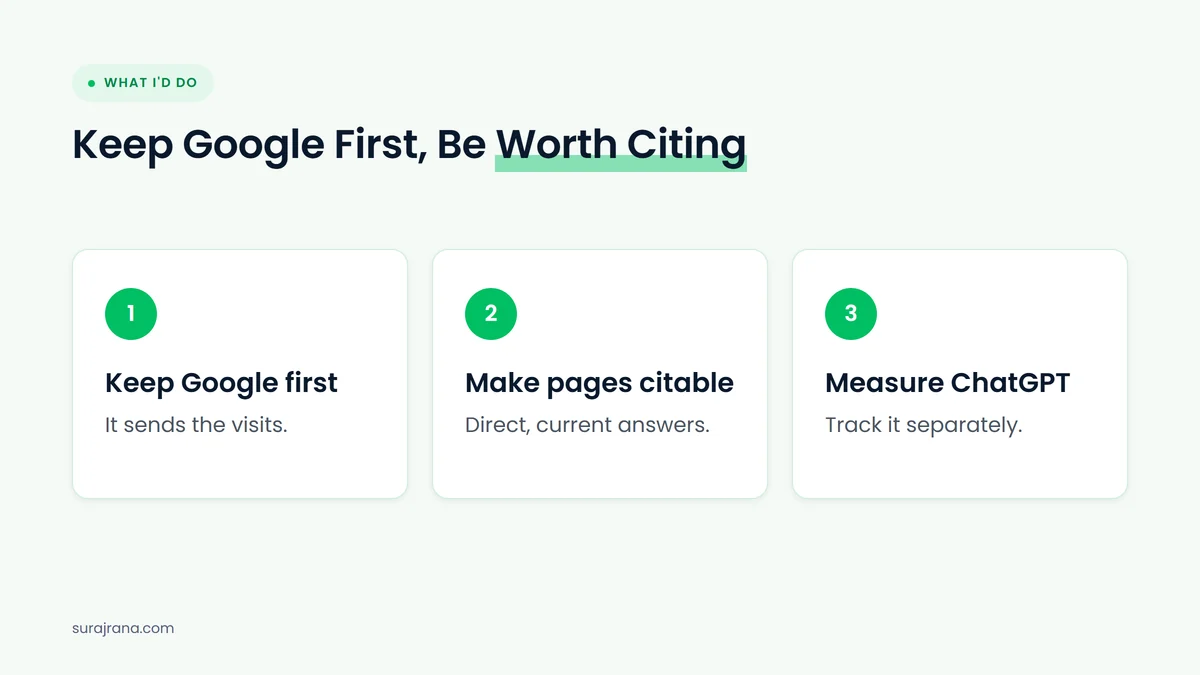
- Keep Google first. It still sends the visits, calls and bookings. Don’t cut local SEO or your Google Business Profile work to fund an AI experiment.
- Make your key pages citable. Open each treatment or service page with a direct answer, back up facts, name the expert who reviewed it and keep it current.
- Make your details consistent. Your name, services, hours and location should match on your website, your profile and the directories AI tools read.
- Measure ChatGPT separately. Watch referrals from chatgpt.com in your analytics and ask how leads found you, so you can see whether the channel matters for your market.
- Review it every quarter. If ChatGPT starts sending real enquiries, shift more effort its way. Let your data, not OpenAI’s press, make that call.
How can you tell if ChatGPT matters for your business yet?
Look at your own numbers before you change anything. If ChatGPT already appears in your referral data, or new patients or clients say they found you through it, it deserves more attention. If it doesn’t show up at all, your effort is better spent on the pages that serve both Google and AI answers.
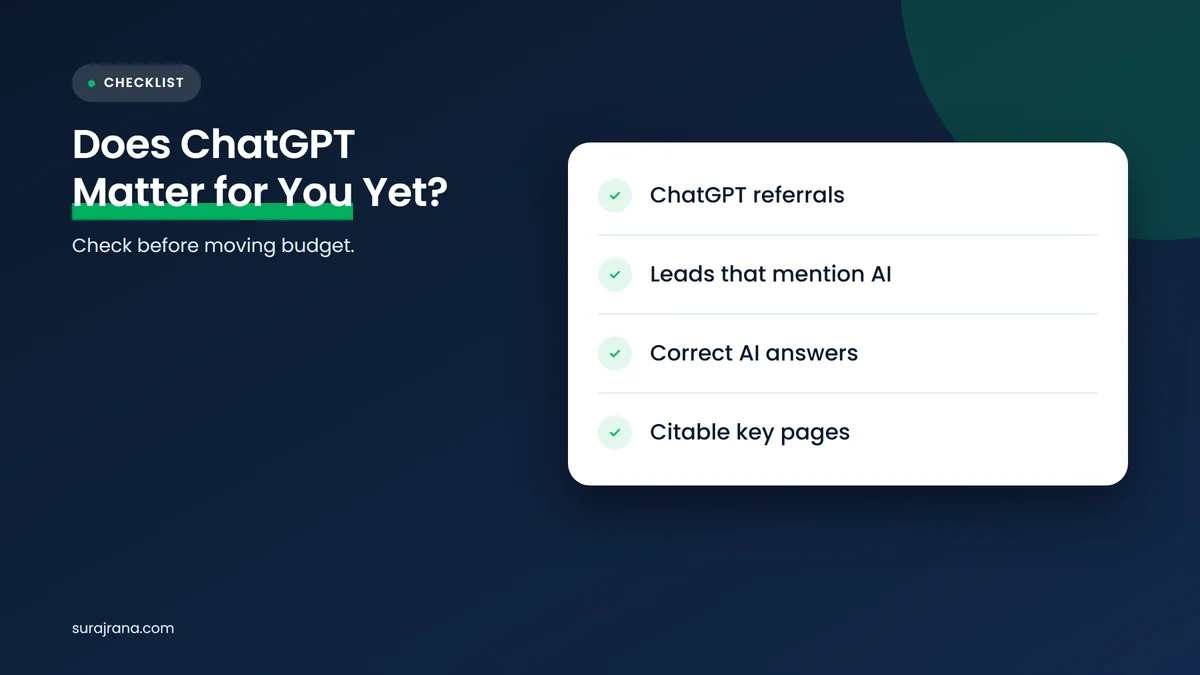
- Referrals: Do you see visits from chatgpt.com in your analytics, and are they growing month to month?
- Leads: Does your intake form or front desk ask how people found you, and does anyone mention ChatGPT or another AI tool?
- Answers: When you ask ChatGPT the questions your patients or clients ask, is your business mentioned, and is the information correct?
- Pages: Do your key pages answer those questions clearly enough to be quoted?
If most answers are “no”, you haven’t missed a boat. You’ve found the work to do next, and it is mostly the same work that improves your Google rankings.
Frequently asked questions
Is ChatGPT really 20% the size of Google?
That is OpenAI’s claim, based on its own count of questions that trigger a ChatGPT web search. OpenAI hasn’t said which Google figure, time period or regions it compared against. An earlier Ahrefs estimate put ChatGPT at about 12% of Google, so treat 20% as a company claim rather than a settled measurement.
Does ChatGPT send much traffic to websites?
Not much yet. Ahrefs’ referral tracker, cited by Search Engine Journal, found ChatGPT sent 0.36% of tracked traffic across 118,671 sites in October 2026, against 24.74% from Google. ChatGPT answers many questions without sending the person to a website, so query volume and referral traffic are very different numbers.
Is Google search volume falling because of ChatGPT?
Not according to Google. In its Q3 2026 earnings, Google said query growth was at its highest year-over-year rate in five years, and search revenue rose 12% to about $63 billion. So far, ChatGPT’s growth seems to sit alongside Google searching rather than replacing it outright.
Should a dental practice optimize for ChatGPT instead of Google?
No. A dental practice should optimize for both with the same work. Clear treatment pages, honest cost information, dentist-reviewed content and consistent business details help a practice rank on Google and give ChatGPT a reliable source to cite. Google still sends far more visits, so it stays the priority.
How can I see if ChatGPT sends visitors to my website?
Check your analytics for referral visits from chatgpt.com, and ask new patients or clients how they found you. Some AI-driven visits arrive without a referrer, so asking people directly fills the gap. Review both every month so you can see whether the channel is growing for your business.
My bottom line on OpenAI’s 20% claim
I believe the direction and question the number. ChatGPT has become a place where people search, including for health and local questions, and any business that ignores that is making a mistake. But a company-defined ratio with no stated baseline is not a reason to move your budget away from the channel that still sends most of your visitors.
My advice is to keep Google first and make every important page good enough to be the answer, wherever the question is asked. If you want a deeper look at how AI answers are changing search, read why Reddit’s falling Google traffic matters, my take on AI Mode on the normal results page, and Dental Master Media’s guide on getting your dental clinic cited by ChatGPT and AI search. Agencies can read why AI search visibility is becoming a core white label SEO deliverable. That is the approach behind my dental SEO services, and you can read more about my work on surajrana.com.
Not sure where your search effort should go?
I’m Suraj Rana, and if headlines about ChatGPT have you wondering whether to change your SEO plan, I’m happy to look at your own data with you. Through my dental SEO services and Dental Master Media, my team and I help dental practices build pages that rank on Google and get cited in AI answers.
Sources
- Big Technology (Alex Kantrowitz), “OpenAI: ChatGPT Search Is About 20% of Google’s, 250 Million People Speak With ChatGPT, and Chat Is Merging With Work”, November 3, 2026. https://www.bigtechnology.com/p/openai-chatgpt-search-is-about-20
- Search Engine Journal (Matt G. Southern), “Google’s Search Volume Is About 5x ChatGPT’s, OpenAI Says”, November 3, 2026. https://www.searchenginejournal.com/googles-search-volume-is-about-5x-chatgpts-openai-says/595817/
- Search Engine Roundtable (Barry Schwartz), “OpenAI Says ChatGPT Is At 20% Of Google Search Volume”, November 4, 2026. https://www.seroundtable.com/chatgpt-20-percent-google-42451.html
- Search Engine Journal (Roger Montti), “Google’s Q3 Earnings Call Casts Shadow Over Classic Search”, October 30, 2026. https://www.searchenginejournal.com/googles-q3-earnings-call-casts-shadow-over-classic-search/595082/
- Glenn Gabe (@glenngabe) on X, post summarizing the Adam Fry interview, November 3, 2026. https://x.com/glenngabe/status/2117676909056102876
- Alex Kantrowitz (@Kantrowitz) on X, post on Bing’s search share, November 3, 2026. https://x.com/Kantrowitz/status/2117429953272627679

My name is Suraj Rana, and I am a seasoned Dental SEO Expert with extensive experience in the Dental SEO industry. Leveraging my deep knowledge and expertise, I help dental practices enhance their online visibility and attract more patients.