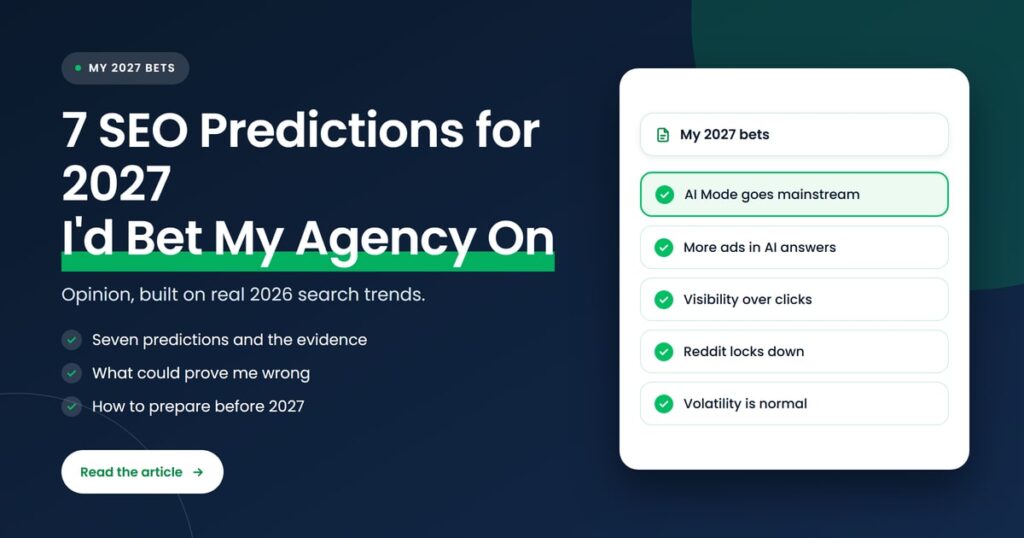
Quick answer: In my opinion, 2027 is the year AI answers stop being a side feature. I expect AI Mode to become the normal way people run complex searches, ads to fill AI answers on Google and ChatGPT, reporting to shift from clicks to visibility, and rankings to move most weeks without any announced update.
Key takeaways
- These are my predictions, not facts. Each one rests on a real 2026 development with a linked source, and I say where I could be wrong.
- The biggest signal is scale: Google says AI Mode passed one billion monthly users within a year of launch, with queries more than doubling every quarter.
- Money follows attention. Google is expanding ads in AI Mode and OpenAI is testing ads in ChatGPT, so I expect less free space in AI answers on commercial searches.
- Search Console now reports AI feature impressions but no clicks, which is why I think visibility, not traffic, becomes the KPI agencies have to explain.
- Reddit’s falling Google referrals and constant unconfirmed ranking volatility tell me the open web is getting less predictable, not more.
What do I mean by an SEO prediction I’d bet my agency on?
An SEO prediction I’d bet my agency on is a call about how search will work in 2027 that is strong enough for me to change how my team plans, prices and reports work today. It is still an opinion. I base each one on something that already happened in 2026, not on hype.
Every year brings a wave of “SEO is dead” and “this one trick” predictions. I’m not interested in those. I’m interested in what the platforms themselves have already shipped, said on earnings calls or written into their documentation, and where that is likely to lead within the next twelve months. If a trend doesn’t affect how a dental practice or an agency should spend money, it doesn’t make my list.
How did I pick these seven predictions?
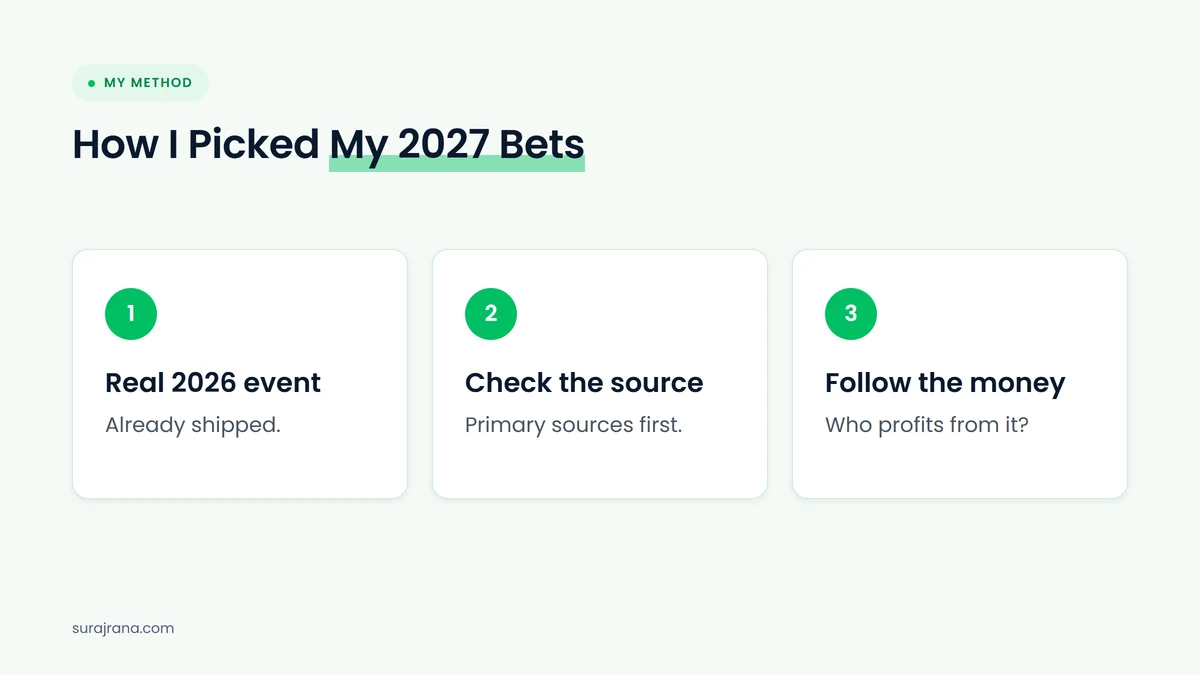
I picked these seven predictions by starting from verified 2026 events, checking each one against a primary or well-sourced report, and then asking who makes money from the change. If a platform has a commercial reason to keep pushing a feature, I’m more willing to bet it grows in 2027.
Here is the short version of all seven, with how confident I personally feel about each one. The confidence column is my judgment, not a measurement.
| # | My 2027 prediction | 2026 signal it rests on | My confidence |
|---|---|---|---|
| 1 | AI Mode becomes the default for complex searches | One billion monthly users, queries doubling each quarter | High |
| 2 | Ads take a bigger share of AI answers on Google | Ads in AI Mode expanded to 10 markets plus follow-up ads in the U.S. | High |
| 3 | ChatGPT becomes a paid channel agencies must manage | OpenAI testing ads for Free and Go users since February | Medium to high |
| 4 | Visibility replaces clicks as the main SEO report | Search Console AI reports show impressions, no clicks | High |
| 5 | Opting out of AI features becomes a real business decision | Search Console AI opt-out control rolled out worldwide | Medium |
| 6 | Reddit and other communities close up, and “Reddit SEO” fades | Reddit’s falling Google referrals and sign-in plan | Medium |
| 7 | Unannounced ranking volatility becomes the normal state | Repeated unconfirmed updates in October 2026 | High |
Prediction 1: Will AI Mode become the default way people search on Google?
My prediction is that in 2027, AI Mode becomes the default experience for complex, multi-part searches on Google, while classic results stay in place for quick navigational and local lookups. I don’t think blue links disappear. I think they stop being where most research-style questions begin and end.
The evidence is hard to ignore. At I/O in May 2026, Google said AI Mode had surpassed one billion monthly users just one year after its debut, with queries more than doubling every quarter. Google’s own U.S. data from the same month said the average AI Mode search is about three times as long as a traditional search. Longer questions are exactly the ones patients ask before choosing a dentist.
Google is also moving AI Mode closer to the normal results page, which I covered in my take on the AI Mode sidebar test. What could prove me wrong: if AI Mode’s growth stalls once the novelty fades, or if people keep starting in classic results and only switch to AI Mode occasionally.
Prediction 2: Will ads take over more of Google’s AI answers?
My prediction is that by the end of 2027, most commercial searches in AI Mode will show at least one sponsored placement, and ads will appear deeper into conversations, not just on the first answer. That leaves less free space for organic businesses on high-value queries, so organic visibility will have to be earned more precisely.
On October 28, 2026, Google announced it was scaling ads in AI Mode to 10 new markets, including Australia, Canada, India, New Zealand and Singapore, with Brazil, Mexico and the UK planned for Q4. It also launched ads in follow-up questions in the U.S., labeled “Sponsored”. A day later, Search Engine Roundtable reported Google saying ads in AI Mode currently earn less than traditional search ads.
That second point is why I’m confident. When a product has a billion users and earns less per query, the company has every reason to add more ad formats. What could prove me wrong: if users react badly to ads in conversations and Google slows the rollout to protect trust.
Prediction 3: Will ChatGPT become a paid channel agencies have to manage?
My prediction is that in 2027, ChatGPT ads become a line item that agencies are asked about in every pitch, separate from both Google Ads and SEO. I also expect many business owners to confuse being recommended in an AI answer with paying for an ad next to it, and agencies will need to explain the difference.
OpenAI started testing ads in the U.S. in February 2026. According to Search Engine Journal, the ads appear for logged-in adults on the Free and Go tiers, below the answer and labeled as sponsored, and OpenAI says they don’t change what ChatGPT recommends. By October 30, ChatGPT Ads had automatic ad changes switched on by default, which is the kind of feature a platform builds when it expects advertisers to scale.
What could prove me wrong: if ad revenue stays small and OpenAI keeps ads limited to a test, or if strict health-topic rules keep most dental advertisers out of the format.
Prediction 4: Will SEO reporting shift from clicks to visibility?
My prediction is that in 2027, the standard SEO report leads with visibility in AI answers, not clicks and rankings. Clients will ask how often they appeared in AI Overviews and AI Mode, and agencies still reporting only traffic will struggle to explain why results feel better while clicks look flat.
Google launched its Search generative AI performance reports on June 3, 2026, covering impressions in AI Overviews, AI Mode and Discover, broken down by page, country, device and date. When the reports reached all sites worldwide on August 31, Search Engine Roundtable noted they include no click data and no query data.
So Google is telling site owners how often they show up, but not what happens next. I wrote about what this means for practices in my post on the new Search Console AI report, and agencies can see how reporting needs to change in Whitelabel SEO’s guide to reporting AI Overviews and zero-click search. What could prove me wrong: if Google adds full click data to these reports in 2027, which would bring traffic back to the center of reporting.
Prediction 5: Will opting out of AI features become a real business decision?
My prediction is that in 2027, choosing whether to appear in AI search features becomes a deliberate decision site owners have to make and defend, much like choosing a CMS. I think publishers who sell content will test opting out, while lead-driven businesses like dental practices and agencies should stay in.
In June 2026, Google introduced a Search Console control that lets site owners choose whether their site appears in, and helps ground, generative AI features such as AI Overviews and AI Mode. Google says opted-out sites lose traffic and impressions from those features, and that the setting is not a ranking signal for other results. It reached all websites worldwide by August 31, 2026.
For a practice that wants new patients, opting out means giving up the answers where people now research treatment. I’d only consider it for content you sell, not content that brings you leads. What could prove me wrong: if AI features send so few visits that opting out costs nothing in practice.
Prediction 6: Will Reddit and other communities matter less for SEO?
My prediction is that in 2027, Reddit content becomes harder to reach from search, more of it sits behind a login, and tactics built on getting a brand mentioned in Reddit threads that rank on Google lose much of their value. Community presence still matters, but as reputation, not as a ranking shortcut.
On its October 29, 2026 earnings call, Reddit CEO Steve Huffman said search referrals fell by more than one million a week on average during October, and blamed Google’s AI features. Reuters reported that he also outlined a plan to require sign-ins for most content, starting with tests in select non-U.S. markets in Q4.
When a platform loses search traffic and starts locking content away, I wouldn’t build a 2027 strategy around that platform’s visibility in Google. What could prove me wrong: if Reddit signs a new data deal or reverses the sign-in plan, keeping its threads as visible as they were in 2025.
Prediction 7: Will ranking volatility without announced updates become normal?
My prediction is that in 2027, rankings move most weeks without any confirmed Google update, and named core updates become less useful as a way to explain results. Practices and agencies will need to judge SEO on quarterly trends and new enquiries, not on what happened to one keyword last Tuesday.
October 2026 shows the pattern. The September 2026 spam update ran from September 24 to October 8, and then Search Engine Roundtable tracked unconfirmed volatility around October 16, October 20 and 21, October 24 and again on October 27, with Google not confirming anything.
I’ve written about how the spam update hit dental sites built on scaled content. The sites that coped best were the ones with real, specific pages, not the ones reacting to every swing. What could prove me wrong: if Google returns to fewer, clearly announced updates with long quiet periods between them.
What am I betting against in 2027?
I’m betting against the idea that SEO is dead, that one trick gets a business into AI answers, and that traffic alone will prove SEO works. Every 2026 signal above points to search getting more complicated, not less useful, and to visibility being spread across more places than one results page.
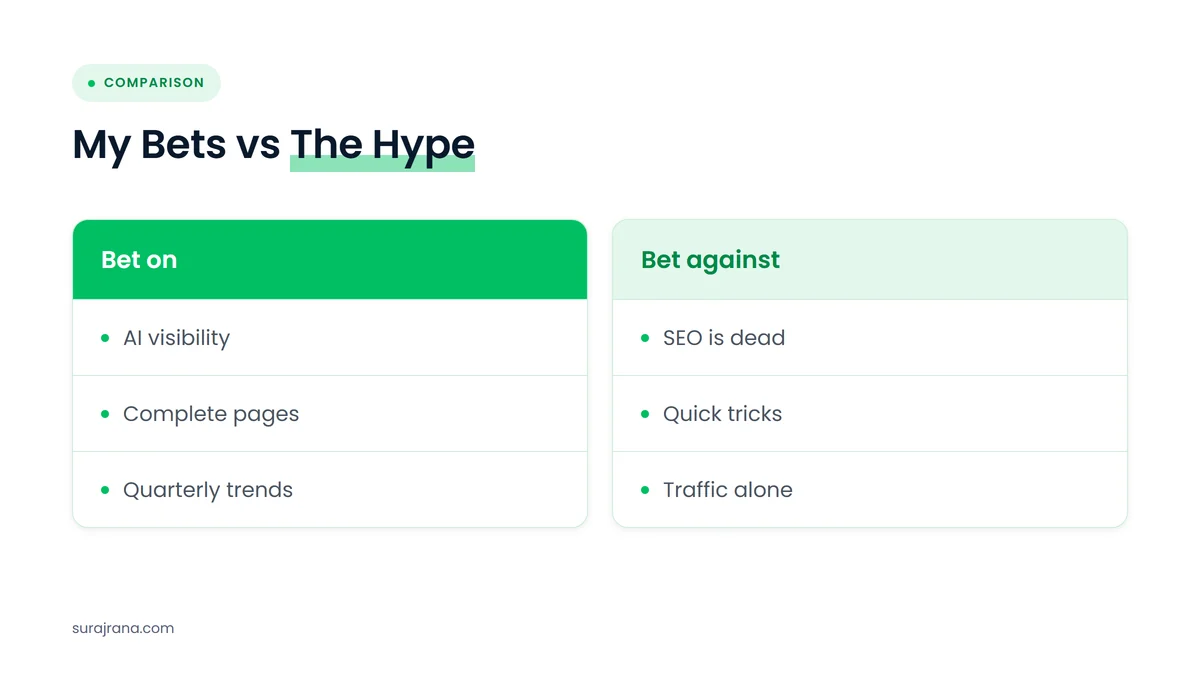
I also don’t think AI answers replace the need for good pages. AI Mode, AI Overviews and ChatGPT still need sources to ground their answers, and the clearest, most specific pages are the ones they can use. That is the same reason I argued that most dental blogs are a waste of money: volume never was the answer, and in 2027 it will matter even less.
How should a dental practice or agency prepare for SEO in 2027?
To prepare for SEO in 2027, I’d tighten the pages that answer real buyer questions, start tracking AI feature impressions alongside leads, decide your AI opt-out position on purpose, and stop judging progress week by week. None of this needs a new budget. It needs a clearer idea of what you’re measuring.
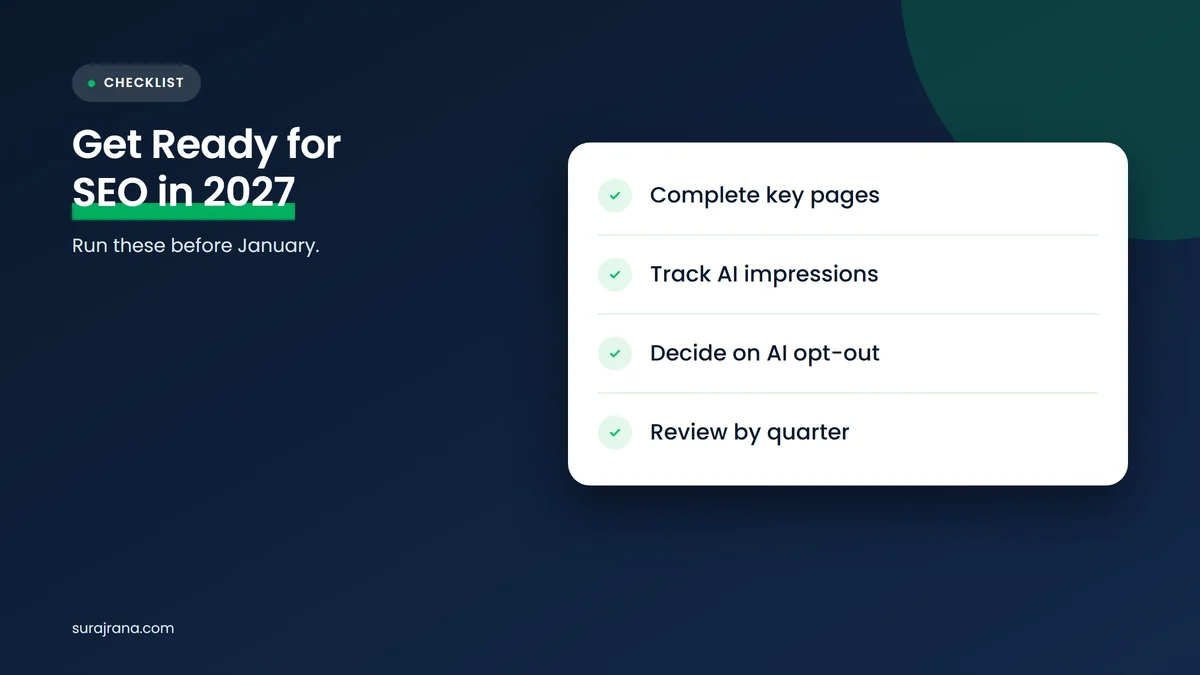
- Make your key pages complete. Treatment, service, pricing and FAQ pages should answer the long, specific questions people now type into AI Mode. Dental Master Media explains how AI Mode is reshaping local search for dental practices.
- Add AI impressions to your monthly report. Pull the Search Console generative AI report next to calls, forms and bookings, so you can see whether visibility turns into enquiries.
- Decide your AI opt-out position on purpose. For most practices and agencies, I’d stay in. Write down why, so the decision isn’t made by accident.
- Separate paid AI placements from organic visibility. If you test ads in AI Mode or ChatGPT, report them on their own, so nobody mistakes a paid slot for an earned recommendation.
- Review rankings by quarter, not by week. With constant unconfirmed volatility, a 90-day trend tells you far more than a single drop.
Frequently asked questions
What will change in SEO and AI search in 2027?
In my opinion, AI Mode will become the normal way people run complex Google searches, ads will appear more often inside AI answers on Google and ChatGPT, SEO reports will focus on visibility rather than clicks, and rankings will move frequently without announced updates. These are predictions based on 2026 trends, not confirmed changes.
Is SEO dead because of AI Mode and ChatGPT?
No. AI answers still rely on web pages to ground what they say, so clear, specific and trustworthy pages still matter. What changes is how success is measured. Appearing in AI answers and turning that visibility into enquiries matters more than raw clicks from a list of blue links.
Should my website opt out of Google’s AI features?
For most dental practices and agencies, I’d say no. Google says sites that opt out lose traffic and impressions from AI Overviews and AI Mode. If your website exists to bring in patients or clients, those features are where many people now research, so staying visible there is usually the better choice.
How can I track my visibility in AI search in 2027?
Start with the generative AI performance report in Google Search Console, which shows how often your pages appeared in AI Overviews, AI Mode and Discover. It shows impressions, not clicks, so pair it with your own lead tracking, such as calls, forms and bookings, to see what that visibility is worth.
Will ChatGPT ads affect organic visibility in ChatGPT?
OpenAI says ads in ChatGPT appear below answers, are labeled as sponsored and don’t change what ChatGPT recommends. I take that at face value for now, but I’d still report paid and organic AI visibility separately, so you always know which results you paid for and which ones you earned.
My bottom line on SEO in 2027
My single biggest bet is this: in 2027, the businesses that win in search will be the ones that measure visibility honestly and build pages AI tools can trust, not the ones chasing every update. I could be wrong on the details, and I’ve said where. I don’t think I’m wrong on the direction.
If you run a practice, start with your treatment and FAQ pages and add AI impressions to your reports. If you run an agency, get ready to explain visibility without clicks to every client. You can see how I approach this through my dental SEO services on surajrana.com, and agencies can see how we deliver the work behind the scenes through our white-label SEO services.
Want to get ready for SEO in 2027?
I’m Suraj Rana. If you want a candid view of how your site or your clients’ sites are placed for AI search next year, I’m happy to talk it through. My team and I work with dental practices through Dental Master Media and with agencies through Whitelabel SEO.
Sources
- Google (Elizabeth Reid), “A new era for AI Search”, May 19, 2026. https://blog.google/products-and-platforms/products/search/search-io-2026/
- Google (Shivani Mohan), “How AI Mode is changing the way people search in the U.S.”, May 19, 2026. https://blog.google/products-and-platforms/products/search/ai-mode-us-insights/
- Google (Shashi Thakur), “Ads in AI Mode expand to new markets”, October 28, 2026. https://blog.google/products/ads-commerce/ads-in-ai-mode-global/
- Search Engine Roundtable (Barry Schwartz), “Google: Ads In AI Mode Earning Less Than Traditional Search Ads”, October 29, 2026. https://www.seroundtable.com/google-ai-mode-ads-earn-less-42417.html
- Search Engine Journal (Matt G. Southern), “OpenAI Begins Testing Ads In ChatGPT For Free And Go Users”, February 9, 2026. https://www.searchenginejournal.com/openai-begins-testing-ads-in-chatgpt-for-free-and-go-users/566869/
- Search Engine Journal (Matt G. Southern), “ChatGPT Ads Turns On Automatic Ad Changes By Default”, October 30, 2026. https://www.searchenginejournal.com/chatgpt-ads-turns-on-automatic-ad-changes-by-default/595117/
- Google Search Central Blog (Hillel Maoz and Moshe Samet), “Introducing Search Generative AI performance reports in Search Console”, June 3, 2026, updated August 31, 2026. https://developers.google.com/search/blog/2026/06/gen-ai-performance-reports
- Search Engine Roundtable (Barry Schwartz), “Global: Google Search Console AI Performance Report & AI Control”, September 1, 2026. https://www.seroundtable.com/google-search-console-generative-ai-tools-live-41984.html
- Google (Mrinalini Loew), “New opportunities, control and insights for website owners”, June 3, 2026, updated August 31, 2026. https://blog.google/products-and-platforms/products/search/new-controls-website-owners/
- Reuters via The Star (Jaspreet Singh), “Reddit puts logged in experience first as Google AI hits traffic”, October 30, 2026. https://www.thestar.com.my/tech/tech-news/2026/10/30/reddit-search-traffic-slumps-will-push-visitor-sign-ins-to-curb-ai-scraping
- Search Engine Roundtable (Barry Schwartz), “Unconfirmed Google Search Ranking Update: Volatility & Chatter Spike”, October 27, 2026. https://www.seroundtable.com/google-search-ranking-volatility-42379.html

My name is Suraj Rana, and I am a seasoned Dental SEO Expert with extensive experience in the Dental SEO industry. Leveraging my deep knowledge and expertise, I help dental practices enhance their online visibility and attract more patients.