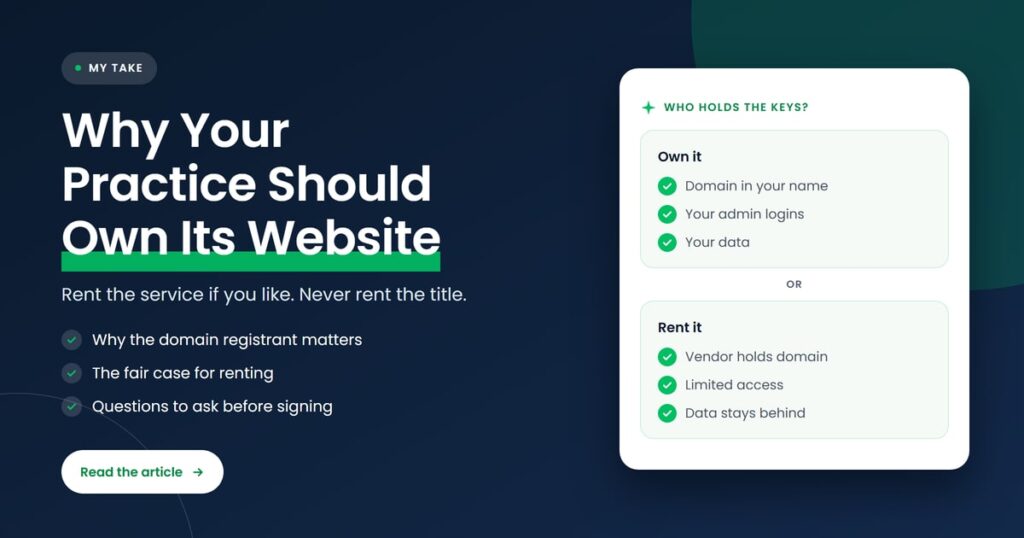
Quick answer: I think every dental practice should own its website outright: the domain registered in the practice’s name, admin access to hosting and the CMS, rights to the content and photos, and owner access to analytics and Google Business Profile. Renting a vendor’s platform can be fine for convenience, but only if you can leave with all of it.
Key takeaways
- My position: your website is a business asset, like your lease or your patient list. You can pay someone to manage it, but the practice should hold the title.
- The domain matters most. Under ICANN’s transfer rules, the registrant is the person who controls a domain transfer, so whoever is listed there holds the keys.
- The American Dental Association advises practices to own everything from the domain name to the content and the code, and to have an attorney review website contracts.
- Ownership disputes are not theoretical. In 2025, a group of North Carolina dental practices sued a former contractor, alleging he kept control of their website domains.
- Renting is not always wrong. It becomes a problem when the contract gives you no domain, no files and no data on the day you leave.
What does it mean to own or rent a dental website?
Owning a dental website means the practice controls every part of it: the domain is registered to the practice, the practice holds admin logins to hosting and the content system, and the contract gives it the content and images. Renting means a vendor holds some or all of those pieces and gives you a working site for a monthly fee.
Most practices don’t sit neatly at one end. I split the question into five parts, and you can own some while renting others:
- The domain name. Who is listed as the registrant, and whose registrar account holds it.
- Hosting and the CMS. Whether the site runs on a platform you can export from and move, with admin logins in the practice’s name.
- Content and images. Whether the written pages, photos and design belong to you or are licensed to you only while you pay.
- Data and tracking. Who owns the Google Analytics property, Search Console and any call tracking numbers.
- Google Business Profile. Who is the primary owner of the profile patients see on Maps.
When I say a practice “owns” its website, I mean it controls all five, even if an agency does the day-to-day work.
Why do I think every dental practice should own its website?
I think every practice should own its website because the site, the domain and the data keep their value long after any one marketing contract ends. Rankings, reviews, links and years of analytics history are tied to accounts. If those accounts belong to a vendor, switching vendors can mean starting again, and that cost lands on the practice.
I’m not alone in that view. The American Dental Association’s guidance on outsourcing website development tells dentists to make sure they own their website, including the domain name, the content and the code. It also warns that businesses without ownership can struggle to update or redesign their sites, and that some who changed vendors had to start from scratch.
Why is the domain name the part that matters most?
The domain name matters most because every other asset points to it. Your Google rankings, the links other sites have built to you, the address printed on your cards and the website listed on your Business Profile all depend on it. If someone else controls the domain, they effectively control where all of that traffic goes.
ICANN’s Transfer Policy gives the registered name holder real power: registrars must provide the transfer code within five calendar days of the holder’s request, and can’t refuse it just because of a payment dispute. ICANN’s own guide for registrants explains that you need that AuthInfo code to move a domain, and that you can complain to ICANN if a transfer is wrongly denied. Those protections help the person listed as the registrant. If that’s your web vendor, they help your web vendor.
This is getting sharper, not softer. Registrar Realtime Register told its partners in July 2026 that under ICANN’s updated transfer policy, applied on its platform from August 4, 2026, the registrant becomes the primary contact for approving transfers, and admin contact details are no longer used for transfer approval. In plain terms, the name in the registrant field is the one that counts.
Why should the practice hold the hosting and CMS logins?
The practice should hold admin logins to hosting and the content management system because that is what lets it make changes, take a backup or move the site without asking permission. A vendor can still have its own login to do the work. The difference is that the practice can add or remove that login, not the other way round.
This is also where rented platforms can differ most. If a platform won’t let you export the site, leaving means rebuilding it. That’s one reason I’ve written about how WordPress and Wix compare for dental SEO: the platform you choose decides how portable your site is later.
Who owns the words and photos on your website?
The words and photos on your site belong to whoever the contract says they belong to, and paying for them doesn’t always settle it. Unless the agreement assigns the rights to the practice, a vendor may own or only license the copy, design and images it supplied, including stock photos licensed in its own name.
The US Copyright Office’s Circular 30 on works made for hire explains that a commissioned work only counts as a work made for hire if it falls into specific listed categories and both sides sign a written agreement saying so. I’m not a lawyer and this isn’t legal advice. My point is simpler: don’t assume. Ask for the ownership terms in writing and have a lawyer review the contract.
Why do analytics and your Google Business Profile count as part of the website?
Analytics and your Google Business Profile count because they hold the history and the patient-facing presence that a website alone doesn’t. Years of traffic data tell you what works, and the Business Profile is often the first thing a patient sees. If a vendor owns either account, you can lose that history or that control when the relationship ends.
Google’s own rules make the point. Its Business Profile help page on owners and managers says a profile can have several owners but only one primary owner, and that only owners can add or remove users. Google Analytics works the same way: its help page on managing users says you need the Administrator role to add or change users. My rule is that the practice holds the primary owner and Administrator roles, and the agency gets a manager or editor role it can lose.
How does owning a dental website compare with renting one?
Owning a dental website gives a practice control and portability, while renting gives it convenience and a lower upfront cost. The trade-off shows up mainly when something goes wrong: a price rise, poor service or a falling-out. An owned site can move with you. A rented one may stay behind, along with the domain and data.
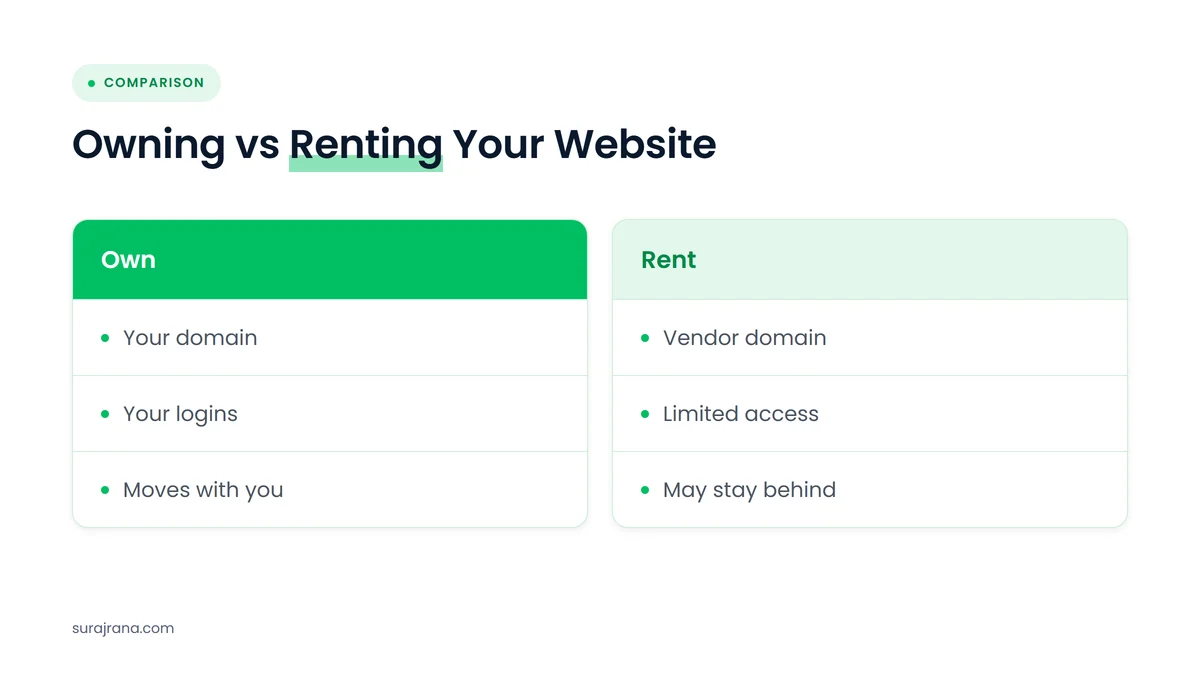
| Factor | Owned website | Rented platform |
|---|---|---|
| Domain registrant | The practice | Often the vendor, unless the contract says otherwise |
| Admin access | Practice holds it and grants access to vendors | Vendor holds it and may give limited editing access |
| Content and images | Assigned to the practice in writing | May be licensed only while you keep paying |
| Analytics and Business Profile | Practice is owner or Administrator | Sometimes set up under the vendor’s accounts |
| Upfront cost and effort | Higher: a build fee and someone to manage it | Lower: a monthly fee covers most of it |
| Switching vendors | Hand over logins and carry on | Possible rebuild, new domain or lost history |
| Who decides changes | The practice | The vendor’s platform and terms |
What happens when a practice doesn’t control its domain?
When a practice doesn’t control its domain, it can’t easily move its website, change providers or fix problems without the cooperation of whoever does. If that relationship breaks down, the practice may face a dispute, a forced rebrand onto a new domain, or a court case, all of which cost far more than registering the domain properly would have.
The clearest public example I know of is from 2025. Law360 reported on April 21, 2025 that a group of pediatric dental practices in North Carolina accused their longtime business consultant of hijacking several website domains after they canceled his contract. The Register’s April 22, 2025 report on the lawsuit said the practices claimed the domains were held in the consultant’s personal hosting account, while he said they were his, and his attorney disputed the claims and said the practices owed his firm money. A court has to sort out who is right. I’m not taking a side on the facts. I’m pointing out that the whole fight depends on whose name and account the domains sat in.
That’s the part I’d want every practice owner to take from it. Nobody plans a dispute when they sign up. The time to settle ownership is before you need it.
What is the strongest case for renting a website platform?
The strongest case for renting is that it takes work off a busy practice. A good platform vendor handles hosting, security updates, backups and design for one predictable monthly fee, and a practice owner who doesn’t want to manage logins or hire a developer gets a working site quickly. For many small practices, that convenience is real.
Here is the fair version of that argument:
- Less to manage. Updates, security and hosting are someone else’s job, which matters if nobody at the practice wants that responsibility.
- Lower upfront cost. A monthly fee can be easier to budget than a one-off build.
- Built for dentistry. Some platforms come with dental page templates and booking features already set up.
- One point of contact. When something breaks, you know exactly who to call.
I agree with all four points. None of them requires the vendor to own your domain, your data or your content. That’s where I land: rent the service if it suits you, but never rent the title. A vendor that is confident in its service shouldn’t need to hold your domain to keep you.
What should a dental practice ask before signing a website contract?
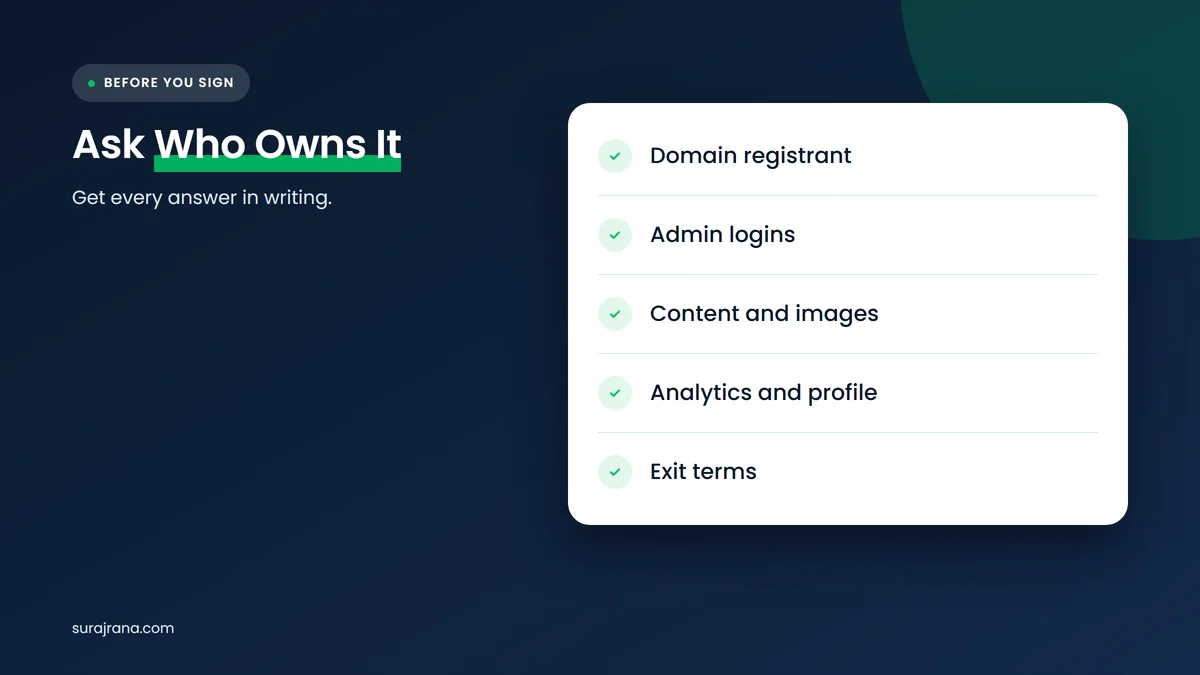
Before signing a website contract, a dental practice should ask who will be the domain registrant, who holds admin access to hosting and the CMS, who owns the content and images, whose accounts analytics and the Business Profile sit in, and exactly what you get to take with you if you cancel. Get every answer in writing.
- Domain: “Will the domain be registered in the practice’s name, in an account the practice controls?”
- Access: “Will the practice have its own admin login to hosting and the website, not just an editor login?”
- Content and images: “Does the contract assign the written content, design and photos to the practice, and are any images licensed only to you?”
- Data: “Will Google Analytics, Search Console and the Business Profile be set up with the practice as owner or Administrator? Who owns any call tracking numbers?”
- Exit: “If we cancel, what do we receive, in what format, within how many days, and does any fee apply?”
It also helps to know what a full service should include in the first place. I’ve set out my view on what a complete dental SEO service should include, and the same principle applies: clear deliverables, clear access and no hidden lock-in. As the ADA recommends, have an attorney review the contract before you sign.
How can you check what you own right now?
You can check what you own right now by looking up your domain’s registration, asking your vendor for a written list of every account and who owns it, and logging into Google Analytics and your Business Profile to see your role. If you can’t log in as an owner, you don’t own it yet.
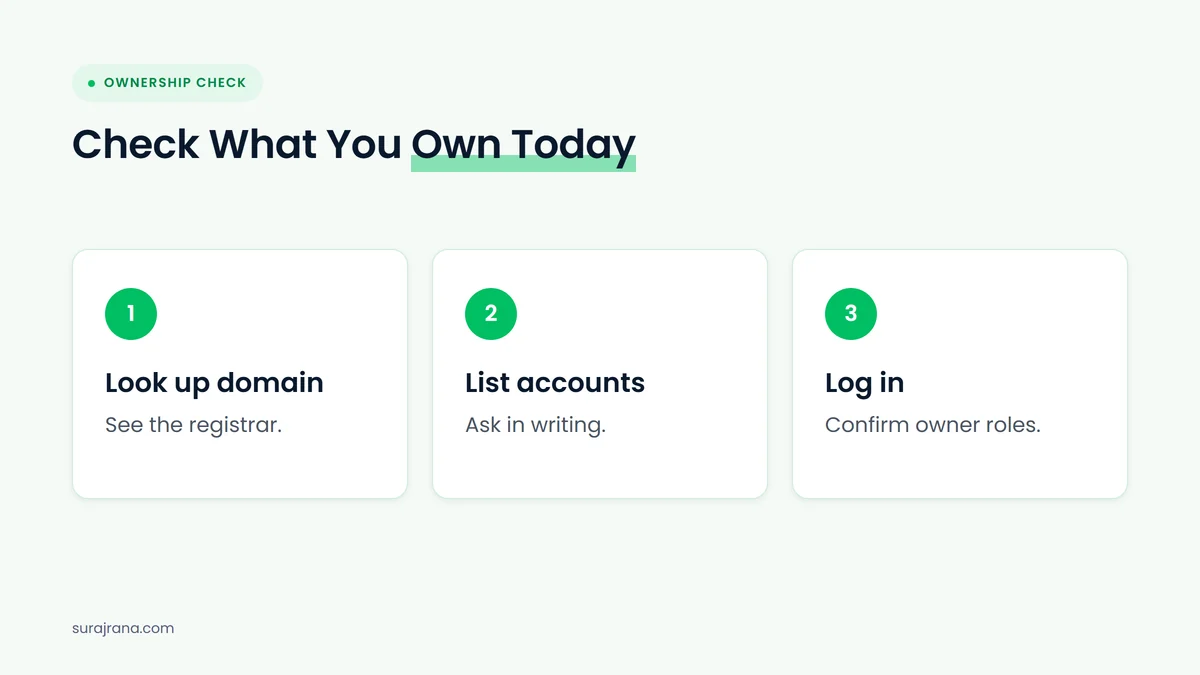
- Look up your domain. Use a registration data lookup to see the registrar and, where shown, the registrant organization. Registrant details are often redacted for privacy, so ask your vendor for the registrar account details too.
- Ask for an account list. Request a written list of every account tied to the site: registrar, hosting, CMS, analytics, Search Console, Business Profile and call tracking, with the owner of each.
- Log in yourself. Check that you are primary owner on the Business Profile and Administrator in Google Analytics. If not, ask for those roles to be transferred.
- Fix gaps one at a time. Start with the domain, then admin access, then data. Keep the vendor’s access in place while you do it so nothing breaks.
Most vendors will cooperate when asked politely and in writing. If one won’t, that tells you something important about the relationship, and that’s the point to involve a lawyer.
Frequently asked questions
Should my dental website domain be registered in my name or my agency’s name?
Your domain should be registered in your practice’s name, in a registrar account the practice controls. Your agency can be given access to manage DNS and settings. Under ICANN’s transfer rules, the registrant is the party that controls transfers, so the registrant field should show your practice, not your agency.
Is it a bad idea to use a dental website platform that charges a monthly fee?
Not necessarily. A monthly platform can be good value if it saves you time and the service is strong. It becomes a bad idea when the vendor owns the domain, the content or the data, or when the contract gives you nothing to take with you if you leave. Check the exit terms first.
Can I move my dental website to a new company if I don’t own it?
You can usually move your domain if you are the registrant, but moving the site itself depends on your contract and platform. If your platform can’t export the site, leaving means rebuilding the pages. If you’re not the registrant, you’ll need the current holder’s cooperation, and possibly legal help.
Who should own Google Analytics and the Google Business Profile for my practice?
Your practice should hold the primary owner role on the Business Profile and the Administrator role in Google Analytics. Agencies can be added as managers or editors so they can do their work. That way you can change agencies without losing your profile or years of traffic history.
Do I need a lawyer to review a dental website contract?
The American Dental Association recommends having an attorney review any contract before signing, including agreements covering the creation, maintenance and ownership of your online presence. I agree. Ownership of the domain, content and data is set by the contract, so it’s worth having a lawyer read it first.
My bottom line on owning your dental website
I believe a dental practice should never rent the things that make it findable. Pay a vendor for design, hosting, updates and marketing if that suits you. But the domain, the admin access, the content, the analytics and the Business Profile should belong to the practice, in writing, from day one.
If you’re planning a new site, Dental Master Media’s dental website design and development service builds mostly on WordPress and gives practices full access to update their own content. And if you want to see how I approach growth once the foundations are yours, read about my dental SEO services on surajrana.com.
Not sure who owns your website?
I’m Suraj Rana, and if you can’t say for certain who holds your domain, your logins or your data, I’m happy to look at it with you. Through my dental SEO services and Dental Master Media, my team and I help dental practices build on foundations they control.
Sources
- American Dental Association, “Considerations when Outsourcing Development”, undated (accessed November 2, 2026). https://www.ada.org/resources/practice/practice-management/25_websitedevelopment_considerationswhenoutsourcing
- ICANN, “Transfer Policy”, effective December 1, 2016, with later updates (accessed November 2, 2026). https://www.icann.org/resources/pages/transfer-policy-2016-06-01-en
- ICANN, “5 Things Every Domain Name Registrant Should Know About ICANN’s Transfer Policy”, undated (accessed November 2, 2026). https://www.icann.org/resources/pages/about-transfer-policy-2017-10-10-en
- Realtime Register, “ICANN Updates gTLD Transfer Policy from 4 August 2026”, July 2, 2026. https://realtimeregister.com/blogs/icann-updates-gtld-transfer-policy-from-4-august-2026
- Law360 (Hayley Fowler), “Dental Practices Say Ex-Contractor Holding Websites Hostage”, April 21, 2025. https://law360.com/healthcare-authority/articles/2327462
- The Register (Brandon Vigliarolo), “Dentists sue ex-contractor for holding web domains hostage in biz fight”, April 22, 2025. https://www.theregister.com/2025/04/22/fired_dental_clinic_administrator_sued/
- US Copyright Office, “Circular 30: Works Made for Hire”, accessed November 2, 2026. https://www.copyright.gov/circs/circ30.pdf
- Google Business Profile Help, “Manage your Business Profile owners & managers”, accessed November 2, 2026. https://support.google.com/business/answer/3403100
- Google Analytics Help, “Add, edit, and delete Analytics users and user groups”, accessed November 2, 2026. https://support.google.com/analytics/answer/9305788

My name is Suraj Rana, and I am a seasoned Dental SEO Expert with extensive experience in the Dental SEO industry. Leveraging my deep knowledge and expertise, I help dental practices enhance their online visibility and attract more patients.