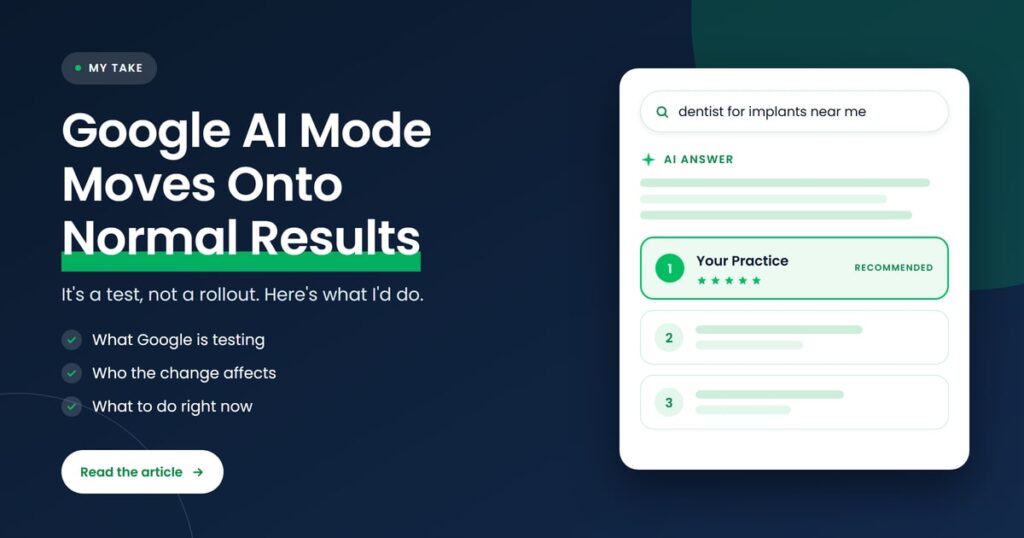
Quick answer: Google is testing AI Mode’s left sidebar, with chat history and a button to start an AI Mode chat, on the normal web results page. It is a test, not a full rollout. My take: it makes AI Mode the default doorway into Google, so practices and agencies should stop treating it as a side channel.
Key takeaways
- Search Engine Roundtable reported on October 14, 2026 that Google is testing the AI Mode left sidebar on the main search results page, and on October 30 said it is still “not fully rolled out”.
- Google has made no public statement about the sidebar, so nobody outside Google knows yet if or when it becomes permanent.
- My opinion: the sidebar matters more than it looks, because it turns a normal Google search into the start of a saved AI conversation.
- Google already reports AI Mode traffic inside the “Web” numbers in Search Console, so you can’t measure this change by watching one report. Track calls, forms and bookings instead.
- Don’t rebuild anything for a test. Do the work that pays off whether the sidebar ships or not: complete service pages, a complete Google Business Profile and clear answers to patient questions.
The AI Mode sidebar is the vertical panel down the left side of Google’s AI Mode screen. It holds a small Google logo, a list of past chats, a way to start a new AI Mode chat and a settings icon. Google is now testing that same panel on the regular page of web results.
AI Mode itself is Google’s chat-style search experience, where you ask a question, get a written AI answer with links, and keep asking follow-up questions. Until now, most people only saw that left panel after clicking into AI Mode. In the test, it sits beside the ten blue links on an ordinary search.
That sounds like a small layout change. I don’t think it is, and the rest of this post explains why.
What exactly did Google change, and is it live for everyone?
Google has not changed anything for everyone yet. Search Engine Roundtable reported on October 14, 2026 that a searcher shared a screenshot of the AI Mode sidebar on normal results, and the editor could not reproduce it. By October 30 he could see it himself, but described it as not fully rolled out.
Here is what has been reported, and what hasn’t:
| Question | What the reporting says | Status |
|---|---|---|
| Where does the sidebar appear? | On the main Google web search results page, on the left | Seen by some users |
| What is in it? | Google logo, AI Mode chat history, start an AI Mode chat, settings | Reported with screenshots |
| Is it rolled out to everyone? | No. Described as “not fully rolled out” on October 30, 2026 | Test |
| Has Google commented? | No statement included in the report | Unknown |
| Does it change rankings? | Nothing reported. It is an interface change | No evidence either way |
The full write-up is Barry Schwartz’s article, Google Tests AI Mode Left Sidebar On Main Google Search Results Page. He also said he wouldn’t be surprised if Google rolled it out, because it makes AI Mode easier to reach from normal search. I agree with him.
I think the sidebar matters because it changes what a Google search feels like. A normal search used to be a one-off: type, scan links, click, leave. With chat history and a “start a chat” button on every results page, each search becomes a possible step in an ongoing AI conversation that Google remembers for the user.
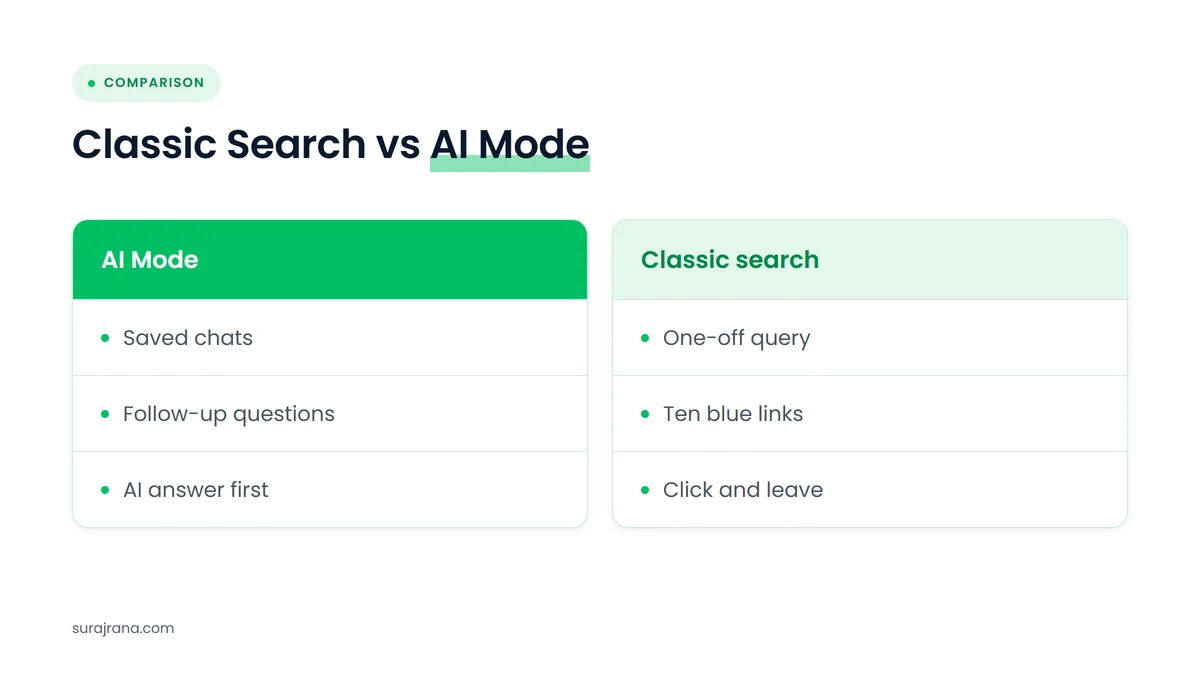
Look at the direction of travel. In August 2026, Google confirmed that for some searches, AI Overviews now expand by default into a fuller answer that looks like AI Mode and opens the follow-up question box, pushing organic results further down. A Google spokesperson said this happens “for topics where our systems determine it’s most useful for people.” Now the AI Mode sidebar is being tested on the classic results page too.
Put those two together and the pattern is hard to miss. Google is moving people from the results page toward AI Mode from both directions: the AI answer at the top grows, and the AI Mode entry point now sits on the side. My prediction, and it is only my prediction: within the next year, a large share of searchers will start or continue a Google search inside AI Mode without ever thinking of it as a separate product.
That is the one opinion I’ll stand behind from this post. AI Mode is becoming the front door of Google, not a tab next to it, and practices that still plan their SEO around ten blue links are planning for a page that is shrinking.
Who is affected by AI Mode on the normal results page?
Anyone who gets customers from Google search is affected, but not equally. Businesses that rely on informational searches feel it first, because those questions suit a chat answer. Local businesses like dental practices feel it differently: patients can research in AI Mode, then still need a name, a map listing and a reason to call.
What does it mean for dental practice owners?
For dental practice owners, it means more patients may ask follow-up questions inside Google before they ever reach a website. Someone searching for implants might move from cost to recovery time to “who near me does this” in one AI Mode thread. The practice that gives clear, specific answers on its own pages has more to be quoted from.
Most of the dental searches that bring bookings are local and specific. I’ve argued before that most patients searching for a dentist never click a single result anymore. An AI Mode entry point on every results page pushes further in that direction.
What does it mean for agency owners?
For agency owners, it means rankings reports will explain less and less of what clients actually see. A client can rank well in the classic results and still be missing from the AI answer their patients read first. Agencies that keep reporting positions alone will struggle to explain flat or falling clicks to clients.
There is also a reporting trap here, which I cover in the next section.
Can you see AI Mode traffic in Search Console?
Not as its own line. Google says traffic from its AI features, including AI Mode and AI Overviews, is counted in the overall search traffic in Search Console, inside the Performance report under the “Web” search type. You can’t filter AI Mode out, so a sidebar rollout won’t show up as a separate number.
This comes from Google’s own page, AI features and your website. The same page says there are no extra technical requirements or special optimizations needed to appear in AI Overviews or AI Mode, beyond being indexed and eligible to show with a snippet.
So if the sidebar rolls out widely, you will most likely see it as a change in the pattern of impressions and clicks, not as a labeled report. That is why I keep telling practice owners to judge their SEO on calls, form fills and booked appointments, not on one Search Console chart.
Should you change your SEO because of a test?
No, not because of a test on its own. Google tests interface changes all the time, and many never ship. What you should do is notice the trend the test confirms, which is that Google keeps moving searchers toward AI answers, and make sure your site is ready for that whether this particular sidebar ships or not.
Here is the fair counter-argument, because I think it deserves a hearing:
- It is unconfirmed. Google hasn’t said anything, and a sidebar seen by some users is not a launch.
- The basics haven’t changed. Google’s own guidance says no special optimization is needed for AI Mode. A good page is still a good page.
- Local intent still ends in a listing. A patient who wants a dentist still needs a practice name, a map and a phone number, and AI Mode doesn’t change that.
I agree with all three. That is exactly why my advice below isn’t “build an AI Mode strategy”. It is “do the things that help in both the old page and the new one, and stop measuring success with the old page’s scoreboard”.
What would I do now if I ran a dental practice or an agency?
If I ran a dental practice, I would make sure every important treatment has a complete page, that my Google Business Profile is fully filled in, and that I track calls and bookings by source. If I ran an agency, I would add AI answer checks to client reporting. None of this needs to wait for Google.
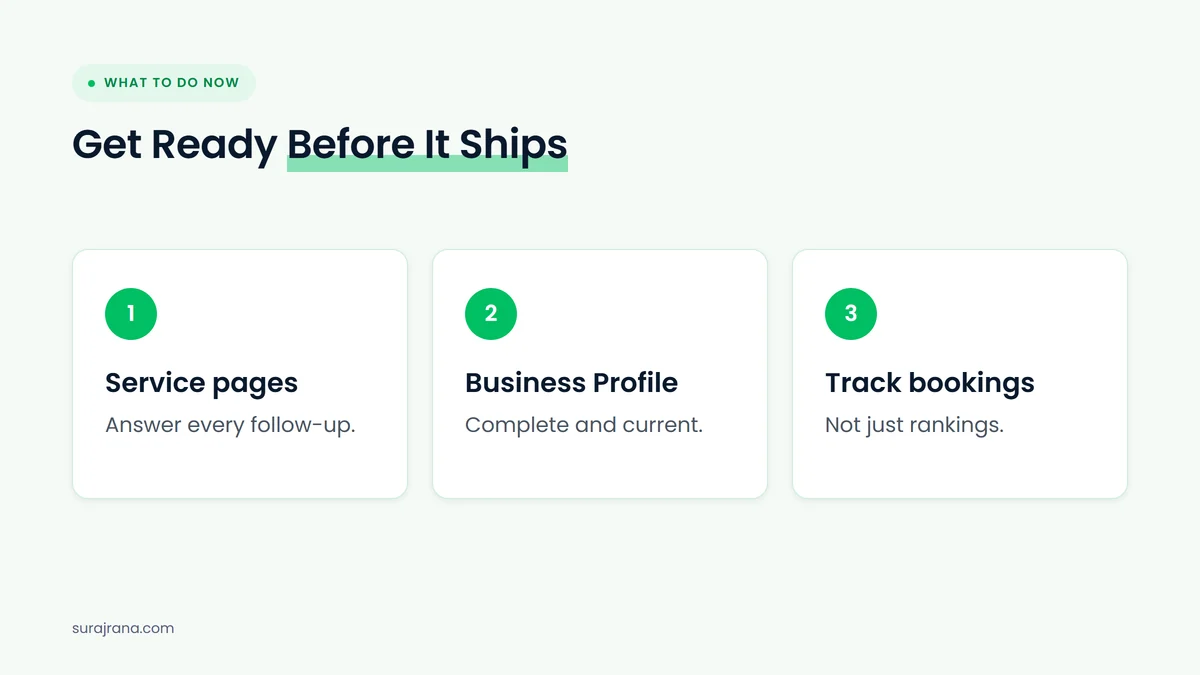
- Answer the whole decision on each service page. Who the treatment suits, how it works, how long it takes, recovery, risks and how the cost is worked out. AI Mode follow-up questions are exactly these questions.
- Complete your Google Business Profile. Services, categories, hours and photos are what turn an AI answer into a call. I’ve written about why your Google Business Profile services list decides if AI recommends you.
- Check what AI answers actually say about you. Search your main treatments plus your town in AI Mode once a month and note whether your practice is named or linked.
- Measure outcomes, not positions. Track calls, forms and bookings by source, because Search Console won’t separate AI Mode for you.
- Watch for Google’s own announcement. If Google confirms the sidebar for everyone, review your click trends in the weeks after, not the day after.
For the longer view on why being quoted matters more than ranking, I’ve made the case that ranking on page one isn’t the finish line anymore. And if you want the practical, dental-specific breakdown, Dental Master Media has a guide on how Google AI Mode is reshaping local search for dental practices.
How can you tell if your practice is ready for AI Mode?
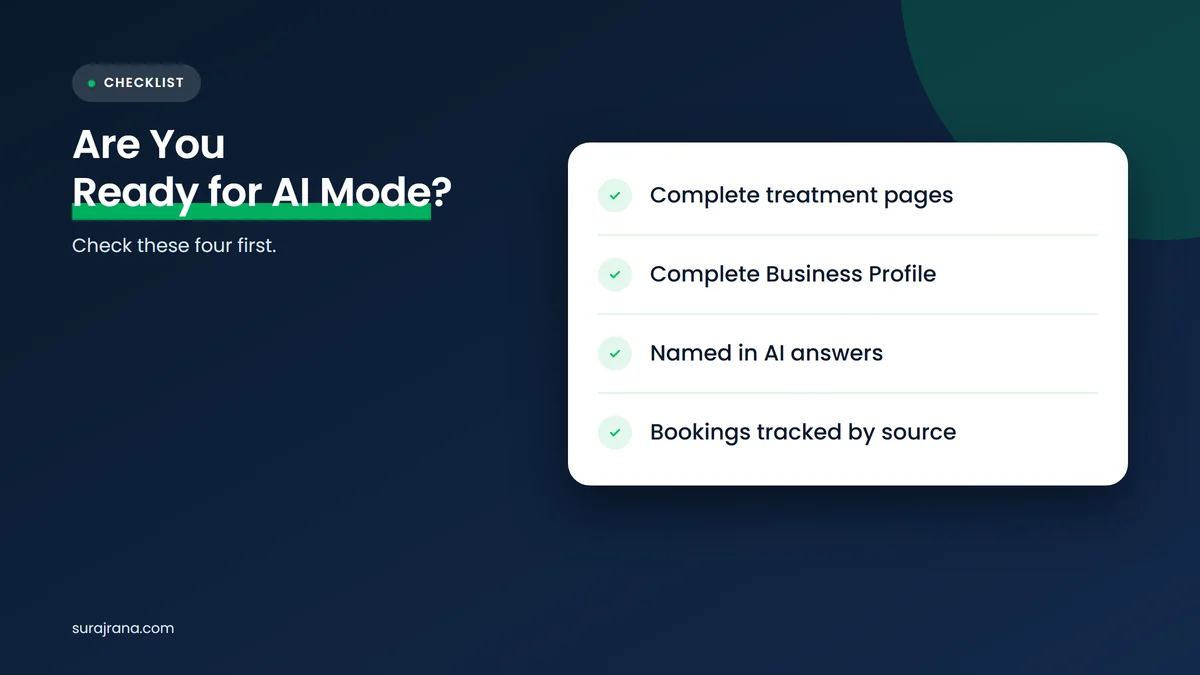
You can tell your practice is ready for AI Mode if your key treatments each have a complete page, your Google Business Profile is complete and current, your practice is named when you test AI answers for your main services, and you can trace new patients back to search. If two or more are missing, start there.
Here is how I’d compare the old way of judging SEO with the way I think it needs to work now:
| What you check | Classic results thinking | AI Mode thinking |
|---|---|---|
| Main goal | Rank in the top three blue links | Be the source the AI answer names or links |
| Content focus | One keyword per page | Every follow-up question a patient might ask |
| Local signal | Map pack position | A complete, accurate Google Business Profile the answer can rely on |
| Reporting | Rankings and clicks | Calls, forms and bookings, plus regular AI answer checks |
Frequently asked questions
No. As of October 30, 2026, Search Engine Roundtable described the AI Mode left sidebar on normal results as a test that is not fully rolled out. Some searchers see it and others don’t. Google has not announced it, so treat it as an experiment until Google says otherwise.
Nothing reported suggests the sidebar changes how pages rank. It is an interface change that puts AI Mode’s chat history and a start-a-chat button next to the normal results. What it may change is how many people move into AI Mode, which can affect clicks even when rankings stay the same.
Do I need special optimization to appear in AI Mode?
Google says no. Its guidance states there are no additional requirements or special optimizations needed to appear in AI Overviews or AI Mode. A page needs to be indexed and eligible to show with a snippet. Clear, complete, accurate pages are still the best way to be used in an answer.
How will I know if AI Mode is affecting my practice’s traffic?
You won’t see a separate AI Mode report, because Google counts AI Mode in the “Web” search type in Search Console. Watch for changes in the pattern of impressions and clicks, and compare them with calls, form fills and bookings. Checking AI answers for your main treatments each month also helps.
Should agencies change how they report to clients?
Yes, in my view. Rankings alone no longer show what a client’s customers see first. I would add a short monthly check of AI answers for the client’s main services and put leads and bookings ahead of positions in the report. That way a drop in clicks has context instead of causing panic.
The AI Mode sidebar is a test, and I won’t pretend otherwise. But it points the same way as everything else Google has done with AI search this year: more of the search happens inside Google’s AI answer, and fewer decisions start with a list of links. I’d rather a practice get ready for that now than react after the fact.
My advice is simple: make your service pages and Google Business Profile the clearest answers in your area, and judge your SEO by the patients it brings in. That is how I approach dental SEO for practices, and you can read more about my work on surajrana.com.
Want to know how your practice shows up in AI Mode?
I’m Suraj Rana. If you’re not sure whether Google’s AI answers mention your practice, or your reports only show rankings, I’m happy to look at it with you. Through my dental SEO work and Dental Master Media, my team and I help practices become the answer patients see first.
Sources
- Search Engine Roundtable (Barry Schwartz), “Google Tests AI Mode Left Sidebar On Main Google Search Results Page”, October 14, 2026, updated October 30, 2026. https://www.seroundtable.com/google-ai-mode-left-sidebar-42298.html
- Search Engine Roundtable (Barry Schwartz), “Google AI Overviews Pushing Searchers Into AI Mode, Drops Show More Button”, August 28, 2026. https://www.seroundtable.com/google-ai-overviews-push-ai-mode-responses-41974.html
- Google Search Central, “AI features and your website”, last updated December 10, 2025. https://developers.google.com/search/docs/appearance/ai-features

My name is Suraj Rana, and I am a seasoned Dental SEO Expert with extensive experience in the Dental SEO industry. Leveraging my deep knowledge and expertise, I help dental practices enhance their online visibility and attract more patients.