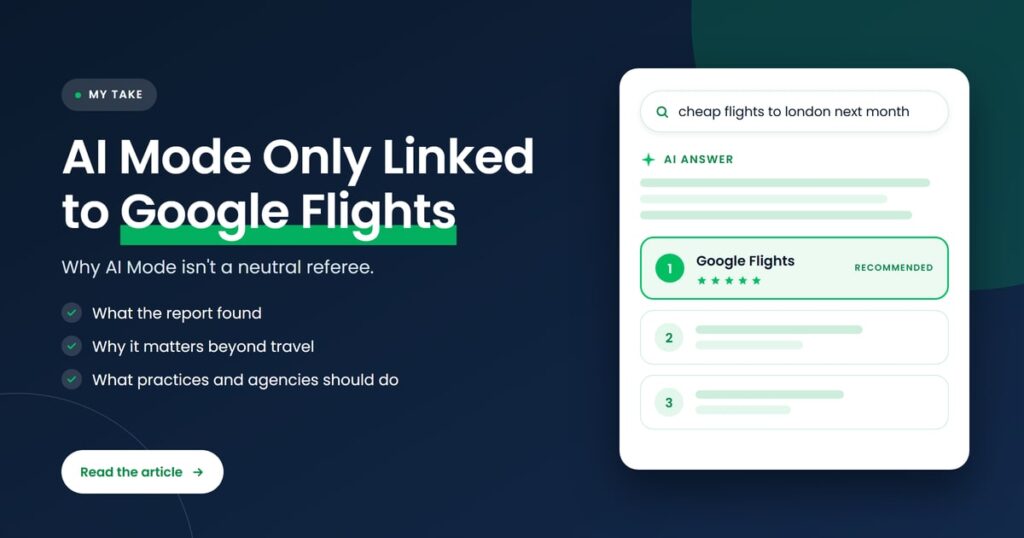
Quick answer: Search Engine Roundtable reported on November 3, 2026 that in its tests, every link in Google AI Mode’s flight answers pointed to Google Flights. My take: AI Mode is not a neutral referee. Where Google has its own product, plan as if Google will send people there, and build the channels Google can’t take away from you.
Key takeaways
- Barry Schwartz at Search Engine Roundtable tested AI Mode flight searches over a weekend and reported that the only links in the answers went to Google Flights, every time.
- The pattern was first shared on X by Natzir (@natzir9) on October 30, 2026. The report includes no statement from Google.
- My opinion: when an AI answer can point to a Google product, assume it will. Treat Google as a platform you rent space on, not a fair judge.
- Dental search has no “Google Flights for dentists”, but Google is moving toward AI agents that book reservations and schedule appointments, which makes the question relevant to practices.
- The practical response is the same for practices and agencies: be complete on the Google surfaces you can appear in, own the channels Google can’t take, and measure bookings, not positions.
What did Search Engine Roundtable report about AI Mode and Google Flights?
Search Engine Roundtable reported that when its editor asked Google AI Mode about flights, the only links in the AI answers went to Google Flights. He tested a range of domestic US and international destinations over a weekend, said this happened every time, and said he has dozens of screenshots showing the same result.
The article is Barry Schwartz’s Google AI Mode Biased: It Only Shows Links To Google Flights, published November 3, 2026. He credits Natzir (@natzir9) on X with pointing it out first, in a post on October 30, 2026 that showed all the links going to Google Flights.
Here is what has been reported, and what hasn’t:
| Question | What the reporting says |
|---|---|
| What was searched? | Flight information in AI Mode, for several US and international destinations |
| Where did the links go? | Only to Google Flights, in every test the editor ran |
| Who spotted it first? | Natzir (@natzir9) on X, October 30, 2026 |
| How much evidence? | The editor says he has dozens of screenshots and shares one |
| Has Google commented? | No statement is included in the report |
| Exact queries used? | Not listed in the article |
Schwartz also wrote that he expects regulators, such as those enforcing Europe’s Digital Markets Act, would be interested. That is his view. I’m not a lawyer and I’m not making any legal claim here. I’m interested in what this tells business owners about how AI Mode behaves.
What does “self-preferencing” mean in AI search?
Self-preferencing is when a platform gives its own products a better position than competitors on the same platform. In AI search, it would mean an AI answer linking to the search company’s own service instead of, or ahead of, other websites that could answer the same question. The SER report describes behavior that fits this pattern for flights.
I’m using the term in a plain, descriptive sense, not a legal one. The point for a business owner is simple. In the classic results page, a Google product box sat next to ten other links you could compete with. In an AI answer, there may be only a handful of links in total. If all of them go to one place, there is nothing left to compete for on that query.
Why does this worry me more than a normal Google product box?
It worries me because an AI answer is a much smaller space than a results page. On a classic page, a Google Flights box still left room for airlines and travel sites below it. In the AI Mode answers SER tested, there was no room at all. When the answer is the whole page, whoever controls the links controls the outcome.
It also fits a direction Google has been signaling openly. In its Q3 2026 earnings call, as reported by Roger Montti at Search Engine Journal in Google’s Q3 Earnings Call Casts Shadow Over Classic Search, Google said query growth was the strongest in five years, partly because AI Mode is creating additional searches. The same report says Google conceded AI Mode monetizes at a lower rate than classic search.
Sundar Pichai also described AI agents as a new stage for Search, built around getting tasks done: booking reservations, filling in forms, scheduling appointments and making purchases. Montti noted that Pichai did not discuss the effect on the open web.
Put those pieces together. AI Mode sessions earn Google less from ads, Google wants Search to complete tasks, and in at least one category the AI answer linked only to Google’s own product. I don’t know Google’s intent, and the report doesn’t claim to. But I’d be naive to plan as if those things are unrelated.
So here is the one opinion I’ll stand behind from this post. AI Mode is not a neutral referee. Wherever Google has, or builds, a product that does what your business does, plan as if the AI answer will send people there first, and build the channels that don’t depend on Google’s goodwill.
Is this only a travel problem, or does it affect dental practices?
Right now, the reported behavior is about flights, and nothing in the report says it happens in dental or other local searches. Dental has no Google Flights equivalent today. But Google says it wants Search agents to schedule appointments and book reservations, and that is exactly the step where a patient chooses a practice.
I want to be careful here. I have not seen any report of AI Mode steering dental searches to a Google product, and I’m not claiming it does. What I’m saying is that the closest thing to a “Google product” in local search is Google’s own business listings and maps, and any future booking agent would most likely sit on top of them.
That changes the job a little. For a practice, the Google Business Profile isn’t just a map pin. It is the version of your practice that lives on Google’s surface, and it may be what an AI answer or agent reads first. I’ve already argued that your Google Business Profile services list decides if AI recommends you, and this story makes me more confident about that, not less.
What does it mean for dental practice owners?
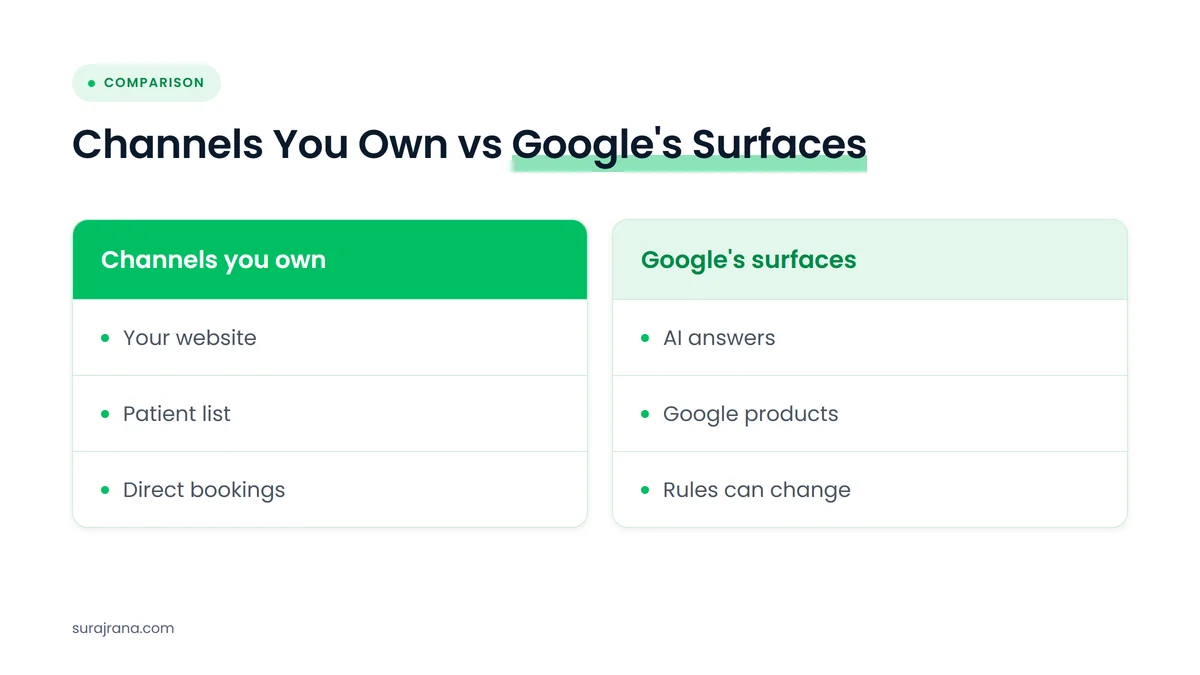
For dental practice owners, it means two things at once. Be complete and accurate on the Google surfaces you can appear in, because that is where AI answers may look. And make sure patients have reasons and routes to come to you directly, so you are not relying on one company’s answer box for every new booking.
The second part is the one most practices skip. A practice that owns its website, its patient list and its reputation has something Google’s answer can point to but can’t replace. That is the case I made in why every dental practice should own its website, not rent it.
What does it mean for agency owners?
For agency owners, it means client risk now depends on category, not just competition. A client in travel, local services or shopping should be told plainly that Google may answer some of their searches with its own product. Reporting should show where AI answers send people, not just where the client ranks in classic results.
If you resell SEO to clients, the reporting change matters as much as the strategy change. Whitelabelseo.co.in covers what white-label SEO partners must report differently now that zero-click answers are common.
What is the fair case against reading too much into this?
The fair case is that this is one editor’s tests in one category, with no statement from Google, and Google tests AI Mode behavior constantly. Search Engine Roundtable reported the same day that Google is testing removing the AI Mode button from the search bar for some users. Nothing about AI Mode is settled yet.
Here is the other side, point by point, because I think it deserves a hearing:
- It is one category. Flights is a vertical where Google has a dedicated product. The report says nothing about categories where it doesn’t.
- The sample is unclear. The article doesn’t list the exact queries, and we only see one screenshot of the dozens the editor says he has.
- Google hasn’t explained it. There is no Google statement in the report, so we don’t know if this is deliberate, a test or a side effect.
- AI Mode itself is still being tested. In Google Tests Removing AI Mode Button From Search Bar, SER reported that Len Raleigh saw the button missing in some sessions, though the editor could not replicate it. Google first added that button in May 2025.
I accept all four points. They are why my advice below isn’t “panic” or “abandon Google”. It is “stop assuming Google’s AI answer is a level playing field, and spread your risk accordingly”. That advice holds whether or not the Flights behavior changes next week.
I made a related point recently about the AI Mode sidebar test on normal results: Google keeps pulling searchers toward AI Mode from several directions at once. This story adds a second question to that one. Not just “will people use AI Mode?” but “where will AI Mode send them?”
What should practice owners and agency owners do now?
Practice owners and agency owners should do three things now: be complete on every Google surface they can appear in, build channels they own that don’t depend on Google’s answer, and measure bookings and leads rather than rankings. None of this needs a Google announcement first, and all of it helps whatever AI Mode does next.
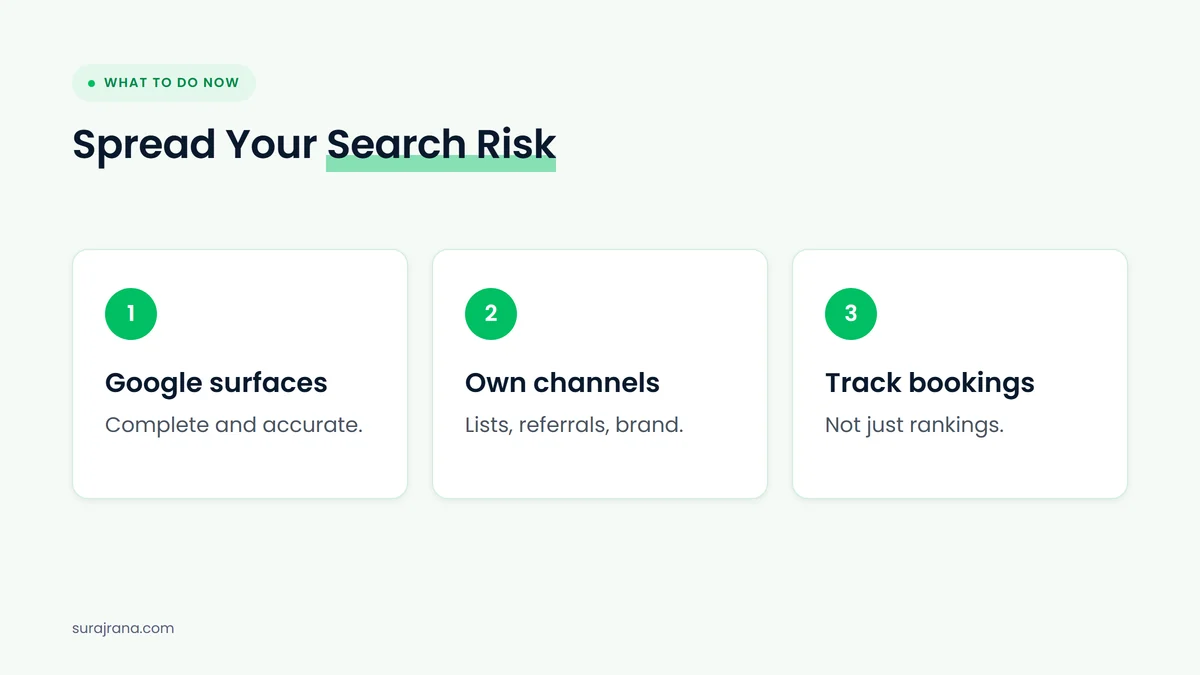
- Be complete where Google looks. For a practice, that means a full Google Business Profile with accurate services, hours, categories and photos. If AI answers lean on Google’s own data, that data should describe you properly.
- Make your website the clearest answer. Complete treatment pages, honest cost information and real FAQs give any AI system something worth citing. Dental Master Media has a practical guide on how Google AI Mode is reshaping local search for dental practices.
- Build direct routes. Patient email and text lists, recall reminders, referral programs and a brand name people search for directly all bring patients without passing through an AI answer.
- Check AI answers by hand. Once a month, ask AI Mode about your main services in your area and note where the links go. If they go somewhere other than you or your listing, you’ve learned something no ranking report will show.
- Measure outcomes. Track calls, forms and bookings by source. Positions can look fine while the answer above them sends people elsewhere.
How can you tell how exposed your business is?
You can tell how exposed your business is by asking four questions. Does Google offer its own product in your category? Do AI answers for your main services link to you, your listing or someone else? What share of new customers come from Google search? And do you have direct channels that bring people back without searching?
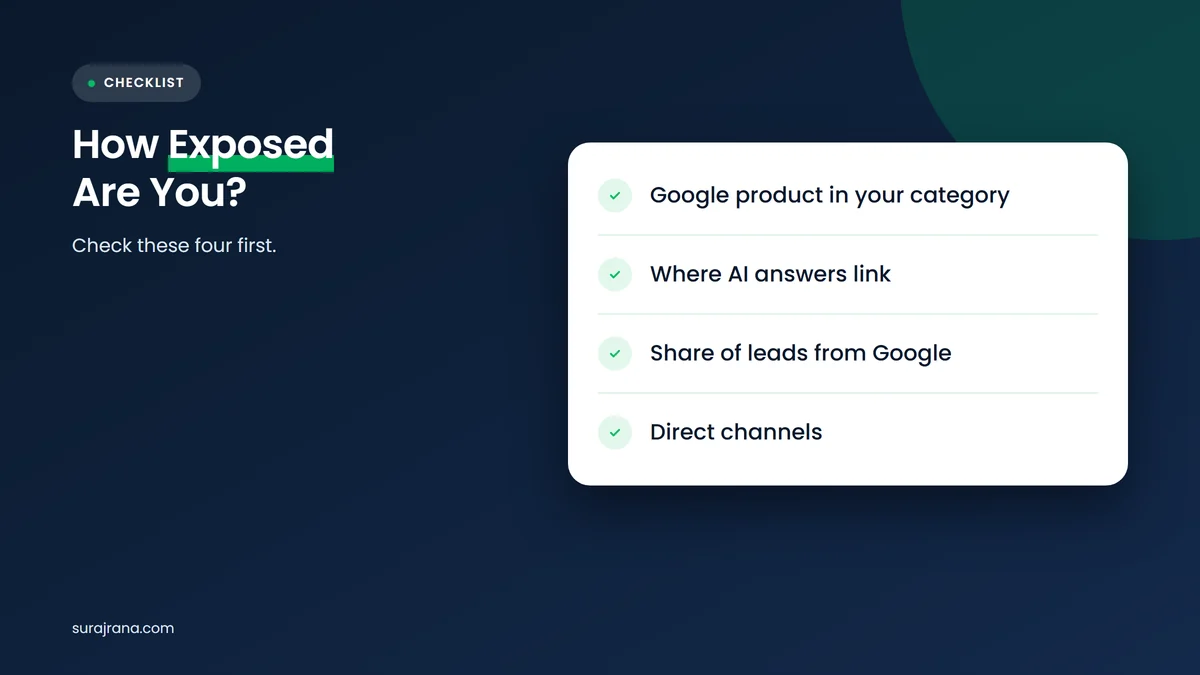
This is how I’d score it:
| Check | Lower exposure | Higher exposure |
|---|---|---|
| Google product in your category | None today | Yes, such as flights |
| Where AI answers link | Your site or your listing | Elsewhere, or nowhere |
| Share of new customers from Google search | One channel among several | Almost all of them |
| Direct channels | Email list, referrals, branded searches | Little or none |
Most dental practices land in the middle: no competing Google product today, but heavy reliance on Google for new patients. That is the group I’d push hardest to build direct channels, because, as I’ve said before, most patients searching for a dentist never click a single result anymore.
Frequently asked questions
Does Google AI Mode only link to Google Flights?
For flight searches, that is what Search Engine Roundtable reported on November 3, 2026. Its editor tested several domestic and international destinations and said the only links in AI Mode’s answers went to Google Flights every time. Google has not commented in the report, so it may change.
Is Google breaking the law by doing this?
I can’t say, and the report doesn’t say either. The SER editor suggested regulators, such as those enforcing Europe’s Digital Markets Act, would likely be interested. That is an opinion, not a finding. For business owners, the practical question is how to reduce reliance on one platform, not the legal one.
Does AI Mode send dental searches to Google products?
Nothing in the reporting says so. The Google Flights behavior was reported for flight searches only. Dental has no equivalent Google product today, but Google’s own listings and maps are the closest thing, so a complete and accurate Google Business Profile matters more as AI answers grow.
Should I stop investing in Google SEO because of this?
No. Google is still where most people search, and a practice that isn’t visible there loses patients. My point is about balance. Keep doing the work that helps on Google, and add channels you own so one change in an AI answer can’t take away most of your new business.
How should agencies explain this to clients?
Explain it as category risk. Tell clients whether Google has its own product in their space, show them where AI answers for their main services currently link, and report leads and bookings ahead of rankings. That way, a change in AI Mode is something you saw coming rather than something you explain afterward.
My bottom line on AI Mode and Google Flights
One report about flights doesn’t prove Google will do the same everywhere, and I won’t pretend it does. But it shows what an AI answer can do when the company writing it also owns a product in that category. I’d rather practices and agencies plan for that now than learn it the hard way.
Be complete on Google’s surfaces, make your own site the clearest answer in your area, build direct routes to your patients, and judge everything by bookings. That is how I approach dental SEO for practices, and you can find out more about Suraj Rana and how I work.
Want to know where AI answers send your patients?
I’m Suraj Rana. If you’re not sure whether Google’s AI answers point patients to your practice or somewhere else, I’m happy to look at it with you. Through my dental SEO work and Dental Master Media, my team and I help practices become the answer patients see, and build the channels Google can’t take away.
Sources
- Search Engine Roundtable (Barry Schwartz), “Google AI Mode Biased: It Only Shows Links To Google Flights”, November 3, 2026. https://www.seroundtable.com/google-ai-mode-links-google-flights-42428.html
- Search Engine Roundtable (Barry Schwartz), “Google Tests Removing AI Mode Button From Search Bar”, November 3, 2026. https://www.seroundtable.com/google-removing-ai-mode-42436.html
- Search Engine Journal (Roger Montti), “Google’s Q3 Earnings Call Casts Shadow Over Classic Search”, October 30, 2026. https://www.searchenginejournal.com/googles-q3-earnings-call-casts-shadow-over-classic-search/595082/

My name is Suraj Rana, and I am a seasoned Dental SEO Expert with extensive experience in the Dental SEO industry. Leveraging my deep knowledge and expertise, I help dental practices enhance their online visibility and attract more patients.