
Quick answer: I think an SEO agency should charge for a defined scope of work, not by the hour. Clients buy finished deliverables and progress, not time, and AI now cuts the hours many SEO tasks take, so hourly billing punishes the agency for getting faster. Hourly still fits open-ended advice, discovery and troubleshooting.
Key takeaways
- My position: SEO agencies should sell a clear list of deliverables at an agreed price, and keep hourly billing for work whose size nobody can know in advance.
- AI is shrinking the time many SEO tasks take. Under hourly billing, that efficiency turns straight into lower invoices.
- Most of the SEO market already leans away from pure hourly pricing. In Ahrefs’ survey of 439 SEO providers, 78.2% used monthly retainers and 34.8% charged by the hour.
- A retainer is not automatically scope pricing. A monthly “bank of hours” is still hourly billing with a different label.
- Scope pricing only works if the scope is written well: deliverables, a definition of done, and a change process for anything extra.
What do I mean by pricing by scope instead of hours?
Pricing by scope means the client pays an agreed price for a defined set of deliverables, such as a technical audit, ten optimized service pages or a monthly package of named tasks. Hourly pricing means the client pays for time logged, whatever that time produces. The first sells an output. The second sells effort.
The two get mixed up because of the word “retainer”. A monthly retainer can be either model:
- A scoped retainer lists what gets delivered each month, for example a set number of pages, a technical check, Google Business Profile updates and a report.
- An hours retainer buys a block of hours, for example 20 hours a month, and the agency spends them on whatever seems most useful.
When I argue for scope, I’m arguing for the first kind. A fixed monthly fee that is really a bank of hours carries most of the problems of hourly billing, plus the awkward conversation about unused time.
How do SEO agencies price their work today?
Most SEO providers already sell monthly retainers, and hourly billing is the less common model. Ahrefs surveyed 439 SEO providers and found 78.2% charging a monthly retainer, 48.9% charging per project and 34.8% charging by the hour. Many use more than one model, so the shares add up to more than 100%.
The Ahrefs SEO pricing survey was last updated in 2024, so I treat it as a picture of the market rather than a current price list. What it shows is that hourly billing is a minority habit in SEO. The bigger question for me is what sits inside those retainers: a defined scope, or a block of hours.
The wider agency world is having the same argument right now. In February 2026, Digiday reported that WPP’s chief executive wants to move away from time and materials, though its CFO said output-based pricing is still a minority of its work. If the largest agency groups are rethinking time-based fees, small SEO agencies have even less reason to cling to them.
Why do I think SEO agencies should price by scope, not hours?
I think scope pricing is better for both sides because it ties the fee to what the client actually receives. Below are my six reasons. Each one stands on its own, but together they explain why I think hourly billing is a poor default for ongoing SEO work.
Reason 1: Clients buy outcomes and deliverables, not time
Clients hire an SEO agency to get pages fixed, content published and visibility improved, not to rent hours. An hourly invoice answers “how long did you work?”, which is rarely the question the client cares about. A scoped invoice answers “what did I get?”, and that is the conversation I would rather have every month.
Hours are a measure of input. A senior specialist might fix a crawl problem in an hour that a junior would spend a day on. Under hourly billing, the client pays more for the slower fix. Under scope pricing, they pay the same price for the same result, and the agency is rewarded for knowing what it’s doing. I made a similar argument about measurement in why I stopped selling keyword rankings: sell the thing the client actually values.
Reason 2: AI makes hourly billing punish efficiency
AI tools now draft outlines, summarize research, cluster keywords and check pages far faster than a person working alone. Under hourly billing, every hour AI saves is an hour the agency can no longer invoice. Under scope pricing, the saving stays with the agency as margin, which is the fair reward for investing in better tools and processes.
Agencies are clearly using AI for speed. A June 2026 Forrester and 4As study of US marketing agencies found about nine in ten use generative AI, with staff productivity the main goal for 81% of them. It also found 61% still classify AI as a “cost of business” rather than something they charge for.
Clients have noticed. When Productive surveyed 180 agencies for its Agencies in the AI Era report in November 2025, around a third had already been asked by clients for a price cut because of AI, and nearly half expected the question soon. That question is very hard to answer if your price is hours times rate.
The same pressure is visible in law, the profession most tied to the billable hour. In October 2026, CNBC reported Clio’s finding that about one in five UK and Irish firms that have widely adopted AI struggle to meet billable-hour targets.
Reason 3: A fixed scope gives the client a number they can approve
Most business owners and practice owners want to know what SEO will cost before they agree to it. An hourly estimate is a guess with a meter attached. A scoped price is a number they can put in a budget, take to a partner or compare with another proposal, and that makes the yes easier to give.
It also removes a quiet source of friction. Hourly billing can make a client hesitate before sending a question, because they know the reply might be billed. With a scoped package, the routine contact is part of the deal, so small problems get raised early instead of growing into big ones.
Reason 4: Scope forces both sides to define “done”
Writing a scope makes the agency and the client agree, before work starts, what will be delivered and what a finished task looks like. That conversation exposes unrealistic expectations at the start, when they are cheap to fix, instead of three months in, when a client wonders what they have paid for.
A good scope also handles extra requests honestly. Anything outside it becomes a change request with its own price, rather than more hours quietly added to the meter. I think that is fairer to the client, who sees the cost before agreeing, and to the agency, which stops absorbing unpaid work. Whitelabel SEO has a useful piece on controlling scope creep and protecting margin that goes into the mechanics.
Reason 5: Hourly billing puts the agency and the client on opposite sides
Hourly billing gives the agency a reason to take longer and gives the client a reason to question every line of a timesheet. Neither side needs to act in bad faith for this to cause damage. The incentive is simply pointing the wrong way, and both sides know it, which slowly erodes trust.
The legal profession shows how sticky hours are even when the tools change. In October 2026, Above the Law reported billing data from legal software company 8am showing that nearly half of small and mid-size firms still bill entirely by the hour, even as generative AI use has grown. The data comes from 8am’s own customers, so it isn’t the whole market, but it shows that habits don’t change just because the work gets faster. SEO agencies don’t have to wait for that habit to break on its own.
Reason 6: Scoped work is easier to repeat, hand over and grow
A scoped deliverable comes with a written definition, which means it can be documented, checked against a standard and passed to another team member or a white-label partner. Hourly work depends on whoever happens to be doing it. If you want an agency that runs without you in every task, scope is the better building block.
It also makes pricing a business decision instead of a timesheet exercise. Once each deliverable has a known cost to produce, you can set prices that hold a healthy margin. Whitelabel SEO covers that side in its guide on pricing white-label SEO for healthy agency margins.
How does hourly billing compare with scope pricing?
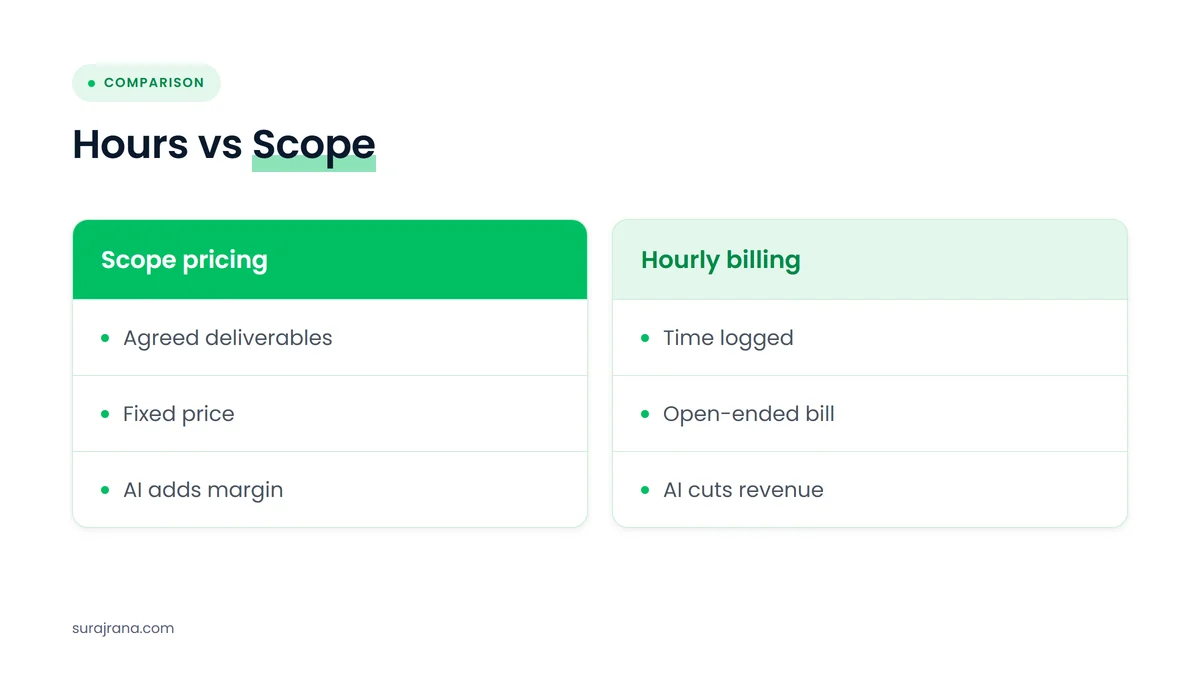
Hourly billing charges for time spent and suits work whose size is unknown. Scope pricing charges for agreed deliverables and suits work that can be defined in advance, which covers most ongoing SEO. The difference shows up in who carries the risk, who benefits from efficiency and how easy the price is to approve.
| Factor | Hourly billing | Scope pricing |
|---|---|---|
| What the client pays for | Time logged | Agreed deliverables |
| Budget certainty for the client | Low, the bill depends on hours | High, the price is agreed up front |
| Who carries the risk of overruns | The client | The agency, within the agreed scope |
| Effect of AI and better processes | Lower invoices for the agency | Better margin for the agency |
| Extra requests | Added to the hours, often unnoticed | Handled as a priced change request |
| Best suited to | Advice, discovery, troubleshooting, training | Ongoing SEO, audits of a known size, page and content work |
When does hourly billing still make sense for an SEO agency?
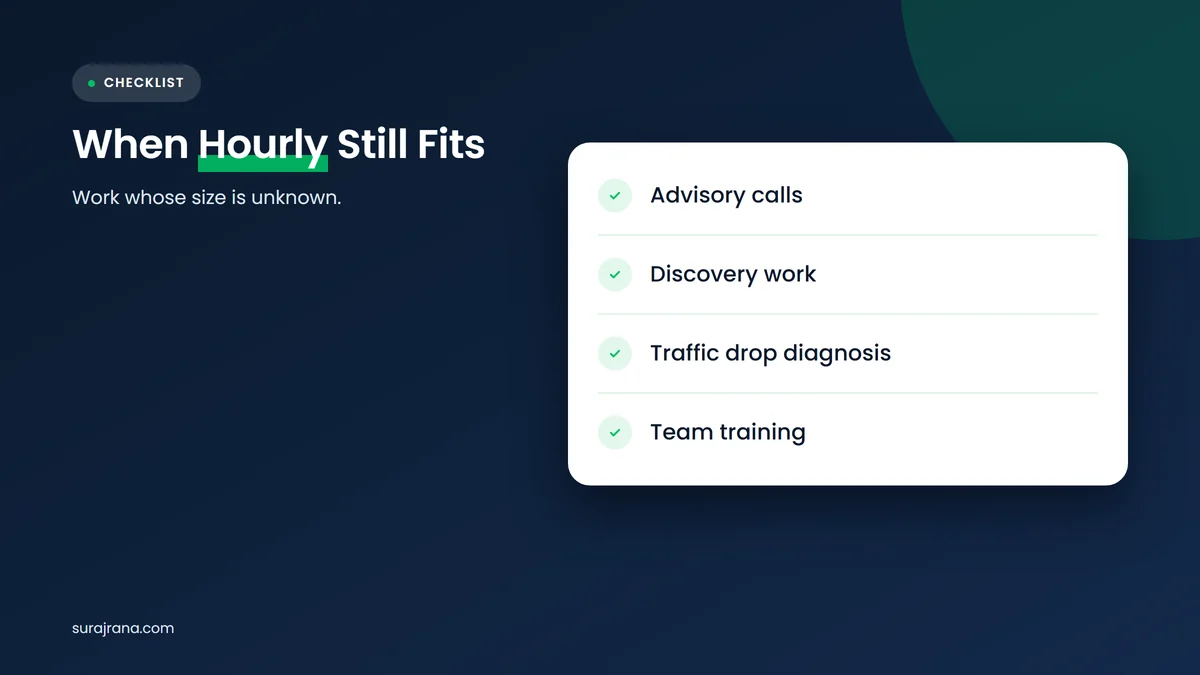
Hourly billing still makes sense when nobody can know the size of the work in advance. Advisory calls, open-ended consulting, diagnosing a sudden traffic drop, expert support during a site migration and team training all fit here. In those cases, a fixed price would force the agency to guess, and someone would lose.
This is the fair version of the other side, and I agree with most of it:
- Consulting is time. When a client wants an experienced person’s judgment on call, the time is the product, and charging for it is honest.
- Unknown problems resist scoping. If rankings fell overnight, nobody knows on day one whether the cause takes an hour or a week to find.
- Scope can be padded. An agency can quote a fixed price with a large buffer built in. A transparent hourly rate can be cheaper for a client who knows exactly what they need.
- Some clients prefer it. In-house teams who direct the work themselves sometimes just want expert hours they can point at tasks.
My answer is to use hours where they belong and turn what you learn into a scope. A paid discovery period or a first audit can be billed by time or at a small fixed fee, and once the work is understood, the ongoing engagement should be priced by deliverables.
What should a good SEO scope include?
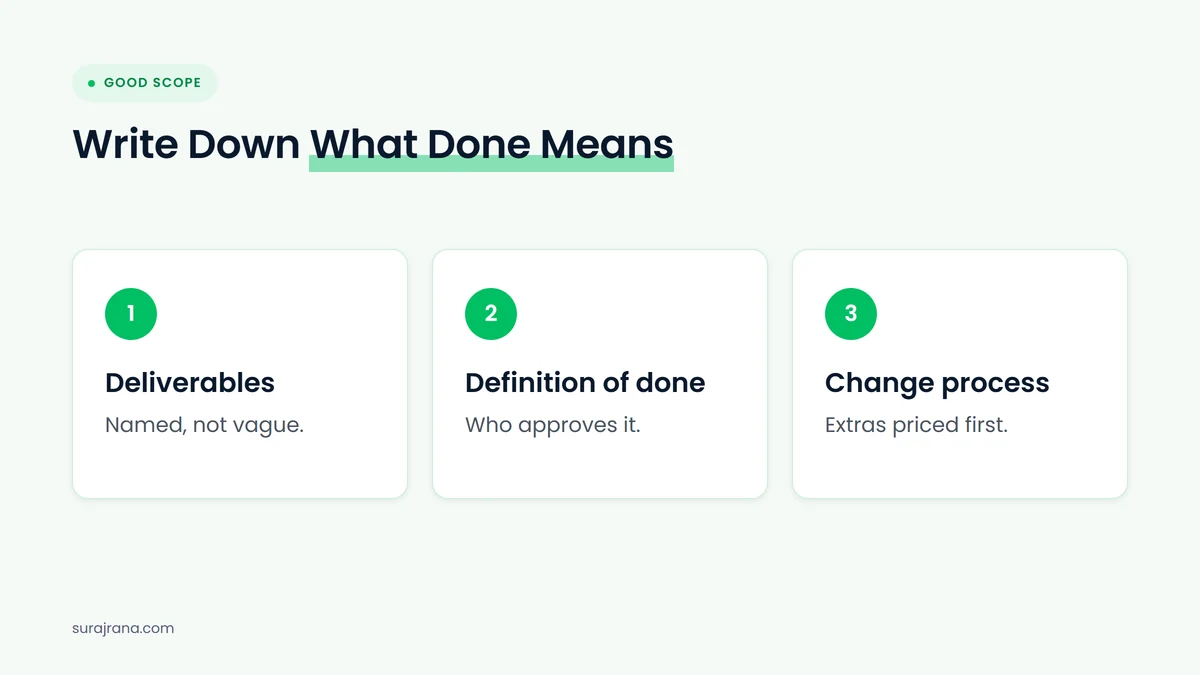
A good SEO scope lists the deliverables, says what “done” means for each one, sets out what the client needs to provide, and explains how extra requests are priced. Without those four parts, a fixed price is just an hourly estimate in disguise, and the disputes simply move to a different place.
This site is for opinion rather than templates, but these are the parts I’d expect to see in any scope I’d sign:
- Named deliverables. “Optimize 10 service pages” or “fix the issues in the technical audit marked high priority”, not “ongoing SEO”.
- A definition of done. What a finished page, fix or report looks like, and who approves it.
- Client inputs. Access, approvals and content the client must supply, with what happens to the timeline if they arrive late.
- A change process. How new requests are quoted and approved before any work starts.
- How progress is reported. The measures you’ll report on, kept honest about what SEO can and can’t promise.
Frequently asked questions
Is it better for an SEO agency to charge hourly or a flat fee?
For ongoing SEO, I think a flat fee for a defined scope is better for both sides. The client gets a predictable price for named deliverables and the agency keeps the benefit of working efficiently. Hourly rates suit consulting, discovery and troubleshooting, where the size of the work can’t be known in advance.
Is a monthly SEO retainer the same as scope pricing?
Not always. A retainer that lists what gets delivered each month is scope pricing. A retainer that buys a fixed number of hours is hourly billing paid monthly. The test is simple: if the contract describes deliverables, it is scoped, and if it describes hours, it isn’t.
How does AI affect SEO agency pricing?
AI cuts the time many SEO tasks take, such as research, drafting and page checks. Under hourly billing that lowers what the agency can invoice, and some clients now ask for discounts because of AI. Under scope pricing, the price reflects the deliverable, so the time saved becomes margin the agency can reinvest.
How do you stop scope creep in fixed-price SEO work?
Write the scope precisely, define what “done” means for every deliverable, and agree in advance that anything outside the scope is quoted separately as a change request. Then follow that process every time, even for small requests, so the client always sees the cost before extra work begins.
When should an SEO agency still bill by the hour?
An SEO agency should bill by the hour when the work is open-ended: advisory calls, consulting, diagnosing a sudden traffic drop, migration support or training. Once that work reveals what needs doing, the follow-on project or monthly engagement can be turned into a defined scope with a fixed price.
My bottom line on SEO agency pricing
I think hours are the wrong unit for selling SEO. They measure effort, they punish agencies for getting faster with AI, and they turn every invoice into a negotiation about time instead of a conversation about results. Scope pricing isn’t perfect, and hourly billing still has a place, but scope should be the default.
If you run an agency, start by checking whether your retainers describe deliverables or hours. If they describe hours, rewrite one package as a scope and see how clients respond. You can see how I approach SEO work through my dental SEO services on surajrana.com, read my SEO predictions for 2027 for where I think the industry is heading, and if you want scoped SEO delivered behind your own brand, look at Whitelabel SEO’s white-label SEO services.
Want a second opinion on how you price SEO?
I’m Suraj Rana. If you run an agency and want to talk through how your SEO packages are scoped and priced, or you’re a practice owner trying to understand what an SEO proposal actually includes, I’m happy to look at it with you.
Sources
- Ahrefs, “SEO Pricing: How Much Does SEO Cost?” (survey of 439 SEO providers), last updated August 15, 2024. https://ahrefs.com/blog/seo-pricing/
- Forrester, “Forrester: Nine In 10 US Marketing Agencies Use AI To Cut Costs At The Expense Of Creativity”, June 24, 2026. https://www.forrester.com/press-newsroom/forrester-nine-in-10-us-marketing-agencies-use-ai-to-cut-costs-at-the-expense-of-creativity/
- Productive (Mia Maček), “Agencies in the AI Era: Between Hype and Reality”, November 21, 2025. https://productive.io/blog/agencies-in-the-ai-era/
- CNBC (Lindsay Dodgson), “AI is changing how lawyers work and putting the billable hour under pressure”, October 10, 2026. https://www.cnbc.com/2026/10/10/ai-lawyers-billable-hour-legal-careers.html
- Above the Law (Joe Patrice), “AI Not Only Failed To Kill The Billable Hour, It’s Looking Like Its Bodyguard”, October 23, 2026. https://abovethelaw.com/2026/10/ai-not-only-failed-to-kill-the-billable-hour-its-looking-like-its-bodyguard/
- Digiday (Seb Joseph), “WPP is betting its future on getting paid for outcomes”, February 27, 2026. https://digiday.com/media-buying/wpp-is-betting-its-future-on-getting-paid-for-outcomes/

My name is Suraj Rana, and I am a seasoned Dental SEO Expert with extensive experience in the Dental SEO industry. Leveraging my deep knowledge and expertise, I help dental practices enhance their online visibility and attract more patients.