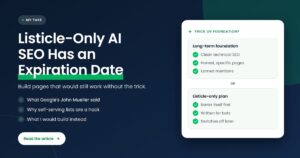

Quick answer: Google’s John Mueller says short-term tactics eventually stop working, and a strategy built only on listicles could switch off as AI systems change. I agree. Self-serving “best X” lists are a short-term AI hack. I’d build pages that would still earn their place if the trick stopped working tomorrow, starting with solid technical SEO.
Key takeaways
- My position: a listicle that ranks your own business first is a shortcut aimed at chatbots, not at customers. It has an expiry date, and I wouldn’t build a plan on it.
- Search Engine Journal reported on November 2, 2026 that Mueller told David Iwanow listicles aren’t automatically spam, but they need to add value.
- Mueller also said many AI systems build on SEO, and that technical SEO in particular will stay very relevant.
- He warned businesses to question what their SEO vendors are doing, because old spam tactics are being sold again under an “AI SEO” label.
- Google’s spam policies now name attempts to manipulate generative AI responses in Search, so this isn’t only a ranking question anymore.
- What I’d do instead: fix the technical basics, publish honest pages with real proof, and earn mentions from people who don’t work for you.
What did Google’s John Mueller say about listicles and AI SEO?
In an interview with David Iwanow, reported by Search Engine Journal on November 2, 2026, Google’s John Mueller said short-term tactics eventually stop working. He said listicles aren’t automatically spam but must add value, and that a strategy built only on listicles could stop working as AI systems keep changing.
Roger Montti’s write-up in Search Engine Journal covers the main points. Mueller said short-term tactics “always have an expiration date”, and that search systems often swing from embracing a tactic to treating it as spam. On a plan that leans entirely on listicles, his warning was blunt: “at some point that’s going to switch off.”
He didn’t tell people to stop experimenting. His point was that the goal should be a site that search engines and AI systems will want to show people in the long run, and he called a serious, stable foundation the most critical part. I couldn’t find a public link to the original interview, so I’m relying on Search Engine Journal’s reporting of what Mueller said.
What did he say about technical SEO and AI search?
Mueller said many AI systems build on SEO, so SEO stays relevant, and that technical SEO in particular will remain very relevant. He added that AI systems may crawl a little differently because they have different goals, but he described that as another flavor of technical SEO, not a new discipline.
That fits what I wrote when I asked whether GEO is just SEO with a new name. The labels keep changing. The work underneath them, making a site easy to crawl, easy to understand and worth citing, mostly doesn’t.
What did he say about SEO vendors?
Mueller said questionable tactics aren’t new. Some SEOs used them for regular search and now do the same for AI search, with examples as old as keyword stuffing and white text on a white background. His advice to businesses was not to take a vendor’s word for it, and to keep questioning what vendors actually do.
Montti added his own observation that people new to SEO are rediscovering old tactics such as cloaking, directories, reciprocal links and listicles, and presenting them as new. I see the same pattern in sales pitches. The packaging says “AI visibility”. The contents would have looked familiar in 2010.
What is a self-serving listicle?
A self-serving listicle is a “best X” article in which the publisher ranks its own business or products at or near the top. It looks like an independent comparison, but the company writing it is also one of the options. Lately these lists are written partly to shape what AI chatbots recommend when people ask for the best provider.
In her February 2026 analysis for Search Engine Journal, Lily Ray defined self-promotional listicles as “best” articles where a company ranks itself or its own products first, and described a related habit of companies naming each other in their lists. Not every listicle is like this. A genuinely independent comparison with clear criteria, honest limitations and no stake in the outcome is a different thing.
Why do I think self-serving listicles are a short-term AI hack?
Because they’re built to influence a machine, not to help a buyer decide. The value to a reader is close to zero when the author picks themselves first. They worked for a while because AI tools pulled from whatever ranked, and that gap is exactly what Google and AI companies are now closing.
Three things make me confident this window is narrowing:
- Google has said it is aware of them. Search Engine Roundtable reported in April 2026 that a Google spokesperson, Jennifer Kutz, told The Verge that Google applies protections against common manipulation in Search and Gemini and is aware of low-quality listicle content.
- Some sites using them lost visibility. Lily Ray tracked several large, mostly software brands whose visibility dropped sharply in early 2026, with company blogs full of self-promotional listicles driving much of the loss. One large B2B brand fell 49% in her Sistrix visibility measurement. She was careful to say this is correlation, not a confirmed cause.
- Google’s rules now mention AI answers. Google’s spam policies include attempts to manipulate generative AI responses in Google Search, and list using AI tools to produce many pages without adding value as scaled content abuse.
Put those together with Mueller’s comments and the direction is clear to me. A tactic that depends on AI systems not noticing it is a tactic with a countdown on it.
How does a listicle-only plan compare with a long-term foundation?
A listicle-only plan bets on one format that AI tools happen to reward today. A long-term foundation bets on things every search system has rewarded for years: a site that works technically, pages that answer real questions, and other people vouching for you. One needs constant replacement. The other compounds.
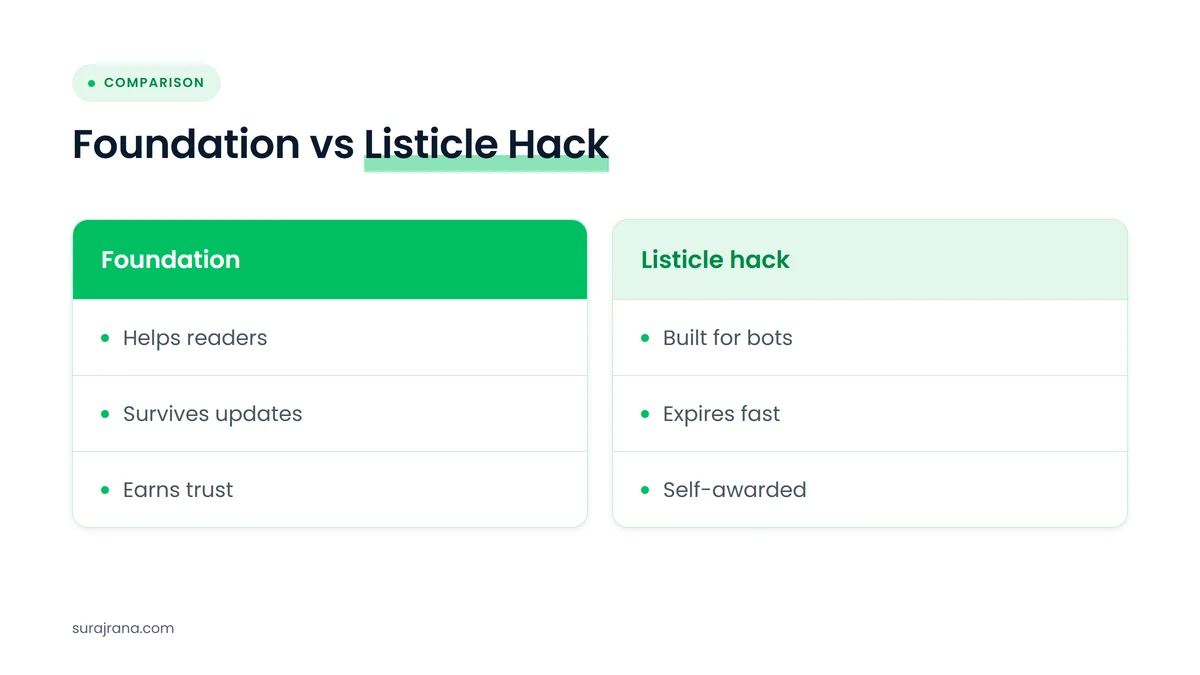
| Factor | Listicle-only AI SEO | Long-term foundation |
|---|---|---|
| Who it’s written for | AI tools and ranking systems | The person deciding who to hire |
| Main asset | A list where you rank yourself first | Fast, crawlable pages with real answers and proof |
| Trust signal | Your own claim about yourself | Reviews, mentions and links from others |
| Risk when systems change | High, as Mueller warned | Low, because it doesn’t rely on a loophole |
| What happens if a reader checks | They see the author is also the winner | They find evidence that holds up |
| How you’d measure it | Appearing in a chatbot answer | Calls, bookings, enquiries and branded searches |
Is every listicle a bad idea?
No. A listicle is just a format, and Mueller said himself that listicles aren’t automatically spam. A comparison of options with stated criteria, honest drawbacks and no hidden stake can be genuinely useful. The problem is a whole strategy built on lists that exist mainly to put the author at the top.
This is the fair version of the other side. “Best X” searches are real, people do want shortlists, and AI tools do look for comparison content when answering them. If you publish one, I’d hold it to a simple standard: would a skeptical reader still find it useful after noticing who wrote it? If you rank yourself first with no evidence and no downsides, the answer is no. If you explain who each option suits, including when you’re not the right fit, it might be yes.
So my objection isn’t to the format. It’s to treating a format as a strategy, and to paying for a plan that falls over the moment one tactic stops working.
What does this mean for dental practice owners?
For dental practices, it means being wary of anyone selling “get recommended by ChatGPT” packages built on lists. A practice listing itself as the best dentist in town on its own blog fools nobody who reads it, and it gives AI tools nothing they can verify. Reviews, complete treatment pages and a clean site do that job far better.
Patients choosing a dentist are making a health and money decision. That raises the bar for trust, not lowers it. I’ve argued before about why Google is cracking down on generic dental website content, and self-ranking lists sit in the same bucket: written for search, not for the patient. If you want the practical side of earning AI citations the honest way, Dental Master Media has a guide on getting a dental practice cited inside AI Overviews, not just ranked.
What does this mean for agency owners?
For agencies, it means the “AI SEO” line on a proposal now carries a credibility test. If the deliverable is mostly listicles, reciprocal mentions or pages built for bots, the client is paying for something with a short shelf life. Agencies that sell foundations will have an easier conversation when the next update lands.
It also means clients are more likely to ask hard questions, because Google’s John Mueller is now telling them to. I’d welcome that. I stopped leading with rankings for a similar reason, which I wrote about in why I stopped selling keyword rankings. If you resell SEO, it’s worth reading the red flags to look for in a white-label SEO report before a client spots them first.
How should you check an AI SEO vendor’s claims?
Ask vendors to show exactly what they will publish, where, and why it helps a real customer. Ask whether any content is hidden, shown differently to bots, or placed on sites they control. Ask how they’ll measure leads. A good vendor answers plainly. A vague answer is your answer.
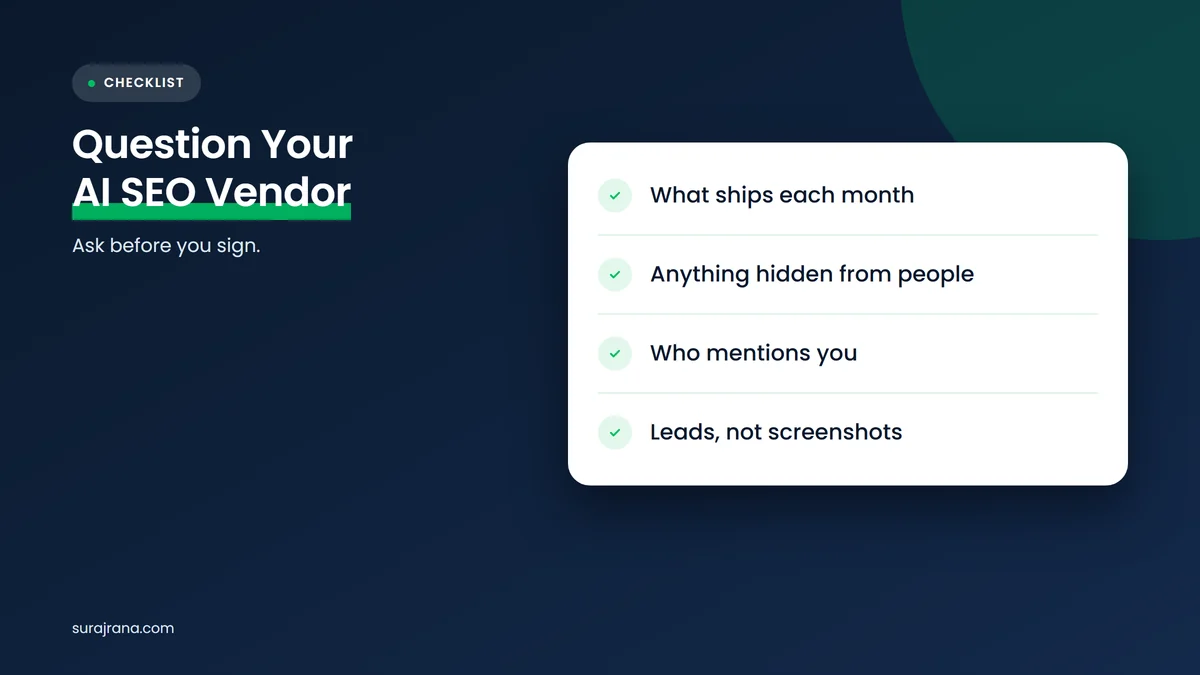
- What exactly ships each month? Ask for examples of real deliverables, not “AI optimization” as a line item.
- Is anything hidden or shown only to bots? White text, cloaked pages for AI crawlers and keyword stuffing are old spam with new names.
- Who will mention or link to you, and why? If the answer is the vendor’s own network or a ring of swapped listicles, walk away.
- How will results be measured? Calls, bookings, enquiries and branded searches should come before screenshots of a chatbot answer.
What would I build instead?
I’d build the things that would still work if every AI shortcut stopped working tomorrow. That means a technically sound site that crawlers can read easily, pages that answer what customers actually ask with real proof, and a reputation that other people express for you through reviews, mentions and links.
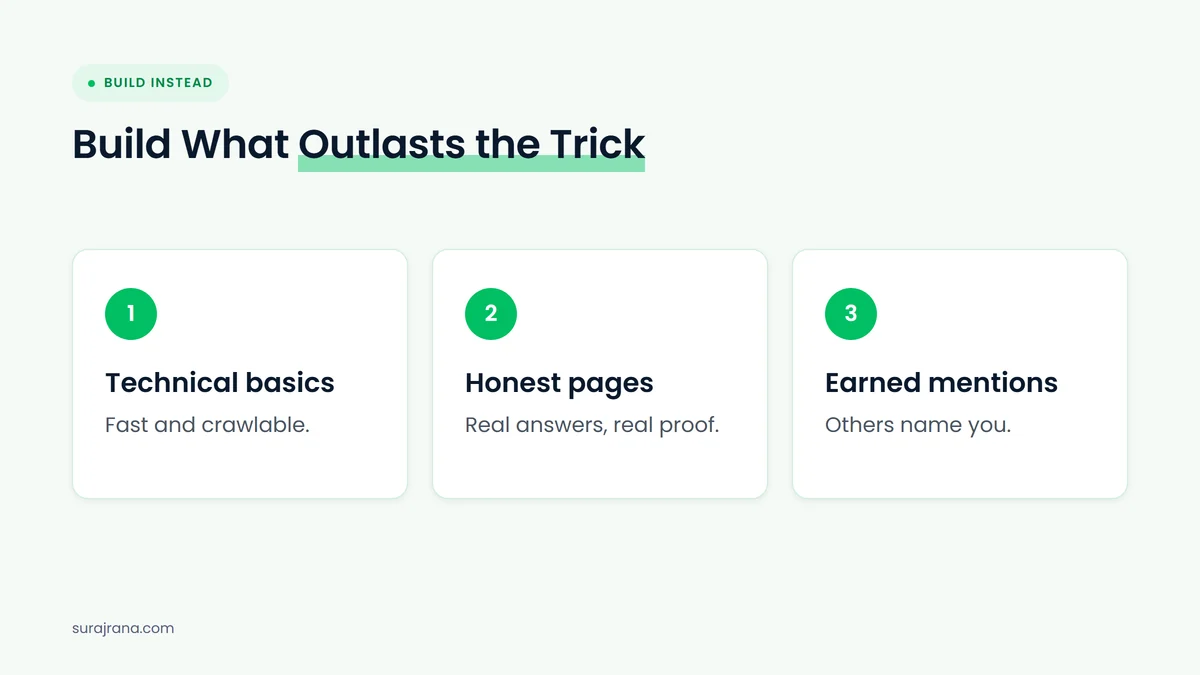
- Technical basics first. Pages that load quickly, can be crawled, carry clear structure and don’t hide content behind scripts. Mueller’s point that technical SEO stays very relevant is the least glamorous and most useful part of the interview.
- Honest, specific pages. Service pages that explain who it suits, what it costs and what to expect, written by someone who does the work. If you compare options, say when you’re not the best fit.
- Earned mentions. Reviews from real customers, local press, partner pages and industry sites that name you because they chose to. That is the kind of signal a self-written list can’t fake.
None of this is new, and that’s the point. When a Google representative describes the newest tactic as something with an expiration date, the safest move is the boring one.
Frequently asked questions
Are listicles spam according to Google?
Not automatically. According to Search Engine Journal’s November 2026 report, John Mueller said listicles shouldn’t automatically be considered spam but need to add value. The risk is in lists made mainly to manipulate rankings or AI answers, such as a company ranking itself first with no real evidence.
Do self-promotional listicles still work for AI search?
They may still appear in some AI answers, but I wouldn’t rely on them. Google has said it is aware of low-quality listicle content, Mueller warned an all-listicle strategy could switch off, and Lily Ray found visibility drops at several sites that used them heavily in early 2026.
Is technical SEO still important for AI search?
Yes. Mueller said many AI systems build on SEO and that technical SEO in particular will remain very relevant. AI crawlers may behave a little differently from Google’s search crawler, but he described that as another flavor of technical SEO rather than a replacement for it.
How can I tell if an SEO agency is selling old spam as AI SEO?
Ask for specific deliverables, where they will appear and how they help a real customer. Be wary of hidden text, pages shown only to bots, mass-produced lists, link swaps and reports that show chatbot screenshots instead of leads. A good agency explains its work plainly and welcomes questions.
Should a small business publish a “best of” list at all?
It can, if the list would still be useful to a skeptical reader. State your criteria, include honest drawbacks for every option, and say who each one suits, including when you’re not the right fit. If the list only exists to put you first, skip it.
My bottom line on listicle-only AI SEO
I think self-serving listicles are a short-term AI hack, and Mueller’s comments are about as clear a warning as Google gives. Experiment if you like, but don’t build your visibility on a trick that depends on AI systems not noticing it. Build pages that would earn their place without it.
That’s the approach behind my dental SEO services: technical basics, honest pages and a reputation people can check. You can read more of my opinions on search and AI on surajrana.com.
Not sure what your “AI SEO” is actually doing?
I’m Suraj Rana. If you’re paying for AI visibility and can’t tell whether it’s a foundation or a trick, I’m happy to look at it with you. Through my dental SEO services and Dental Master Media, my team and I build search visibility that doesn’t depend on a loophole.
Sources
- Search Engine Journal (Roger Montti), “Google Says Technical SEO Remains Key For AI SEO”, November 2, 2026. https://www.searchenginejournal.com/google-says-technical-seo-remains-key-for-ai-seo/595550/
- Search Engine Roundtable (Mordy Oberstein), “Google Is Aware Of And Warns Against Self-Serving Listicles”, April 14, 2026. https://www.seroundtable.com/google-warns-against-trying-to-manipulate-llms-41156.html
- Search Engine Journal (Lily Ray), “Is Google Finally Cracking Down On Self-Promotional Listicles?”, February 5, 2026. https://www.searchenginejournal.com/is-google-finally-cracking-down-on-self-promotional-listicles/566529/
- Google Search Central, “Spam policies for Google web search”, accessed November 8, 2026. https://developers.google.com/search/docs/essentials/spam-policies

My name is Suraj Rana, and I am a seasoned Dental SEO Expert with extensive experience in the Dental SEO industry. Leveraging my deep knowledge and expertise, I help dental practices enhance their online visibility and attract more patients.