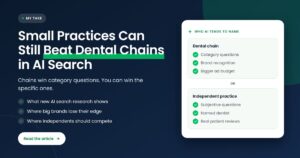

Quick answer: Yes. Big brands do dominate AI answers for clearly defined, category-style questions, but new research shows that dominance weakens on subjective, experience-based questions. That is where an independent practice can compete: specific expertise, real patient experience and a strong local profile, not a bigger budget or a louder brand.
Key takeaways
- My position: an independent dental practice can’t out-brand a dental chain in AI search, but it can out-specific one, and that is the contest worth entering.
- BrightEdge’s October 2026 travel study found big brands leading the category answers in both Google AI Overviews and ChatGPT, with the leading brands holding roughly a quarter to a third of visibility in their categories.
- Search Engine Journal’s read of that study is that subjective questions see less big-brand domination, and that content with human experience behind it does better there.
- Google’s own local ranking factors are relevance, distance and prominence. Two of those three have nothing to do with how many locations you own.
- Google says there are no special optimizations needed to appear in AI Overviews or AI Mode, so the fundamentals a small practice can control still decide most of the outcome.
What do I mean by competing with dental chains in AI search?
By competing with dental chains in AI search, I mean an independent practice being named, cited or recommended when a patient asks Google AI Overviews, AI Mode or ChatGPT a question about dental care nearby. That includes questions about treatments, costs, nervous patients and which dentist to choose, not only “dentist near me”.
When I talk about dental chains here, I mean groups that run many locations under one brand, often with a central marketing team, one large website and a lot of brand recognition. The independent practice is usually one or two locations, one website and a dentist whose name patients actually know.
AI answers don’t have a page one in the old sense. BrightEdge measures them by share of voice, which is how often a brand appears across a set of tracked AI answers. That is a useful way to think about this question: not “can I rank first?”, but “how often does my practice show up in the answers patients read?”
Do big brands really dominate AI search answers?
For clearly defined categories, yes. When a question has an obvious set of well-known answers, AI engines lean heavily on the biggest names in that category. The latest evidence comes from travel rather than dentistry, but the pattern is clear enough that I’d expect a version of it in any category with recognizable national brands.
BrightEdge’s holiday travel study looked at US English travel prompts in Google AI Overviews and ChatGPT between August and September 2026. American Airlines, Royal Caribbean and Expedia led their categories on both engines. Hilton led hotels in Google AI Overviews at 28.3%, while Marriott led in ChatGPT at 29.4%. Among booking platforms, Expedia led Google AI Overviews at 31.3%, against 14.4% for Kayak.
BrightEdge is careful to say these figures show observed visibility, not bookings or market share. I’ll be equally careful: this is a travel study, and nobody has published the same analysis for dental chains. What it does show is how AI engines behave when a category has a short list of famous brands. They name the famous brands.
Where do smaller sites still win in AI answers?
Smaller sites still win on subjective questions, the ones where people want judgment, experience or an opinion rather than a list of the biggest names. In the travel data, inspiration questions were less dominated by big brands and leaned more on sources with a human, first-hand quality to them, such as forums and video.
In Search Engine Journal’s write-up of the study on October 31, 2026, Roger Montti points out that BrightEdge found YouTube, Reddit and AAA more prominent in inspiration questions. His conclusion is that there is an opening for smaller brands wherever human experience and subjective, experience-based opinion are what people are looking for.
BrightEdge’s data also shows how intent changes who gets named. In Google AI Overviews, booking platforms appeared in 12% of inspiration prompts, 25% of comparison prompts and 38% of booking-intent prompts. The closer a question gets to “just tell me the big option”, the more the big brands take over. The more it asks “what is this actually like?”, the more room there is for everyone else.
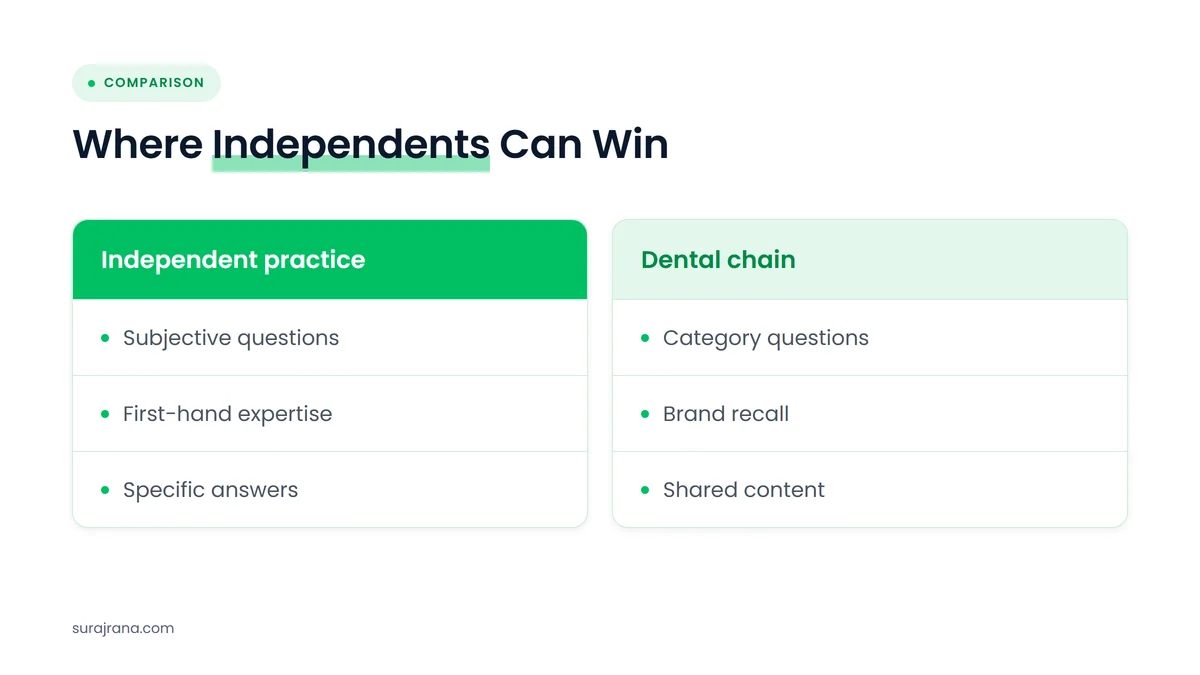
Now translate that to dentistry. “Dental clinic open on Saturday” is a category question. “Which dentist near me is good with anxious patients?”, “Is it worth seeing a specialist for a failed implant?” and “What is it like getting veneers at a small practice?” are not. Those are subjective questions, and they are where I think an independent practice has the better story to tell.
Why do I think small dental practices can still beat chains?
I think small practices can still beat chains because the things AI answers reward on subjective local questions are things a single practice often does better: a named dentist with real experience, reviews that describe actual visits, specific answers to specific questions and a profile that matches exactly what the practice offers. Scale doesn’t buy any of those.
Does local search favor big dental brands?
Not by design. Google says local results are based mainly on relevance, distance and prominence. A chain’s brand can help prominence, but each chain location is still one location competing on its own relevance and its own distance from the person searching, exactly like the independent practice down the road.
Google’s local ranking help page defines relevance as how well a Business Profile matches what someone is searching for, distance as how far each business is from the searcher, and prominence as how well-known a business is. It adds that prominence also draws on how many websites link to the business and how many reviews it has, and that more reviews and positive ratings can help. It also says there is no way to request or pay for a better local ranking.
That last line matters to me. A chain can outspend you on ads and brand campaigns. It can’t buy its way up the local results. On the factor of distance, it is a straight fight, location by location.
Do you need special tricks to appear in AI Overviews?
No. Google says there are no additional requirements or special optimizations needed to appear in AI Overviews or AI Mode. A page has to be indexed and eligible to show in Search with a snippet. That means the same fundamentals that help an independent practice in normal search also decide whether it can appear in Google’s AI answers.
Google’s guidance on AI features and your website, last updated in December 2025, says this plainly. It also explains that these features may run several related searches across subtopics to build a response, which Google calls query fan-out. I read that as good news for specific practices. A detailed question gets broken into detailed sub-questions, and detailed pages are what answer them.
Why does first-hand experience matter so much here?
First-hand experience matters because it is the one thing a chain’s central content team can’t copy at scale. Google’s helpful content guidance asks whether content shows first-hand expertise and depth of knowledge, and the travel research suggests human experience is exactly what earns visibility on subjective questions.
Google’s guide to helpful, people-first content, last updated in October 2026, lists first-hand expertise among its self-assessment questions. A chain website often has one implant page written for fifty locations. An independent practice can have an implant page written by the dentist who places the implants, describing how they plan cases, who they refer out and what patients usually ask in the consultation. That is a different kind of page, and I think it is a better answer to a subjective question.
How do dental chains and independent practices compare in AI search?
Dental chains and independent practices have different strengths in AI search. Chains have brand recognition, bigger budgets and more links. Independents have a named dentist, closer patient relationships and the freedom to be specific. The table below sums up how I see the trade-off on the factors that matter for AI answers.
| Factor | Dental chain | Independent practice |
|---|---|---|
| Brand recognition | Strong, often regional or national | Local, built on the dentist’s name |
| Category questions (“dentist open Saturday”) | Likely advantage from brand and scale | Competes mainly on distance and profile relevance |
| Subjective questions (“good with nervous patients”) | Content usually generic across locations | Can answer from real chair-side experience |
| Distance to the searcher | Same as anyone, one location at a time | Same as anyone, one location at a time |
| Reviews | Spread across many locations and dentists | Concentrated on one practice and one team |
| Speed of change | Central approvals, brand rules | The owner can decide and publish this week |
| Paid ads and brand campaigns | Bigger budgets | Smaller budgets, but local results can’t be bought |
What is the strongest argument that chains will win anyway?
The strongest argument is that AI engines lean on the most recognized, most linked and most talked-about brands, and chains have more of all three. If AI answers keep favoring famous names, the independent practice could get squeezed out of more questions over time. I take that argument seriously, and parts of it are right.
Here is the fair version, point by point:
- Prominence is real. Google’s own help page says prominence includes links and reviews, and a chain with dozens of locations and a big website can collect more of both.
- Category questions are common. BrightEdge found inspiration and comparison questions made up most of its travel panel, but many dental searches are simple category searches, and those suit the big brands.
- Brand campaigns create brand searches. Montti’s advice to brands in the SEJ piece is to build awareness and trust, and chains have the budget to do that.
- Consistency at scale is easier for some chains. A central team can keep every listing and page in the same format across all locations.
My answer: all of that is true for the questions that suit a chain. It is much less true for the questions that suit you. I’d rather an independent practice owned twenty specific, experience-led questions than fought a chain for one generic one.
Where should an independent practice compete first?
An independent practice should compete first where scale helps least: its Google Business Profile for the services it actually offers, pages written from the dentist’s own experience, reviews that describe real visits and clear answers to the subjective questions patients ask before choosing a dentist. This is an opinion piece, so I’ll keep it to priorities rather than a full how-to.
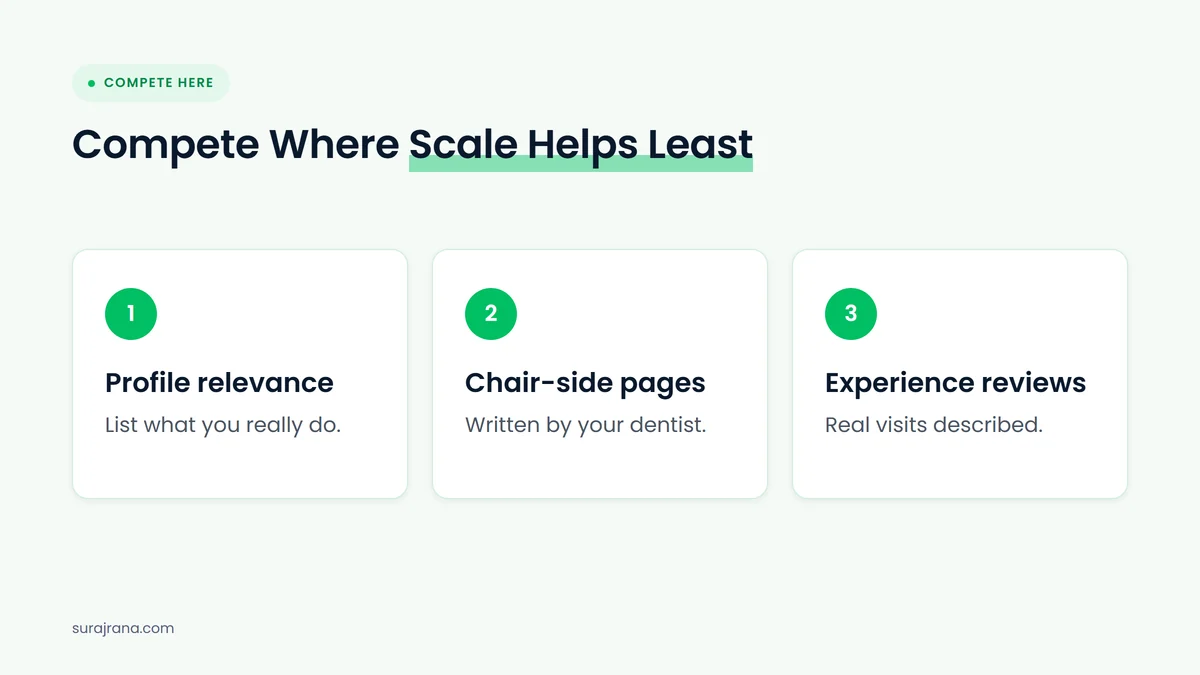
- Make your profile match what you really do. Relevance is the first factor on Google’s list. I’ve argued before that your Business Profile services list decides whether AI recommends you, and that matters even more when a chain lists everything at every location.
- Write from the chair, not from a template. Treatment pages and answers that only your dentist could have written are your strongest response to a chain’s shared content.
- Earn reviews that describe the experience. Google says more reviews and positive ratings can help local ranking. Ask patients to say what the visit was like, not just to leave stars.
- Be the same practice everywhere. Your name, services and details should match across your site, profile and listings. I’ve written about why brand consistency decides whether AI recommends your clinic.
- Own your website. Every one of these steps is easier when you control your own site and can change it this week. That is part of why I think every dental practice should own its website.
For the practical side of chain competition in normal local results, Dental Master Media has a guide on whether corporate dental chains are taking over local Google rankings.
How can you tell if a chain is beating you in AI answers?
You can tell if a chain is beating you by asking AI tools the questions your patients ask, in your own area, and noting who gets named. Do it for category questions and subjective questions separately. If the chain wins both, you have a profile and content problem. If it wins only the category questions, that is normal.
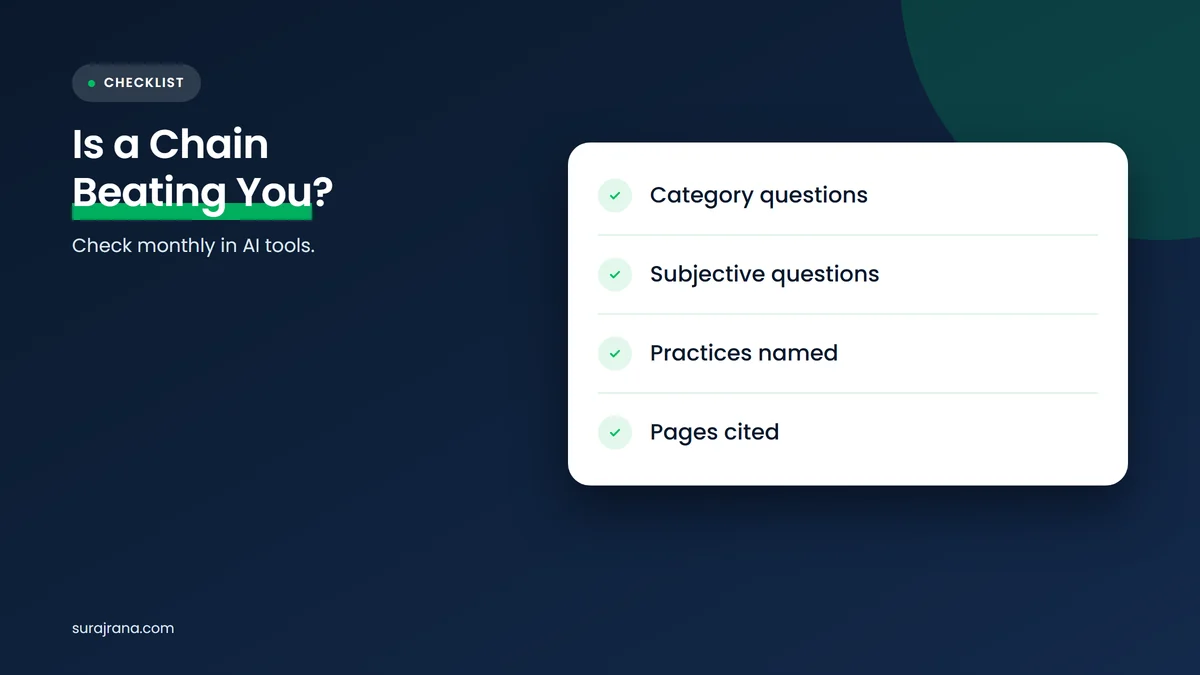
- Write down ten questions patients ask before booking: five category questions and five subjective ones.
- Ask each one in Google AI Mode and ChatGPT, adding your town or neighborhood.
- Note which practices are named and which pages are cited, and repeat the check every month, because AI answers change.
- Compare your Business Profile services, reviews and pages against the practices that keep appearing.
- Fix the gap on the subjective questions first. That is where the research suggests the opening is.
I’d also be honest about what this check can’t tell you. AI answers vary between sessions and people, so treat it as a pattern over several weeks, not a single verdict.
Frequently asked questions
Can a single-location dental practice appear in AI Overviews?
Yes. Google says there are no special requirements to appear in AI Overviews or AI Mode beyond being indexed and eligible to show with a snippet. A single-location practice with clear, specific, accurate pages can be cited just like a large group, especially on detailed questions.
Do dental chains rank better in Google’s local results?
Not automatically. Google bases local results mainly on relevance, distance and prominence. A chain’s brand may help prominence, but each location competes on its own relevance and distance. Google also says there is no way to request or pay for a better local ranking.
Is the BrightEdge study about dental search?
No. It covers US holiday travel prompts in Google AI Overviews and ChatGPT. I use it because it is recent evidence on how AI engines treat big brands versus subjective questions. I expect a similar pattern in dentistry, but no one has published the dental version yet.
What kind of questions give independent practices the best chance?
Subjective, experience-based questions give independent practices the best chance. Questions about anxious patients, what a treatment feels like, when to see a specialist or how a practice handles complex cases reward first-hand expertise, which a named dentist can show and a chain’s shared content often can’t.
Should a small practice try to out-advertise a dental chain?
I wouldn’t. A chain will usually have the bigger ad budget, and paid ads don’t change local rankings. A small practice gets more from making its profile, reviews and pages specific and accurate, so it becomes the obvious answer to the questions it is best placed to answer.
My bottom line on chains and AI search
I don’t think the independent dental practice is losing AI search to the chains by default. It is losing the generic questions, which it was never going to win, and leaving the specific ones unclaimed. The research says big brands dominate defined categories and leave room on subjective questions. That is a clear map of where to fight.
Stop trying to look like a smaller chain. Be the practice with the named dentist, the honest answers and the reviews that describe real visits. If you want to see how I approach this work, read about my dental SEO services on surajrana.com.
Worried a chain is crowding you out?
I’m Suraj Rana, and if you can’t tell whether AI tools are recommending your practice or the chain down the road, I’m happy to look at it with you. Through my dental SEO services and Dental Master Media, my team and I help independent practices compete on the questions they are best placed to answer.
Sources
- Search Engine Journal (Roger Montti), “Big Brands Dominate AI Search But Leave Openings For Smaller Sites”, October 31, 2026. https://www.searchenginejournal.com/big-brands-dominate-ai-search-but-leave-openings-for-smaller-sites/595397/
- BrightEdge, “Holiday Travel in AI Search: The Travel Brands AI Puts on Its List”, October 2026. https://www.brightedge.com/resources/research-reports/holiday-travel-ai-search
- Google Business Profile Help, “Tips to improve your local ranking on Google”, accessed November 8, 2026. https://support.google.com/business/answer/7091
- Google Search Central, “AI features and your website”, last updated December 10, 2025. https://developers.google.com/search/docs/appearance/ai-features
- Google Search Central, “Creating Helpful, Reliable, People-First Content”, last updated October 5, 2026. https://developers.google.com/search/docs/fundamentals/creating-helpful-content

My name is Suraj Rana, and I am a seasoned Dental SEO Expert with extensive experience in the Dental SEO industry. Leveraging my deep knowledge and expertise, I help dental practices enhance their online visibility and attract more patients.