
Quick answer: Google is testing an AI summary above the block of sponsored results that sums up every advertiser’s ads, plus an AI-written description under each ad. It is a test, not a rollout, and Google hasn’t commented. My take: when Google writes the words beside your ad, your website becomes your real ad copy.
Key takeaways
- Search Engine Roundtable reported on November 9, 2026 that Google is testing an AI summary above the sponsored results and an AI-generated description below each ad, spotted on mobile by Brodie Clark.
- This is a test. The report includes no statement from Google, and nobody outside Google knows if it will ship.
- It follows two earlier tests in July 2026: AI summaries under single search ads, then AI descriptions on Shopping ads.
- Google’s own Google Ads Help page already says advertisers can’t write, edit, approve or opt out of the AI text it adds to some ads in AI Overviews and AI Mode.
- My opinion: if this ships, the text that sells your ad is no longer only the text you wrote. The pages Google can read about you start doing the selling.
What are Google’s AI-generated ad summaries?
Google’s AI-generated ad summaries are short pieces of text, written by Google’s AI rather than the advertiser, that sit around paid search ads. In the newest test there are two kinds: one summary above the whole sponsored block covering all the advertisers, and one description under each individual ad.
A normal search ad is made of text the advertiser writes: headlines, descriptions and assets such as sitelinks. The advertiser picks the words, tests them and pays when someone clicks. An AI summary adds a layer that the advertiser didn’t write, placed right next to the words they did.
In plain terms, Google is starting to explain the ads to the searcher in its own voice. That is the part I want to talk about.
What exactly did Google test, and is it live for everyone?
It isn’t live for everyone. Brodie Clark shared the test in his SERP Alert notes on November 8, 2026, writing that Google’s mobile sponsored results are “increasingly becoming more generative.” Search Engine Roundtable covered it the next day. The example shows a summary over the ad block, a description per ad and a loading animation.
Here is what the reporting says, and what it doesn’t:
| Question | What the reporting says | Status |
|---|---|---|
| What is new? | An AI summary above the sponsored block covering all advertisers’ ads | Seen in a test |
| What else is there? | An AI-generated description below each ad | Seen in a test |
| Where was it seen? | Google mobile search results | Reported with a video |
| Has Google commented? | No statement in the report | Unknown |
| Is it rolled out? | No sign of a wide rollout | Test |
Barry Schwartz’s write-up is Google Ads AI-Generated Summaries Above & Within Search Ads. He also said he wasn’t sure a summary above the ads had been seen before, which is why this one caught my attention.
How did we get here?
We got here in three steps over about four months. In July 2026 Google tested AI summaries under single search ads. Later that month it tested AI descriptions on Shopping ads. Now, in November, the summary has moved above the whole ad block and covers every advertiser at once.
- July 1, 2026: AI summaries under search ads. Search Engine Roundtable reported AI-generated summaries showing below the ad description, with a note that Google’s AI responses can make mistakes. A Google spokesperson called it “a small experiment” to see if AI context helps people make more informed decisions.
- July 30, 2026: AI descriptions on Shopping ads. Brodie Clark spotted AI-generated descriptions on sponsored products on mobile. The report noted advertisers’ worry that the AI text could lower click-through rates.
- November 8 and 9, 2026: one summary for all the ads. The new test adds a summary across the whole sponsored block, on top of a description per ad.
Each step on its own looks small. Together they show a direction: Google wants its AI to stand between the searcher and the ad copy.
Is AI-written text in ads already official anywhere?
Yes, in Google’s AI search surfaces. Google’s Ads Help page on ads in AI Overviews and AI Mode says some placements include “AI explainers”, short independent text generated by Google’s Gemini models to give context about an ad. Advertisers can’t write, edit, approve or opt out of them. The new test looks like the same idea on the normal results page.
The page is About ads in AI-powered experiences in Google Search. Two lines matter for this post. First, advertisers “can’t manually write, edit, approve, or opt out of” the AI explainers. Second, Google says ads are labeled “Sponsored” and that paid advertising doesn’t influence its organic AI responses.
I’m careful not to claim the November test uses the same system, because Google hasn’t said so. But the policy is already written down for AI Mode and AI Overviews, so I’d expect the same rules if a version of this test ships on normal results.
What do AI ad summaries mean for businesses paying for clicks?
For businesses paying for clicks, AI ad summaries mean less control over the message next to the ad. You still bid, write headlines and pay per click, but a summary you didn’t write may shape how a searcher reads you first. A summary covering all the ads also makes it easier to compare you with every competitor in one glance.
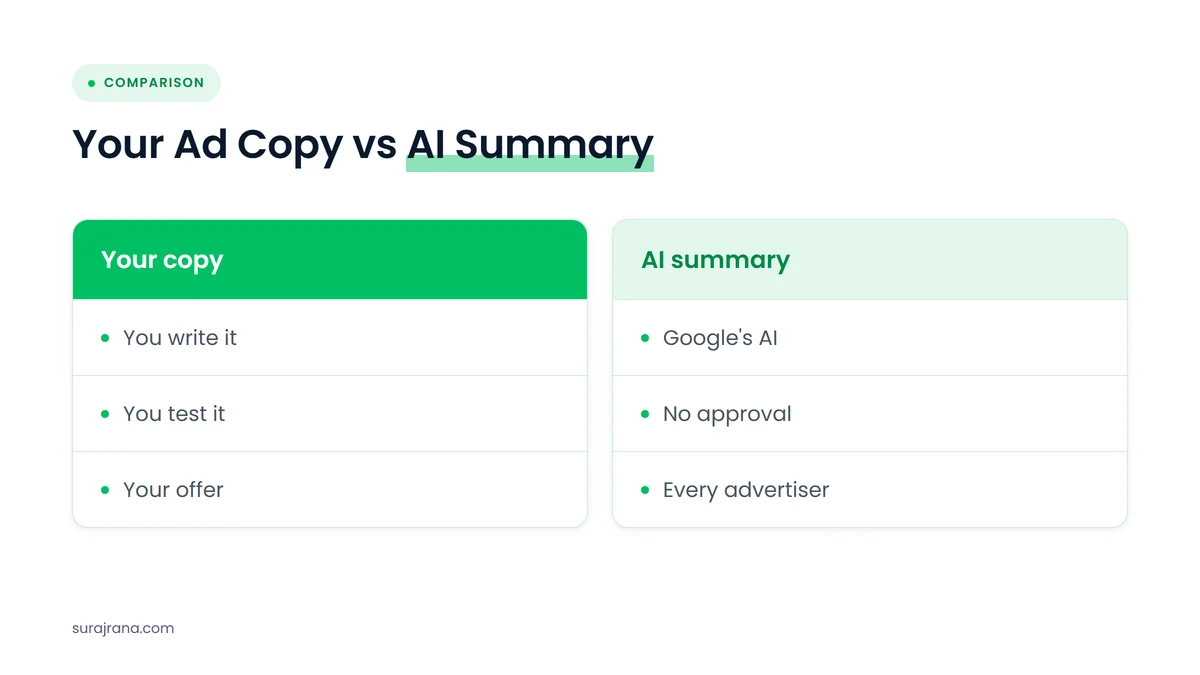
Here is how I see the trade-off for an advertiser:
| Part of the result | Your ad copy | Google’s AI summary |
|---|---|---|
| Who writes it | You or your agency | Google’s AI |
| Can you test versions? | Yes | Not that has been reported |
| Can you approve it? | Yes | For AI explainers in AI Mode, Google says no |
| What it compares | Only your offer | In the new test, every advertiser in the block |
| What you pay for | The click | Nothing extra has been reported |
For a dental practice, picture a search for implants. If a summary above the ads lines up three practices side by side, the clever headline matters less. What matters is whether Google can find something clear and specific to say about you. I’ve argued before that rising dental Google Ads costs make SEO the smarter long-term bet, and this test pushes me further that way.
What do AI ad summaries mean for organic results?
For organic results, the clearest effect is space. A summary above the ads, plus a description under each one, makes the sponsored block taller, and on a phone that pushes the first organic link further down. That is my reading of the layout, not a measured number, and the test may change before anything ships.
There is a second, quieter effect. If Google’s AI is summarizing ads, it wants something to summarize. The more Google can read about a business, the more there is to say. That means the same things that help organic visibility, a clear website, complete service pages and a complete Google Business Profile, may start to shape the paid result too.
I’ve written that most patients searching for a dentist never click a single result anymore. Every extra block of AI text on the page adds to that pattern, whether the text is organic or paid.
Why do I think your website becomes your real ad copy?
I think your website becomes your real ad copy because Google is moving toward writing the words searchers read about you, and its AI needs material to write from. An advertiser can’t fully control a summary, but they can control what their own pages say. The clearer those pages are, the less room there is for a vague summary.
This is the one opinion I’ll stand behind from this post. If Google writes the words next to your ad, your landing page and your website are now part of your ad, and a thin page is a weak ad no matter how good the headline is.
Here is the fair counter-argument, because it deserves a hearing:
- It’s a test. Google tests a lot of layouts that never ship, and this one has no official statement.
- We don’t know the inputs. Nobody outside Google has confirmed what the summaries draw on. Google calls its AI explainers “independent” text.
- Searchers may ignore it. Advertisers worried the July Shopping test could lower click-through rates, but nobody has published data on how searchers actually react.
I accept all three. That’s why my advice below doesn’t depend on this test shipping. Clear pages help your ads, your organic results and your AI visibility whether or not Google ever shows an AI summary above the ads.
What would I do now if I ran a practice or an agency?
If I ran a practice, I would make each paid landing page answer the whole decision for that treatment, keep my Google Business Profile complete and track calls and bookings by source. If I ran an agency, I would start checking how AI text describes each client’s ads and add that to reporting. None of it needs to wait for Google.
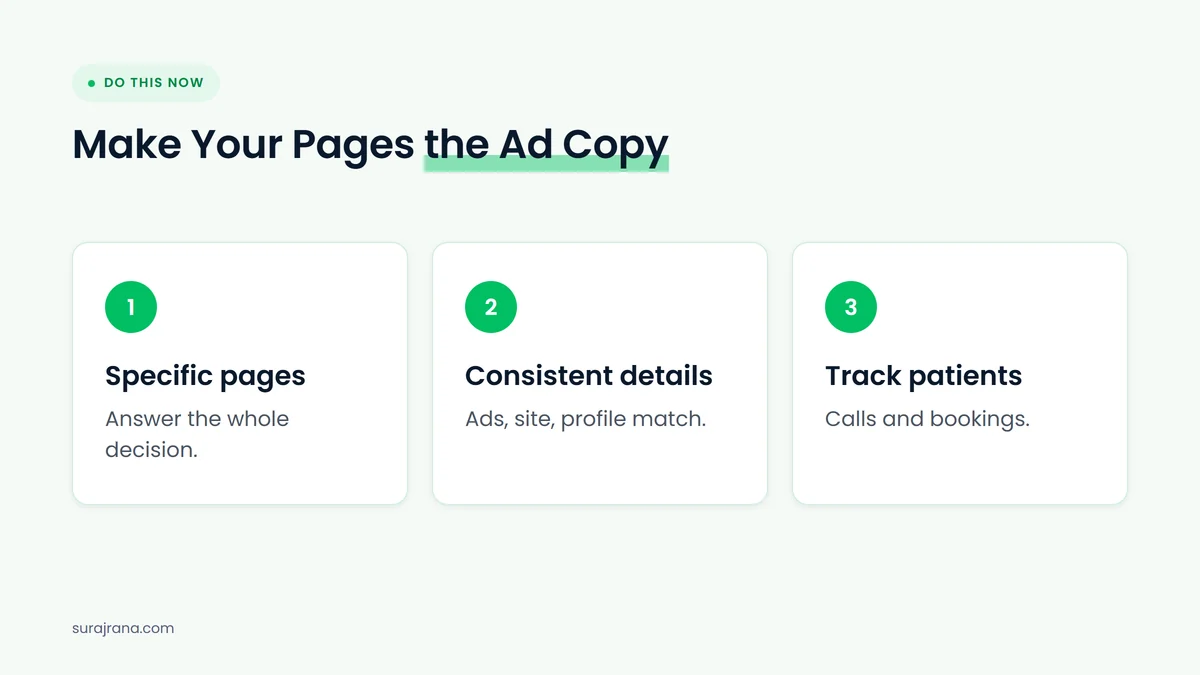
- Make every ad’s landing page specific. Who the treatment suits, how it works, how long it takes and how cost is worked out. A summary can only be as clear as what it has to work with.
- Say the same thing everywhere. Your ads, your website and your Google Business Profile should describe your services, hours and focus the same way, so no summary has to guess.
- Watch what Google writes about you. Search your main paid terms on a phone now and then, and note any AI text that appears around your ads.
- Judge ads by patients, not clicks. If AI text changes how people click, cost per click alone won’t tell you. Track calls, forms and booked appointments.
- Don’t pull budget over a test. Wait for an announcement from Google, then compare results in the weeks after any change.
This is the same thinking behind why I stopped selling keyword rankings: the scoreboard that matters is new patients, not a position or a click.
How can you tell if your landing pages are ready for AI summaries?
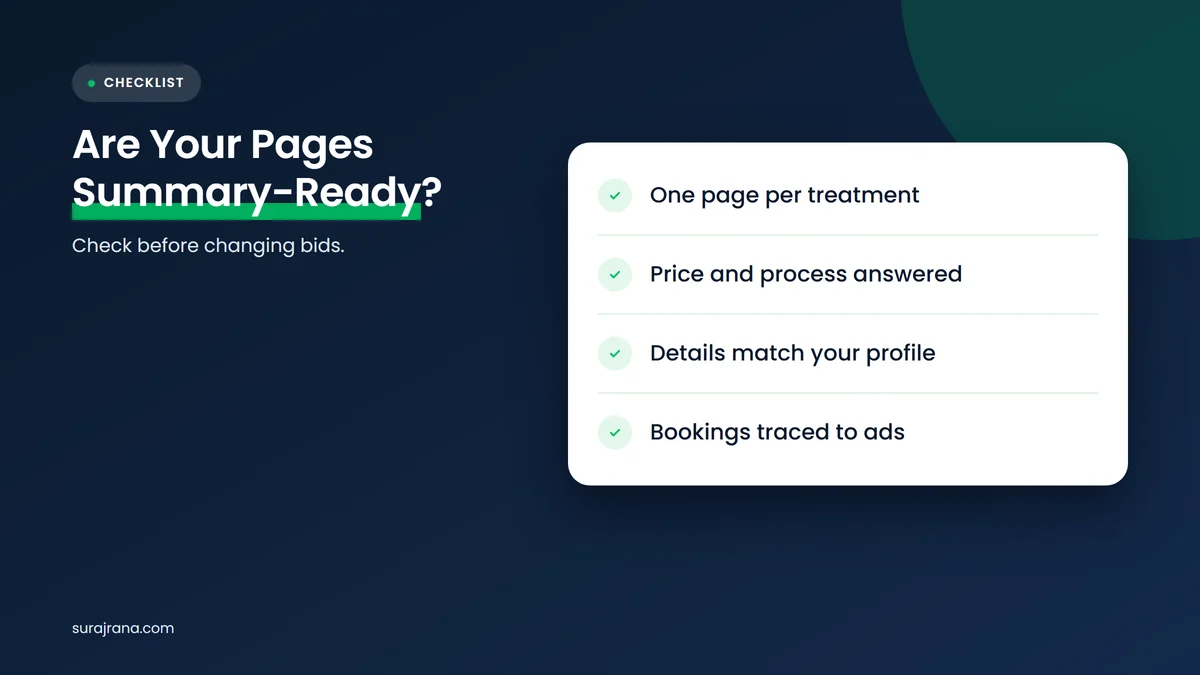
Your landing pages are ready for AI summaries if each paid treatment has its own page, the page answers price, process and suitability questions, your details match your Google Business Profile, and you can trace bookings back to the ad. If two or more of those are missing, fix them before changing bids.
If you want the dental-specific view of how ads are changing inside Google’s AI search, Dental Master Media has a breakdown of what up to four ads in Google AI Mode means for dental practices.
Frequently asked questions
Are Google’s AI ad summaries rolled out to everyone?
No. As of November 9, 2026, Search Engine Roundtable described the AI summary above the sponsored results as a test spotted on mobile, and the report included no statement from Google. Some searchers may see it and most won’t. Treat it as an experiment until Google announces otherwise.
Can advertisers edit or turn off AI summaries of their ads?
For this new test, nothing has been reported either way. For the AI explainers Google adds to some ads in AI Overviews and AI Mode, Google’s Ads Help page says advertisers can’t write, edit, approve or opt out of them. I would expect similar rules if a version of this test ships.
Do AI ad summaries cost advertisers more?
Nothing reported says so. Google’s Ads Help page says ads in its AI search experiences use the same auction and bidding as standard Search ads, with no extra charge to take part. The bigger question is whether AI text changes how often people click, and no data has been published on that yet.
Do AI ad summaries affect organic rankings?
Nothing suggests they change how organic pages rank. Google says paid advertising does not influence its organic AI responses. What a taller ad block can change is how far down the page the first organic result sits, especially on a phone, which can affect clicks even when rankings stay the same.
Should dental practices change their Google Ads because of this test?
Not because of the test alone. I would use it as a reason to check that every paid treatment has a clear, specific landing page and that ads are judged on calls and bookings. Those changes help today and still help if Google starts writing summaries of your ads.
My bottom line on AI summaries of search ads
Google’s AI ad summaries are a test, and I won’t pretend otherwise. But they fit a clear pattern: over four months, Google has moved from AI text under one ad, to AI text on Shopping ads, to one AI summary covering every advertiser. I’d rather practices and agencies prepare for Google writing about their ads than be surprised by it.
My advice is simple: make the pages behind your ads the clearest answers in your area, keep your details consistent everywhere, and judge every channel by the patients it brings in. That is how I approach dental SEO for practices, and you can read more about my work on surajrana.com.
Want a second opinion on your ads and landing pages?
I’m Suraj Rana. If you’re paying for clicks and not sure your landing pages would hold up when Google starts describing your ads for you, I’m happy to look at them with you. Through my dental SEO work and Dental Master Media, my team and I help practices turn searches into booked patients.
Sources
- Google Ads Help, “About ads in AI-powered experiences in Google Search”, accessed November 10, 2026. https://support.google.com/google-ads/answer/16297775
- Brodie Clark, “SERP Alert notes” (note dated November 8, 2026). https://brodieclark.com/notes/
- Search Engine Roundtable (Barry Schwartz), “Google Ads AI-Generated Summaries Above & Within Search Ads”, November 9, 2026. https://www.seroundtable.com/google-ads-ai-generated-summaries-42482.html
- Search Engine Roundtable (Barry Schwartz), “Google Ads Tests AI Generated Summaries Under Descriptions”, July 1, 2026. https://www.seroundtable.com/google-ads-ai-generate-summaries-41599.html
- Search Engine Roundtable (Barry Schwartz), “Google Shopping Ads With AI-Generated Descriptions”, July 30, 2026. https://www.seroundtable.com/google-shopping-ads-ai-generated-descriptions-41784.html

My name is Suraj Rana, and I am a seasoned Dental SEO Expert with extensive experience in the Dental SEO industry. Leveraging my deep knowledge and expertise, I help dental practices enhance their online visibility and attract more patients.