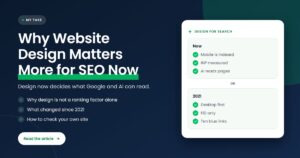

Quick answer: Yes, but not because Google added a “design” ranking factor. Design matters more because Google now indexes the mobile version of your site, measures how quickly pages respond to taps, and feeds AI answers from pages it can crawl and understand. When clicks are scarcer, the visitors who do arrive also judge your design faster.
Key takeaways
- My position: website design is now part of how search systems read your site, not just how patients feel about it. I’d stop treating a redesign and SEO as two separate budgets.
- Google is clear that there is no single page experience signal, and that page experience aspects beyond Core Web Vitals don’t directly help a site rank higher. I’m not arguing otherwise.
- Three changes since 2021 raised the stakes: mobile-first indexing was completed in October 2023, INP replaced FID as a Core Web Vital in March 2024, and AI Overviews and AI Mode now pull answers from indexed pages.
- Google says there are no special requirements for AI features. That means the basics a designer controls, crawlable content, clear structure and a good page experience, carry the whole load.
- Fewer clicks from search means each visit matters more. A confusing layout now wastes a scarcer visitor.
What do I mean by website design in an SEO conversation?
When I talk about website design and SEO, I don’t mean colors, fonts or whether a site looks modern. I mean the decisions a designer makes that change what search engines and AI systems can read: the mobile layout, page structure, navigation, how content is loaded, how fast the page responds and how clearly each page states what it is.
In practice, design decisions that affect search include:
- Whether the mobile version shows the same content as the desktop version, or hides some of it.
- Whether treatment information sits in readable text, or inside images, sliders and pop-ups.
- How many scripts, animations and third-party widgets the theme loads before a patient can tap anything.
- Whether each service has its own clear page, or everything is crammed onto one long homepage.
- Whether headings, navigation and internal links make the structure of the site obvious.
Five years ago, many practice owners treated these as a designer’s preferences. I now treat them as SEO decisions.
Is website design a Google ranking factor?
Not on its own. Google says there is no single page experience signal, and that aspects beyond Core Web Vitals don’t directly help a site rank higher. Core Web Vitals are used by its ranking systems, and its core systems look to reward content that gives a good page experience. Design matters through those routes, not as a separate score.
I want to be careful here, because a lot of web design sales pitches overstate this. Google’s page experience documentation, last updated in September 2026, says plainly: “There is no single signal.” When Google added experimental CrUX ad metrics to that same page in September, John Mueller told Search Engine Roundtable that not everything is a direct search ranking factor.
So my argument isn’t “beautiful sites rank higher”. It’s that design now decides whether Google and AI tools can find, read and trust your content, and whether the visitor they send actually books. That is a bigger job than ranking alone.
Why do I think design matters more for SEO now than five years ago?
I think design matters more now because three things changed after 2021. Google finished moving to mobile-first indexing, it swapped a lenient responsiveness metric for a stricter one, and AI answers started choosing sources from indexed pages. Each change made the design of a site more visible to search systems.
For context, five years ago Google was just finishing the page experience update. It said it would begin using page experience in its ranking systems from mid-June 2021, with the rollout complete by the end of August 2021. Back then, many practices treated it as a speed checkbox. Here is what has happened since.
Why does mobile-first indexing make design an SEO decision?
Mobile-first indexing makes design an SEO decision because Google indexes and ranks the mobile version of your site. If your mobile layout drops content, hides treatment details or swaps text for images to look cleaner, that thinner version is what Google sees. The mobile design is the version that counts.
Google announced in October 2023 that the move to mobile-first indexing was complete. Its mobile-first indexing guidance says Google uses the mobile version of a site’s content, crawled with the smartphone agent, for indexing and ranking, and asks site owners to make sure the mobile site contains the same content as the desktop site.
Accordions and tabs are fine, as long as the content is there. What I still see is designers trimming mobile pages to make them look tidy, and nobody telling them that they’ve just trimmed what Google indexes. I’ve written before about why Core Web Vitals on dental websites are often misunderstood, and this is the same pattern: design choices made without SEO in the room.
How did INP change what a slow design costs?
INP changed the cost of a slow design because it measures how quickly a page responds to every tap and click during a visit, not just the first one. Heavy themes, sliders, chat widgets and tracking scripts are exactly what slow those responses down, so design and development choices now show up directly in a Core Web Vital.
Google confirmed that INP would replace FID as a Core Web Vital on March 12, 2024. Its Core Web Vitals documentation asks site owners to aim for an INP under 200 milliseconds, an LCP within 2.5 seconds and a CLS under 0.1, and says it highly recommends achieving good Core Web Vitals for success with Search.
FID only looked at the delay before the first interaction, which most sites passed. INP is harder to fake. A page can look finished and still feel sluggish when someone taps “Book now”, and that sluggishness is now measured.
Why does AI search depend on design basics?
AI search depends on design basics because Google says there are no special requirements for its AI features. A page has to be indexed and eligible to show with a snippet, and the usual SEO practices apply. So the things a designer controls, crawlable text, clear structure, matching structured data and a good page experience, are the whole entry ticket.
Google’s guide to AI features and your website lists the practices it recommends, including making content easy to find through internal links, providing a great page experience and making sure structured data matches the visible text on the page. It also explains that AI Overviews and AI Mode may use a “query fan-out” technique, running several related searches across subtopics to find supporting pages.
My reading of that is simple. If your implant information lives on one clearly structured page, it can be found for one of those subtopic searches. If it lives in a slider on the homepage, it probably can’t. Google’s own advice from May 2025 on succeeding in AI search also asks site owners to provide a good page experience for people arriving from classic or AI results.
Why do fewer clicks make design matter more, not less?
Fewer clicks make design matter more because every visitor who does arrive is harder to replace. When an AI summary answers the easy question, the person who still clicks through usually wants something specific, such as a price, a time slot or a reason to trust you. A cluttered or slow page wastes that visit.
Pew Research Center found in July 2025 that Google users who saw an AI summary clicked a traditional result in 8% of visits, compared with 15% when there was no summary. Google, for its part, has said clicks from AI Overviews tend to be higher quality, with users more likely to spend time on the site. Both points lead me to the same place: design for the visitor who has already made up half their mind.
Google’s October 15, 2026 update on AI Mode and AI Overviews added more inline links and is testing a section that highlights official pages for a task. If an AI answer sends someone to your practice site as the official page, that page needs to make the next step obvious the moment it loads.
How has the role of design changed since 2021?
In 2021, design was mostly judged on looks and on a desktop screen, and SEO was a separate job done afterwards. Now the mobile layout is the indexed version, responsiveness is measured through INP, and AI tools pull answers from pages they can read. This table sums up how I see the shift.

| Factor | Around 2021 | Now |
|---|---|---|
| Version Google indexes | Many sites still indexed from desktop | Mobile version for indexing and ranking |
| Responsiveness metric | FID, the delay before the first interaction | INP, responsiveness across the whole visit |
| Where answers come from | Ten blue links and featured snippets | AI Overviews and AI Mode drawing on indexed pages |
| Content in images and sliders | A missed keyword opportunity | Content that may not be read or cited at all |
| Page structure | Helpful for users | Helps a page match a specific subtopic search |
| Value of each click | More clicks to spare | Fewer clicks, so each visit counts more |
What should a dental website design do for search now?
A dental website design should now do three jobs for search: let crawlers reach all the content on mobile, make each page’s purpose and structure obvious to people and AI systems, and turn the visitor who arrives into a call or booking. A design that only does the third job is leaving the first two to chance.

This site is for opinion rather than step-by-step guides, so here is how I think about each job and where to read more:
- Be readable. Real text on the mobile page, not text baked into images, and the same content on mobile and desktop. If a patient can read it, Googlebot’s smartphone crawler should be able to read it too.
- Be clear. One page per treatment, sensible headings, and navigation and internal links that show how pages relate. Google’s newest helpful content guidance, updated in October 2026, defines main content as any part of the page that directly helps it achieve its purpose, and lists functional page tools as a sign of skill.
- Be usable. Fast responses to taps, no layout jumps, and an obvious next step. I’ve argued that a site can look fine while patients still don’t book, and that is usually a usability problem, not a traffic problem.
None of this requires a flashy redesign. Often it means removing things: the homepage slider, the third chat widget, the animation nobody asked for.
What is the strongest case against my view?
The strongest case against me is that content and relevance still decide most rankings, and Google has said page experience beyond Core Web Vitals doesn’t directly lift rankings. Plenty of plain, dated-looking sites rank well because they answer the question best. I accept that. My point is about access, clarity and conversion, not about looks.
Here is the fair version of the other side:
- Relevance wins first. Google’s documentation describes page experience as one of many things its systems consider, and great content on an average site can outrank thin content on a beautiful one.
- Core Web Vitals are not a magic switch. Passing all three thresholds won’t push a weak page to the top.
- Redesigns carry risk. A redesign that changes URLs or removes content can lose rankings, so “redesign for SEO” can backfire.
- Many design trends are irrelevant to search. Colors, fonts and photography styles matter to patients, not to crawlers.
All four points are true, and none of them contradicts what I’m saying. A plain site that loads its content as text, works well on a phone and has clear pages is well designed in the sense that matters here. That is also why I tell practices to own their website rather than rent it: you can’t fix design decisions on a platform you don’t control.
How can you tell whether your site’s design is holding back your SEO?
You can tell whether your design is holding back your SEO by checking your site the way Google now does: on a phone, as text, and with real-user data. If key content is missing on mobile, responsiveness is poor in Search Console’s Core Web Vitals report, or treatments share one page, design is part of the problem.

- Open your main treatment pages on a phone and compare them with desktop. Anything missing on mobile is missing from what Google indexes.
- Try selecting the text on your key pages. If prices, services or opening hours are part of an image, search systems may not read them.
- Check the Core Web Vitals report in Google Search Console, starting with INP on mobile.
- Count your treatment pages. If several treatments share one page or live only on the homepage, an AI answer has nothing specific to point to.
- Make sure any structured data on the page matches what visitors can actually see.
I’ve also written about why most dental clinic websites fail to generate enquiries, which covers the conversion side of the same problem.
Frequently asked questions
Does a better-looking website rank higher on Google?
Not because it looks better. Google says there is no single page experience signal and that aspects beyond Core Web Vitals don’t directly help rankings. A redesign helps search when it makes content easier to crawl and understand, improves Core Web Vitals or adds clear pages for each service, not when it only changes the look.
Is INP a ranking factor?
INP is one of the three Core Web Vitals, and Google says Core Web Vitals are used by its ranking systems. It replaced FID on March 12, 2024. Google also says good Core Web Vitals don’t automatically mean top rankings, so treat INP as a signal worth fixing rather than a shortcut.
Do I need a special design to appear in AI Overviews?
No. Google says there are no additional requirements or special optimizations needed for AI Overviews or AI Mode. A page must be indexed and eligible to show with a snippet. Clear structure, readable text, internal links and a good page experience are what give a page its best chance.
Does mobile design matter more than desktop design for SEO?
For indexing, yes. Google uses the mobile version of a site’s content for indexing and ranking, and its move to mobile-first indexing was completed in October 2023. Your desktop design still matters to the people who use it, but the mobile version is the one Google reads.
Should I redesign my dental website to improve SEO?
Only if the current design is causing a real problem, such as missing mobile content, poor Core Web Vitals or no dedicated treatment pages. A redesign that changes URLs or drops content can lose rankings. Fixing specific issues on the existing site is often safer than starting again.
My bottom line on design and SEO
I don’t think a prettier website will rank you higher. I think a website that is readable on a phone, clear about what each page is for and quick to respond is now part of your SEO, because Google indexes the mobile version, measures responsiveness and builds AI answers from pages it can understand. Design and SEO used to be two projects. I’d now budget them as one.
If you’re planning a redesign, put someone who understands search in the room before the designer starts. If you want to see how I approach this, read about my dental SEO services on surajrana.com, or look at how Dental Master Media handles dental website design with search built in from the start.
Planning a redesign or wondering if yours is the problem?
I’m Suraj Rana, and I’m happy to look at your site the way Google and AI search now see it: on a phone, as text and through real-user data. Through my dental SEO services and Dental Master Media, my team and I help dental practices make design and SEO decisions together, before they cost rankings.
Sources
- Google Search Central, “Understanding Google Page Experience”, last updated September 22, 2026. https://developers.google.com/search/docs/appearance/page-experience
- Search Engine Roundtable (Barry Schwartz), “Google Page Experience Docs Adds CrUX Ad Metrics”, September 22, 2026. https://www.seroundtable.com/google-page-experience-crux-ad-metrics-42141.html
- Google Search Central Blog, “More time, tools, and details on the page experience update”, April 19, 2021 (updated June 15, 2021). https://developers.google.com/search/blog/2021/04/more-details-page-experience
- Google Search Central Blog, “Mobile-first indexing has landed – thanks for all your support”, October 31, 2023. https://developers.google.com/search/blog/2023/10/mobile-first-is-here
- Google Search Central, “Mobile-first Indexing Best Practices”, last updated December 10, 2025. https://developers.google.com/search/docs/crawling-indexing/mobile/mobile-sites-mobile-first-indexing
- Google Search Central Blog, “Introducing INP to Core Web Vitals”, May 10, 2023 (updated January 31, 2024). https://developers.google.com/search/blog/2023/05/introducing-inp
- Google Search Central, “Understanding Core Web Vitals and Google search results”, last updated December 10, 2025. https://developers.google.com/search/docs/appearance/core-web-vitals
- Google Search Central, “AI Features and Your Website”, last updated December 10, 2025. https://developers.google.com/search/docs/appearance/ai-features
- Google Search Central Blog (John Mueller), “Top ways to ensure your content performs well in Google’s AI experiences on Search”, May 21, 2025. https://developers.google.com/search/blog/2025/05/succeeding-in-ai-search
- Google Search Central, “Creating Helpful, Reliable, People-First Content”, last updated October 5, 2026. https://developers.google.com/search/docs/fundamentals/creating-helpful-content
- Google (Hema Budaraju), “More ways to connect with the web from Search”, October 15, 2026. https://blog.google/products-and-platforms/products/search/updates-ai-mode-overviews-explore-web/
- Pew Research Center, “Google users are less likely to click on links when an AI summary appears in the results”, July 22, 2025. https://www.pewresearch.org/short-reads/2025/07/22/google-users-are-less-likely-to-click-on-links-when-an-ai-summary-appears-in-the-results/

My name is Suraj Rana, and I am a seasoned Dental SEO Expert with extensive experience in the Dental SEO industry. Leveraging my deep knowledge and expertise, I help dental practices enhance their online visibility and attract more patients.