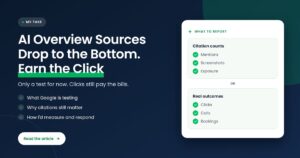

Quick answer: Google is testing a version of AI Overviews that shows the source sites at the bottom of the answer instead of the top, with the full list appearing on hover. It is a test, not a rollout. My take: being cited still helps your brand, but measure clicks honestly and give people reasons to visit that an AI summary can’t replace.
Key takeaways
- Brodie Clark spotted Google testing AI Overviews with the count of referenced sites shown at the bottom of the response. Search Engine Roundtable covered it on November 11, 2026.
- In the earlier version of this experiment, the sources sat at the top, directly above the citations. In the test, hovering over the bottom placement shows the full list.
- This is a test seen by some searchers on desktop. Google has not announced it or commented on it.
- The same day, Google began expanding AI Overviews for definition searches by default, and Bing gave users a way to turn AI answers off.
- My opinion: a citation is brand exposure, not a visit. Judge AI search by clicks, calls and bookings, and build pages that give people a reason to click.
What is Google testing with AI Overview sources?
Google is testing a layout where the AI Overview shows how many sites it referenced at the bottom of the answer rather than at the top. Hovering over that bottom element reveals the full list of cited sites. Brodie Clark spotted the test and Search Engine Roundtable reported it on November 11, 2026.
Brodie Clark logged it in his SERP Alert notes, tagged as a desktop test. His description is specific: the test shows the number of sites referenced at the bottom of the response, and the previous version of this experiment placed them at the top, directly above the citations. Hovering over the new bottom placement shows the full list of citations.
Barry Schwartz at Search Engine Roundtable reported it and said what a lot of site owners will be thinking: moving the sources lower may make them harder to find, which could mean fewer clicks to the sites being cited. He also said he couldn’t see the top placement himself, which is normal for a test that only some searchers get. The article includes no comment from Google.
What are AI Overview source icons?
AI Overview source icons are the small site logos, or favicons, and the site count that show which web pages Google used to build an AI Overview. They act as a shortcut to the cited pages. Clicking or hovering on them opens the list of sources, and each source links through to the website.
Two other terms are worth defining plainly:
- AI Overview is the AI-written summary Google shows above some search results, with links to the pages it drew on.
- Citation here means being one of the linked sources in that summary. It is not the same as a ranking, and it is not the same as a visit.
Google’s own guidance says AI Overviews only appear when its systems think they add something beyond classic results, and that there are no special optimizations needed to appear in them. Normal SEO basics still decide whether a page is eligible to be shown as a source.
Is this a full rollout or only a test?
It is only a test. Brodie Clark tagged it as a test, Search Engine Roundtable described it as one, and Google has not announced any change to how AI Overviews show sources. Google runs many layout experiments, and plenty never ship, so nobody should rebuild a strategy around this one yet.
It also didn’t happen in isolation. Here is what changed in AI answers on the same day, based only on what the sources reported:
| Change | Reported | Status | What it could mean for websites |
|---|---|---|---|
| AI Overview sources moved to the bottom | November 11, 2026 (Search Engine Roundtable) | Test, spotted by Brodie Clark on desktop | Sources may be less visible at first glance |
| Definition AI Overviews expanded by default | November 11, 2026 (Search Engine Roundtable) | Spotted by Glenn Gabe; not described as a test | Searchers scroll further before reaching web results |
| Bing lets users turn AI answers on or off | November 11, 2026 (Bing blog) | Extension in preview, plus a “-ai” search operator | Some searchers can choose classic results only |
I’m not claiming these are connected. They are three separate companies’ decisions and experiments. But read together, they show the same tension: AI answers are getting bigger, and the links inside them are a design choice the search engine controls, not something a website owner can count on.
What could moving the sources to the bottom mean for clicks?
Nobody has published click data on this test, so any effect is a guess. My view is simple: when sources move further from the top of an answer, fewer people are likely to notice them before they get what they came for. That would mean fewer clicks to cited sites, but it is an opinion, not a measurement.
Think about how most people read an AI Overview. They read the answer. If the answer is enough, they move on. Sources at the top at least catch the eye on the way in. Sources at the bottom, partly hidden behind a hover, only get seen by people who read to the end and want more. On mobile, where there is no hover, it would depend entirely on how Google adapts the design, and the test as reported is on desktop.
There is a fair counter-argument. Google says that when people click from search results pages with AI Overviews, those clicks are higher quality and visitors are more likely to spend more time on the site. If that holds, the people who do scroll down and open the sources may be the most interested ones. So the honest framing is this: possibly fewer clicks, possibly more motivated ones. Neither side should be stated as fact until someone has real data.
Does being cited in an AI Overview still matter?
Yes, being cited still matters, but mostly for brand rather than traffic. A citation puts your name in front of a searcher at the moment they are learning about a topic. That can lead to a branded search, a call or a visit later. It just doesn’t pay the bills on its own if nobody clicks.
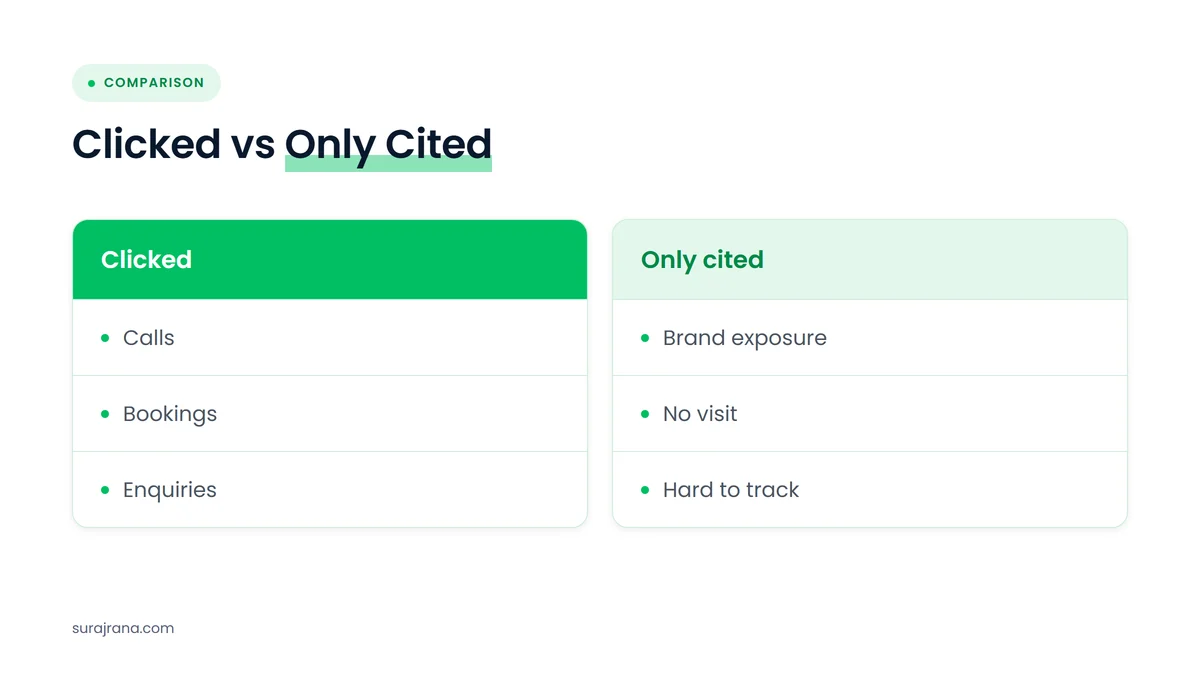
I’ve argued before that ranking on page one isn’t the finish line anymore and getting cited in the AI Overview is. I still think that’s right. This test adds the next step: getting cited isn’t the finish line either. The citation is only valuable if it leads to someone choosing you.
For a dental practice, that means a patient remembering your name and booking. For an agency, it means a client seeing your brand mentioned and getting in touch. If your reports celebrate citations without showing what happened next, they are measuring the wrong thing.
How should you measure AI Overview visibility honestly?
Measure it by what people do, not by how often your name appears. Google counts traffic from AI features inside the Search Console Performance report under the Web search type, so clicks from AI Overviews are already in your normal click numbers. Track clicks, enquiries, calls and bookings, and treat citation counts as context.
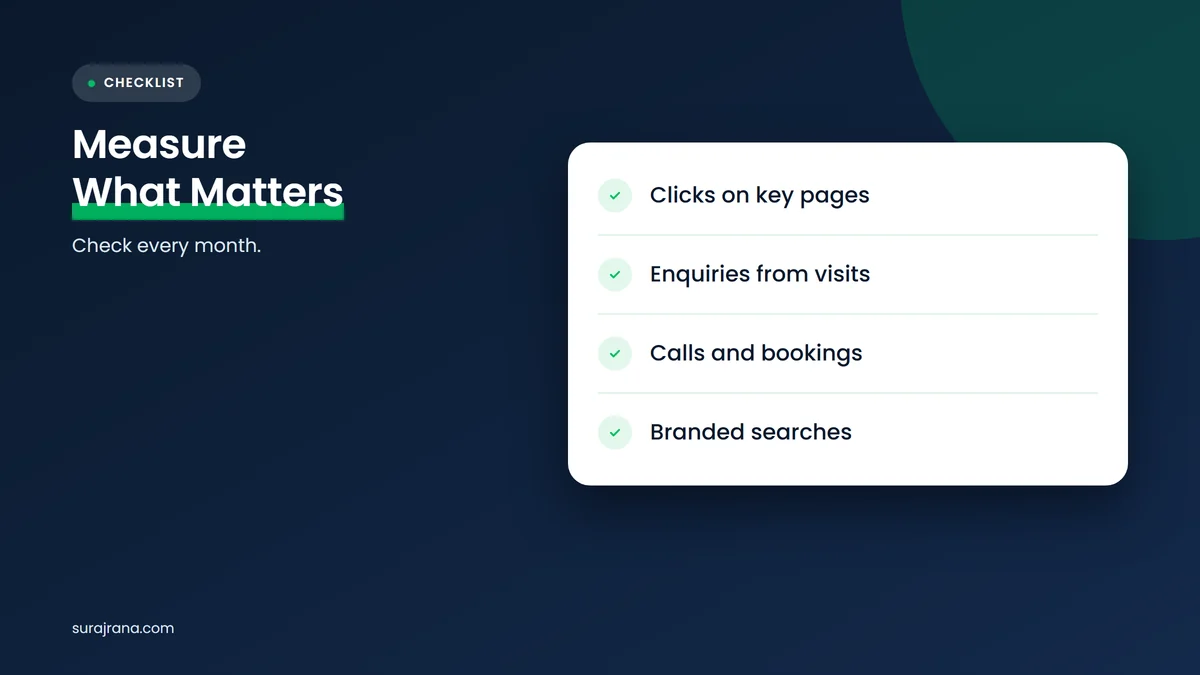
Here is the routine I’d use each month:
- Watch clicks on your key pages. In Search Console, compare clicks and impressions for your main service and information pages month over month. If impressions hold and clicks fall, something on the results page is taking attention.
- Follow the click to an enquiry. In your analytics, check whether visitors to those pages go on to your contact, booking or pricing pages.
- Count real outcomes. Calls, form fills and bookings are the numbers that matter. Ask the front desk or sales team how new people found you.
- Watch branded searches. If citations are building your brand, more people should search for your name over time. That is the fairest way to give a citation credit.
- Note layout changes. Keep a simple log of changes like this test, so you can explain a dip instead of guessing at it later.
This is the same reason I wrote about why I stopped selling keyword rankings. Rankings, and now citations, are signals on the way to the result. They are not the result.
What should businesses do to earn the click?
Give people a reason to visit that an AI summary can’t replace. An AI Overview can explain what a dental implant is. It can’t book the appointment, show your actual price ranges or prove your team does good work. Pages that offer booking, pricing and proof give the searcher something they can only get by clicking.
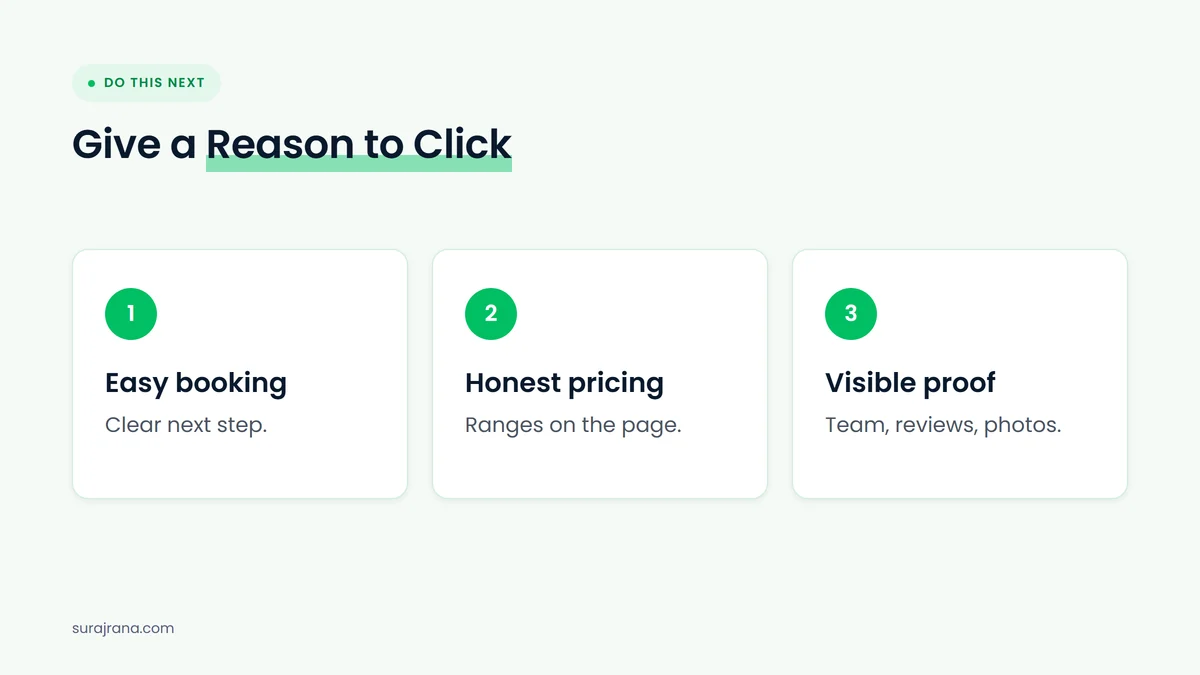
- Make booking easy. Put a clear way to book, call or request a quote on every key page, near the top. If the next step is obvious, the click has somewhere to go.
- Show pricing honestly. Price ranges, or a plain explanation of what affects price, are things people want and summaries often can’t give in detail. I’ve made the case that vague dental pricing pages are losing you patients, and that matters even more when the AI answer has already covered the basics.
- Put proof on the page. Named dentists or team members, real credentials, reviews and photos of your own work. A summary can say a treatment exists. Only your page can show why someone should trust you with it.
- Answer the next question. Cover who a service suits, how long it takes and what happens after. If your page goes further than the AI answer, people who want detail have a reason to come to you.
None of this is new advice. That’s my point. A layout test shouldn’t change your strategy. It should remind you that the pages which convert are the ones worth being cited for.
Why I wouldn’t chase AI Overview citation counts
I wouldn’t chase citation counts because they measure exposure that the search engine controls, not results you own. Google can move sources to the bottom, hide them behind a hover or change the design next month. If your whole strategy depends on that placement, every test like this becomes a threat instead of a footnote.
I expect more agencies to start selling AI citation reports, and some will show impressive-looking counts. A rising number of citations with flat calls and bookings is not a win. It’s a sign the effort is going into the wrong place. Dental Master Media has a practical guide on getting your dental practice cited inside AI Overviews, and I’m in favor of being cited. I just wouldn’t make it the number you report to a client or your partners without the outcome next to it.
Bing’s move is a useful reminder here. Microsoft says some people prefer to look through the results and weigh the sources on their own, so it now lets them switch AI answers off. Searchers want different things. The safest position is to be useful and visible in both the AI answer and the classic results.
Frequently asked questions
Has Google moved AI Overview sources to the bottom for everyone?
No. As of November 11, 2026, it is a test that Brodie Clark spotted on desktop and Search Engine Roundtable reported. Google has not announced the change or said whether it will roll out more widely.
How do you see the sources in the test version?
In the test, the number of sites referenced appears at the bottom of the AI Overview. Hovering over that placement shows the full list of cited sites. In the earlier version of the experiment, the sources sat at the top, directly above the citations.
Will this test reduce clicks to my website?
Nobody has published data on it yet. My opinion is that sources placed further down are likely to get noticed less, which could mean fewer clicks. Google says clicks from pages with AI Overviews tend to be higher quality, so watch your own clicks and enquiries rather than guessing.
Do I need to change my SEO because of this test?
No. Google says there are no special optimizations needed to appear in AI Overviews, and a layout test doesn’t change that. Keep pages indexed, helpful and specific, and give visitors clear reasons to click, such as booking, pricing and proof.
Where can I see AI Overview traffic in Search Console?
Google counts traffic from AI features, including AI Overviews, in the Search Console Performance report under the Web search type. That means AI Overview clicks are part of your normal search click numbers, so track trends on your key pages over time.
My bottom line on AI Overview sources moving to the bottom
This is a test, and it may never ship. But it shows something worth remembering: where your link sits inside an AI answer is Google’s decision, not yours. Being cited still helps your brand. It just isn’t the same as being chosen, and it shouldn’t be reported as if it were.
So measure clicks honestly, give people reasons to visit that a summary can’t replace, and don’t build a strategy on citation counts. That is how I approach dental SEO for practices, and it is what my team does through Dental Master Media’s dental SEO services. You can read more about my work on surajrana.com.
Want to know if AI search is sending you patients or just mentions?
I’m Suraj Rana. If you’re not sure whether being cited in AI answers is turning into calls and bookings for your practice or your clients, I’m happy to look at the numbers with you and tell you what I’d fix first. Through my dental SEO work and Dental Master Media, my team and I help practices turn visibility into real enquiries.
Sources
- Search Engine Roundtable (Barry Schwartz), “Google Placing Source Icons At Bottom Of AI Overviews”, November 11, 2026. https://www.seroundtable.com/google-ai-overview-source-icons-bottom-42519.html
- Brodie Clark, SERP Alert notes, “Google SERP Feature & ChatGPT Updates”, note dated November 12, 2026. https://brodieclark.com/notes/
- Search Engine Roundtable (Barry Schwartz), “Google Search AI Overview Definitions Expanded By Default”, November 11, 2026. https://www.seroundtable.com/google-expanding-definitions-42514.html
- Microsoft Bing Blogs, “Your choice: Turn AI answers on or off in Bing”, November 11, 2026. https://blogs.bing.com/search/2026/11/your-choice-turn-ai-answers-on-or-off-in-bing/
- Google Search Central, “AI features and your website”, last updated December 10, 2025. https://developers.google.com/search/docs/appearance/ai-features

My name is Suraj Rana, and I am a seasoned Dental SEO Expert with extensive experience in the Dental SEO industry. Leveraging my deep knowledge and expertise, I help dental practices enhance their online visibility and attract more patients.