
Quick answer: The SEO myths that hold dental practices back are mostly old shortcuts: meta keywords, fear of duplicate content, panic about AI writing, paying for ads to rank, stuffing the city into the profile name, treating every core update as a penalty and hunting for an AI-search trick. Google’s own documentation contradicts every one of them.
Key takeaways
- My position: most dental SEO money is wasted on myths, not on bad luck. If a tactic contradicts Google’s own documentation, I don’t want a practice paying for it.
- Google says plainly that it does not use the meta keywords tag, and that duplicate content on your own site is not a spam violation.
- AI-assisted content isn’t banned. Publishing lots of unreviewed pages that add nothing is the problem, however they were written.
- You can’t pay Google for a better organic or local ranking. Map results come down to relevance, distance and prominence.
- A drop during a core update, like the one Google started on November 10, 2026, is not a penalty, and there is no special file or markup for AI Overviews.
What do I mean by an SEO myth?
An SEO myth is a belief about how Google ranks websites that sounds sensible, gets repeated by agencies and forums, but isn’t supported by Google’s own documentation. Some myths were true years ago and never died. Others were never true. Either way, they cost practices money and attention.
I’m not talking about honest disagreements between SEOs. Plenty of things in search are uncertain, and nobody outside Google knows exactly how every system weighs every signal. A myth is different: it’s a claim Google has directly addressed, in writing, and the practice is still being sold the opposite.
The reason I’m writing this now is timing. Google began rolling out its November 2026 core update on November 10, and every core update brings a fresh wave of practice owners asking whether they’ve been penalized, whether they need to rewrite everything, or whether AI content is to blame. Those are exactly the moments when myths get sold.
What are the 7 SEO myths I still hear from dental practice owners?
The seven myths I hear most are about meta keywords, duplicate content, AI-written content, paying for ads to rank, keywords in the business name, core update penalties and special tricks for AI search. Each one sounds reasonable. Each one is contradicted by Google Search Central or Google Business Profile Help.
1. “We need to fill in the meta keywords tag”
You don’t. Google stopped using the meta keywords tag a long time ago, and it has no effect on how your pages are indexed or ranked. If an agency still lists “meta keyword optimization” as a deliverable, that tells you something about how current the rest of its work is.
Google’s documentation on meta tags that Google understands says the tag is not used by Google Search and has no effect on indexing and ranking. The SEO Starter Guide repeats the point and adds that keyword stuffing is against Google’s spam policies.
The related myth is that a page needs the phrase “dentist in [city]” repeated a set number of times. It doesn’t. The same guide says excessive repetition is tiring for readers. Write the page for a nervous patient, not for a keyword counter.
2. “Google will penalize us for duplicate content”
Not in the way most practice owners fear. Having similar text on several of your own pages, such as the same insurance paragraph on every treatment page, is not a spam violation and won’t cause a manual action. It’s inefficient, because Google picks one version to show, but it isn’t a penalty.
Google’s SEO Starter Guide says duplicate content on your site is not a violation of its spam policies, and its guide to canonicalization explains how Google chooses which duplicate URL to show.
Where I’d be careful is the opposite problem. Copying content from other sites is treated differently, and so are near-identical “dentist in [suburb]” pages built only to catch searches. Google’s spam policies name doorway abuse specifically. So the honest answer is: stop worrying about a shared paragraph, and start worrying about thin location pages.
3. “Google penalizes anything written with AI”
It doesn’t. Google judges pages by whether they help people, not by which tool helped write them. What it does act on is generating lots of pages without adding value, which its spam policies call scaled content abuse. A dentist-reviewed page drafted with AI is fine. A hundred unreviewed AI posts are not.
Google’s guidance on using generative AI content says that generating many pages without adding value for users may violate its spam policy on scaled content abuse, and that it’s critical to fact-check and review all AI-generated content. That’s the rule I’d hold any writer to, human or not.
For a dental practice, the risk isn’t a penalty for using a tool. It’s publishing a clinical claim nobody checked. I made a related argument about volume publishing in why I think most dental blogs are a waste of money, so I won’t repeat it here.
4. “If we spend more on Google Ads, our organic rankings will go up”
They won’t. Google Ads and organic search are separate. Google says it doesn’t give ranking boosts to anyone because of advertising, and Google Business Profile Help says there’s no way to request or pay for a better local ranking. Ads buy visibility while you pay. They don’t buy rankings.
Google’s How Search Works page says Search does not give special treatment such as ranking boosts based on financial relationships, including advertising. Google Business Profile Help on improving your local ranking says the same for the map results.
I hear this myth most from practices that cut their ad budget, saw calls fall and concluded their SEO “dropped”. Usually nothing happened to their rankings. They just stopped renting the top of the page.
5. “Putting the city and ‘best dentist’ in our profile name will help us rank”
It might move a listing briefly, but it breaks Google’s rules and can get the profile suspended. Map rankings come from three things Google names: relevance, distance and prominence. You can’t change distance, but you can improve relevance with complete profile details and prominence with reviews and a stronger website.
Google Business Profile Help on how local ranking works describes relevance, distance and prominence, and says more reviews and positive ratings can help a business’s local ranking. Google’s guidelines for representing your business say including unnecessary information in the business name isn’t permitted and can lead to suspension.
The sister myth is “it’s all about being closest, so there’s nothing we can do”. Distance matters, but it’s one of three factors. A practice two miles further away with a complete profile, steady reviews and clear treatment pages can still earn its place.
6. “Our traffic dropped in the core update, so Google penalized us”
A core update is not a penalty. Google says core updates are broad changes that don’t target specific sites or pages, and that pages which move down aren’t necessarily bad. A drop means Google re-weighed what’s most helpful for those searches. The answer is an honest review of your pages, not panic.
Google’s documentation on core updates says they don’t target specific sites, and that some improvements can take effect in a few days while it could take several months for Google’s systems to recognize them. The November 2026 core update started on November 10, and Search Engine Roundtable reported that Google expected it to take up to two weeks.
My advice is boring on purpose. Don’t rewrite your whole site mid-rollout. Wait until it finishes, compare the same date ranges in Search Console, and look at which pages moved and for which searches. Then decide.
7. “We need a special AI file or schema to appear in AI Overviews”
You don’t. Google says there are no additional requirements to appear in AI Overviews or AI Mode, no special optimizations, and no new machine-readable files, AI text files or special schema you need to add. The pages that get shown are the ones that already do well in normal search.
That’s stated directly in Google’s documentation on AI features and your website. If someone is selling a practice an “AI file” as the route into AI Overviews, I’d ask them to show where Google says that.
I’ve written about the wider debate in is GEO just SEO with a new name? My short version: the work that helps AI answers cite you is the same work that helps patients choose you.
How do the myths compare with what Google actually says?
Side by side, the pattern is clear. Every myth promises a shortcut, and every correction from Google points back to the same few things: useful pages, an accurate Business Profile, real reviews and patience. This table puts each myth next to what Google’s documentation says and what I’d do instead.
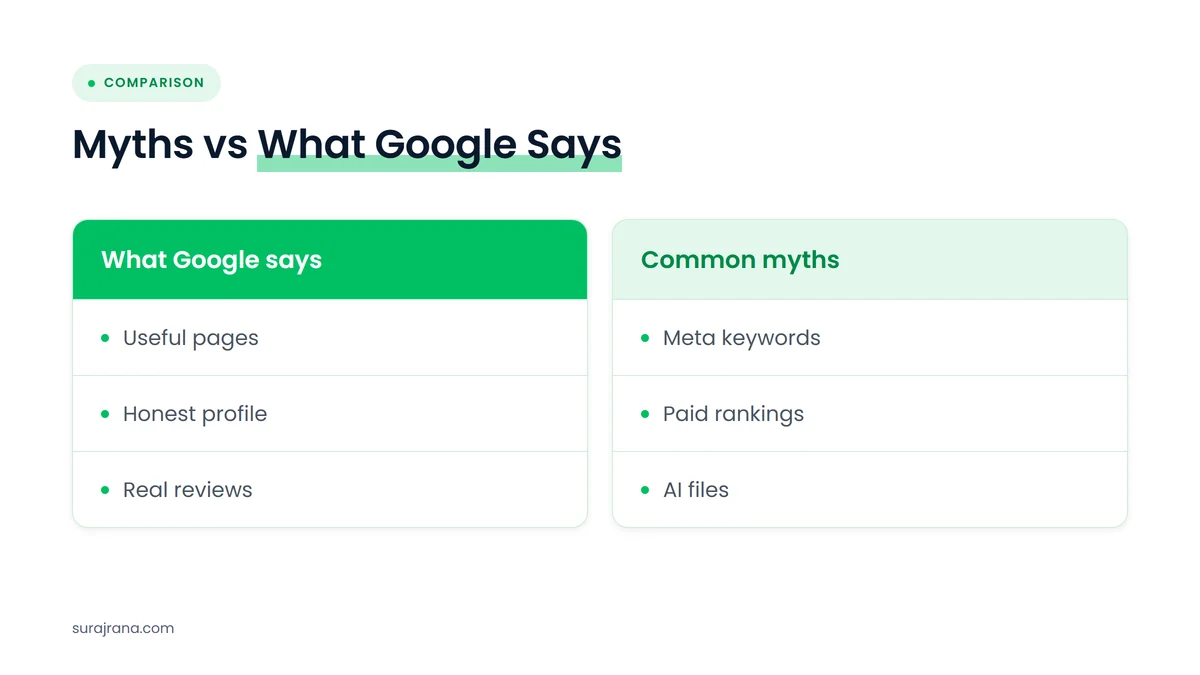
| Myth | What Google says | What I’d do instead |
|---|---|---|
| Fill in meta keywords | Not used by Google Search | Write clear titles and page copy for patients |
| Duplicate content gets penalized | Not a spam violation on your own site | Fix thin location pages instead |
| AI content is penalized | Scaled, low-value content is the problem | Have a dentist review every page |
| Ads boost rankings | No ranking boosts for advertising | Judge ads and SEO separately |
| Keywords in the profile name | Unnecessary information isn’t permitted | Use your real name and complete the profile |
| Core update drop is a penalty | Updates don’t target specific sites | Wait for the rollout, then review pages |
| AI search needs a special file | No additional requirements | Keep doing solid, people-first SEO |
Why do these SEO myths keep spreading among dental practices?
These myths keep spreading because they are easy to sell and easy to report on. A practice can see that meta keywords were added or that an AI file was uploaded. It can’t easily see whether a treatment page is genuinely more useful. Shortcuts feel like progress, and some agencies are happy to bill for them.
To be fair to the other side, some myths have a grain of truth. Exact phrases still help Google understand what a page is about, which is why the starter guide encourages using the words people search for. Distance really does limit how far a single practice can rank on the map. And plenty of mass-produced AI content does get hit, just not because of the tool.
The trouble is that half-true advice gets stretched into a rule. “Use the words patients search for” becomes “repeat the city ten times”. “Spam updates target scaled content” becomes “never use AI”. I’d rather practice owners went to the source. That’s also why I stopped reporting keyword positions as the main measure of success, which I explained in why I stopped selling keyword rankings to clients.
What should dental practices focus on instead of SEO myths?
Dental practices should focus on the few things Google consistently points to: pages that fully answer patient questions, an accurate and complete Business Profile, a steady flow of genuine reviews and clean technical basics. None of it is clever. All of it compounds, and none of it breaks when Google changes an algorithm.
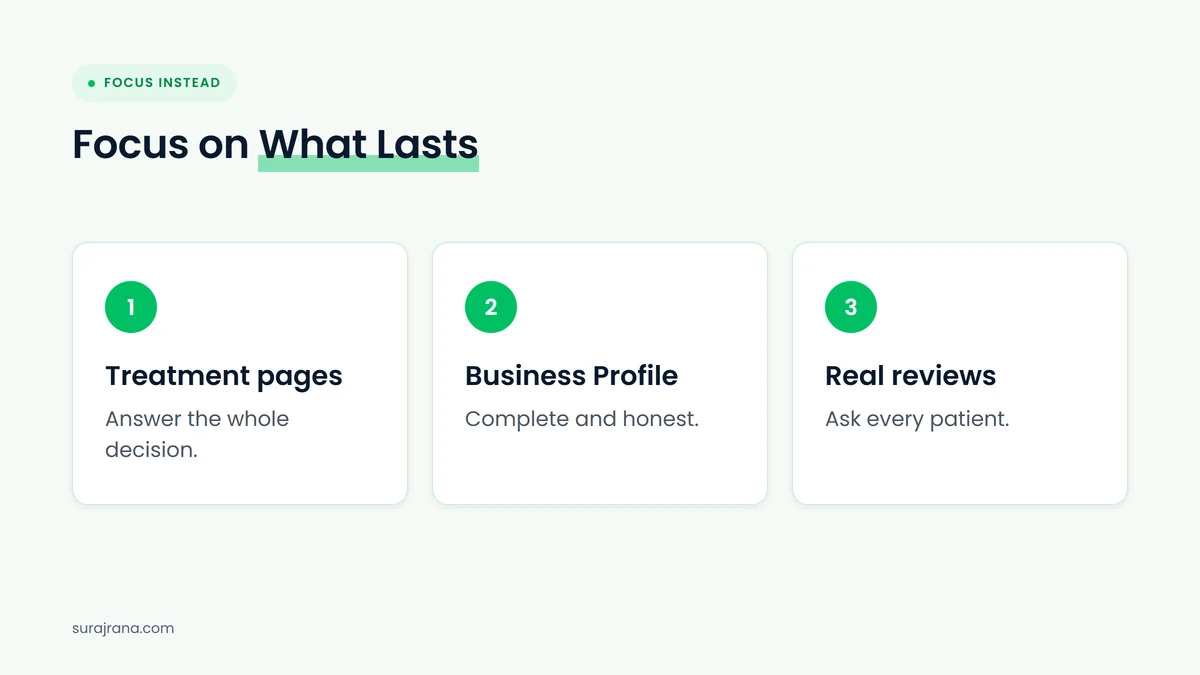
- Treatment pages that answer the whole decision. Who a treatment suits, how it works, how long it takes, aftercare, risks and how costs are structured, reviewed by a dentist.
- A complete, honest Business Profile. Your real business name, accurate categories, hours and services, and photos of the actual practice.
- Reviews earned in the normal course of care. Ask every patient, reply to reviews, and never buy or filter them.
- Technical basics that let Google find your pages. Indexable pages, sensible internal links and a site that works well on a phone.
- Measurement you can trust. Calls, bookings and Search Console clicks, compared over the same periods, not one ranking screenshot.
How can you tell if your SEO provider is selling you a myth?
You can tell by checking each deliverable against Google’s own documentation. If a monthly report lists meta keyword updates, keyword-stuffed profile names, “AI optimization files” or a promised fix for a core update, ask where Google supports it. A good provider can point to the source. A weak one changes the subject.
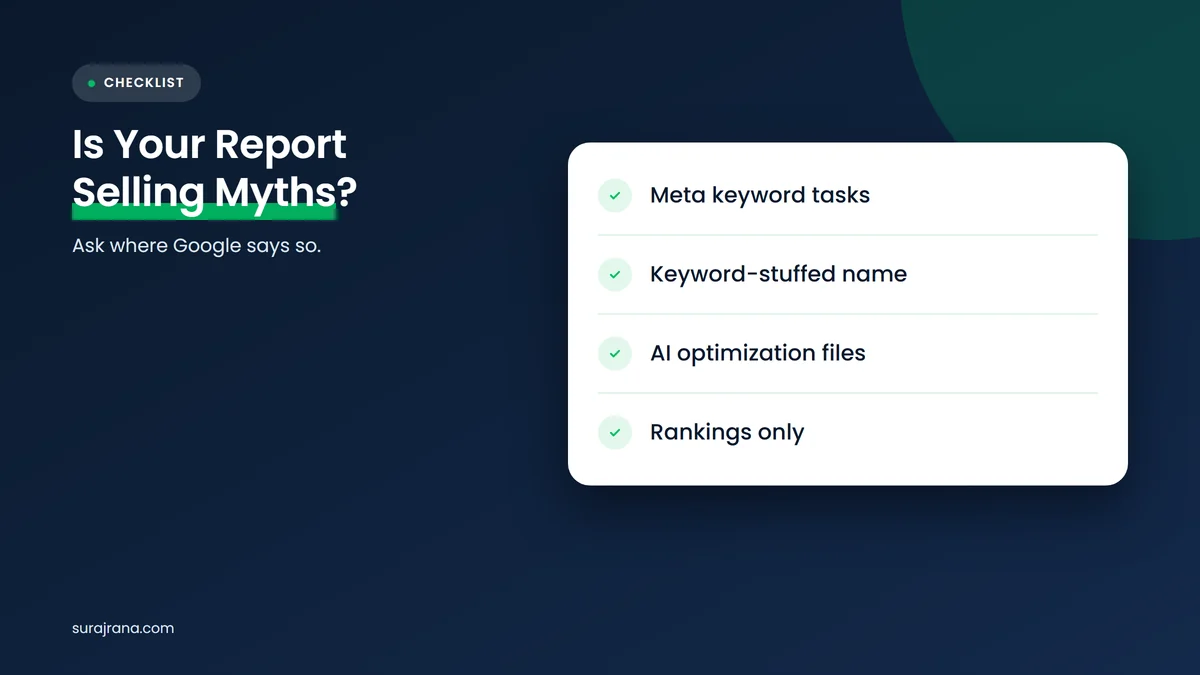
- Read your last three monthly reports and list every task the provider says it completed.
- Mark any task that matches one of the seven myths above.
- Ask the provider which Google document supports each marked task.
- Check whether the report shows calls, bookings or Search Console clicks, or only rankings and task counts.
- Watch for promises of fixed positions. I explained why that’s a warning sign in why a ranking promise should make you walk away from an SEO agency.
If you’d like someone independent to look, Dental Master Media offers a free dental SEO audit that checks what your current setup is actually doing.
Frequently asked questions
Does Google still use the meta keywords tag?
No. Google’s documentation says the meta keywords tag is not used by Google Search and has no effect on indexing or ranking. You can leave it empty or remove it. Time is better spent on page titles, headings and copy that answer what patients actually ask.
Will using the same paragraph on several dental pages hurt my rankings?
Not as a penalty. Google says duplicate content on your own site isn’t a spam violation, although Google will usually show only one version. The bigger risk is thin, near-identical location pages made only to catch searches, which Google’s spam policies treat as doorway abuse.
Is it safe to use AI to write content for my dental website?
It can be, if a qualified person reviews and fact-checks every page before it goes live. Google’s guidance targets generating many pages without adding value, not the tool itself. For dental content, accuracy matters most, so a dentist should check any clinical claim.
Do longer pages rank better on Google?
Not because of length. Google’s SEO Starter Guide says the length of content alone doesn’t matter for ranking and that there is no magic word count. A page should be as long as it takes to answer the patient’s question fully, and no longer.
How long should I wait before judging a core update drop?
Wait until the rollout has finished before drawing conclusions, then compare equal date ranges in Search Console. Google says some improvements can take effect within days, while others can take several months for its systems to recognize, sometimes not until a later core update.
My bottom line on dental SEO myths
I don’t think dental practices lose at SEO because Google is unfair. I think they lose because they pay for shortcuts that Google has already said don’t work. Every myth on this list has a written answer from Google, and every answer points back to useful pages, an honest profile and patience.
Before you approve the next task, ask one question: where does Google say this helps? If nobody can answer, skip it. If you want to see how I approach this work, read about my dental SEO services on surajrana.com, or look at the dental SEO services at Dental Master Media, where my team does the hands-on work.
Not sure which advice to trust?
I’m Suraj Rana. If you’re being sold SEO tasks you can’t verify, I’m happy to go through them with you and tell you plainly which ones match Google’s own guidance and which ones don’t.
Sources
- Google Search Central, “Meta Tags and Attributes that Google Supports”, last updated December 10, 2025. https://developers.google.com/search/docs/crawling-indexing/special-tags
- Google Search Central, “SEO Starter Guide: The Basics”, last updated December 10, 2025. https://developers.google.com/search/docs/fundamentals/seo-starter-guide
- Google Search Central, “What is URL Canonicalization”, last updated August 20, 2026. https://developers.google.com/search/docs/crawling-indexing/canonicalization
- Google Search Central, “Spam policies for Google web search”, last updated August 28, 2026. https://developers.google.com/search/docs/essentials/spam-policies
- Google Search Central, “Google Search’s Guidance on Generative AI Content on Your Website”, last updated October 1, 2026. https://developers.google.com/search/docs/fundamentals/using-gen-ai-content
- Google, “Our Approach – How Google Search Works”, accessed November 15, 2026. https://www.google.com/search/howsearchworks/our-approach/
- Google Business Profile Help, “Tips to improve your local ranking on Google”, accessed November 15, 2026. https://support.google.com/business/answer/7091
- Google Business Profile Help, “Guidelines for representing your business on Google”, accessed November 15, 2026. https://support.google.com/business/answer/3038177
- Google Search Central, “Google Search’s Core Updates”, last updated December 10, 2025. https://developers.google.com/search/docs/appearance/core-updates
- Search Engine Roundtable (Barry Schwartz), “Google November 2026 Core Update Is Rolling Out”, November 10, 2026. https://www.seroundtable.com/google-november-2026-core-update-42504.html
- Google Search Central, “AI Features and Your Website”, last updated December 10, 2025. https://developers.google.com/search/docs/appearance/ai-features

My name is Suraj Rana, and I am a seasoned Dental SEO Expert with extensive experience in the Dental SEO industry. Leveraging my deep knowledge and expertise, I help dental practices enhance their online visibility and attract more patients.