
Quick answer: ChatGPT has been spotted testing blue links: web results shown alone, five web links above its answer, and an AI answer cut short by a “See more” button with organic links below. It is a small test, not a rollout. I think it shows ChatGPT search still leans on classic web pages, so SEO remains the base of AI visibility.
Key takeaways
- ChatGPT is testing blue links: Search Engine Roundtable reported 3 result formats on November 16, 2026, and its editor could not reproduce any of them.
- The 3 tests are web results only, five web links before the answer, and an AI answer with a “See more” button followed by organic links.
- I think OpenAI is testing blue links because ChatGPT search now handles about one-fifth of Google’s search volume, and logged-out users expect search to look like search.
- ChatGPT search still sends little referral traffic: 5.2% of ChatGPT sessions ended in a clean visit to an outside website, against 31.1% of Google queries, in a Bocconi University study.
- For SEO, I read the test as proof that ranking web pages still feed AI answers. Businesses chasing AI visibility should keep building pages that deserve a click.
What is ChatGPT testing with blue links?
ChatGPT is testing classic web results, the list of blue links people know from Google, either in place of its AI answer, above it, or below a shortened answer with a “See more” button. Search Engine Roundtable editor Barry Schwartz reported the tests on November 16, 2026, based on screenshots shared on X, and wrote that he could not replicate any of them himself.
That last detail matters. These are tests seen by a handful of people, not a feature OpenAI has announced or rolled out to all users. I’m writing about it because of what it says about where ChatGPT search is heading, and because the business owners I work with on dental SEO keep asking me whether Google rankings still count now that patients ask ChatGPT.
For context, ChatGPT search itself is not new. OpenAI launched it on October 31, 2024 to give “fast, timely answers with links to relevant web sources”, with a Sources button that opens the cited pages in a sidebar. OpenAI opened ChatGPT search to logged-in free users on December 16, 2024 and to logged-out users, with no account needed, on February 5, 2025.
What are the 3 ChatGPT search result tests people spotted?
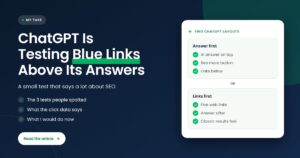
The 3 ChatGPT search result tests people spotted are web results only, five web links shown before the ChatGPT answer, and an AI answer with a “See more” button followed by organic links. Each one moves the blue links closer to the top of ChatGPT search than the current Sources button does.
The 3 ChatGPT search result formats reported by Search Engine Roundtable are described below, in the order the article lists them.
Web results only
The first ChatGPT test shows web results only, with no AI answer at all. Joe Youngblood spotted it and posted on November 14, 2026 that ChatGPT appeared to be replying to prompts with blue links. Barry Schwartz noted that he had seen this format before and had treated it as a bug at the time.
Five web links first, then the ChatGPT answer
The second ChatGPT test puts five web links at the top and the normal ChatGPT answer underneath. Juozas Kaziukėnas, who reported seeing it, described the layout plainly on X.
“five organic links followed by the response”
Juozas Kaziukėnas (@juokaz) on X, November 11, 2026 (source)
Of the 3 tests, this is the one I find most interesting, because it reverses the usual order. The web results come first and the AI answer becomes the supporting act.
The third ChatGPT test shows a short AI answer at the top, a “See more” button to expand it, and organic links below. Fernando spotted it, and Barry Schwartz pointed out that it looks like the way Google handles AI Overviews. Fernando’s own reaction was blunter.
“Looks like ChatGPT is copying Google”
Fernando (@fomerino) on X, November 11, 2026 (source)
Google is testing the same tension from the other side. I covered that in my take on Google testing AI Overview sources at the bottom, where the links move down instead of up.
Why do I think ChatGPT is testing blue links?
I think ChatGPT is testing blue links because ChatGPT search is now big enough to be judged as a search engine, and logged-out users arrive with search engine habits. A person who types a short query without an account often wants a list of websites, not a 400-word essay.
The scale is real. Adam Fry, who leads ChatGPT’s consumer product at OpenAI, said ChatGPT’s volume of search-like queries is roughly one-fifth of Google’s, according to Big Technology on November 3, 2026. The same report said ChatGPT weekly users grew from 1 billion to 1.2 billion in 2 months. I gave my full view on that number in my post on OpenAI saying ChatGPT is at 20% of Google’s search volume.
I see 3 likely reasons behind the test, and I’m labelling them as my reading, not OpenAI’s stated plan. The 3 reasons I think OpenAI is testing web results are listed below.
- Search intent: navigational and local queries, like a business name or “dentist near me”, are served better by a list of web results than by a long AI answer.
- Trust: visible blue links show users where an answer comes from, which matters more as ChatGPT search handles health and money questions.
- Publishers: showing organic links higher up sends more referral traffic to the websites ChatGPT depends on for fresh information.
How much referral traffic does ChatGPT search send to websites?
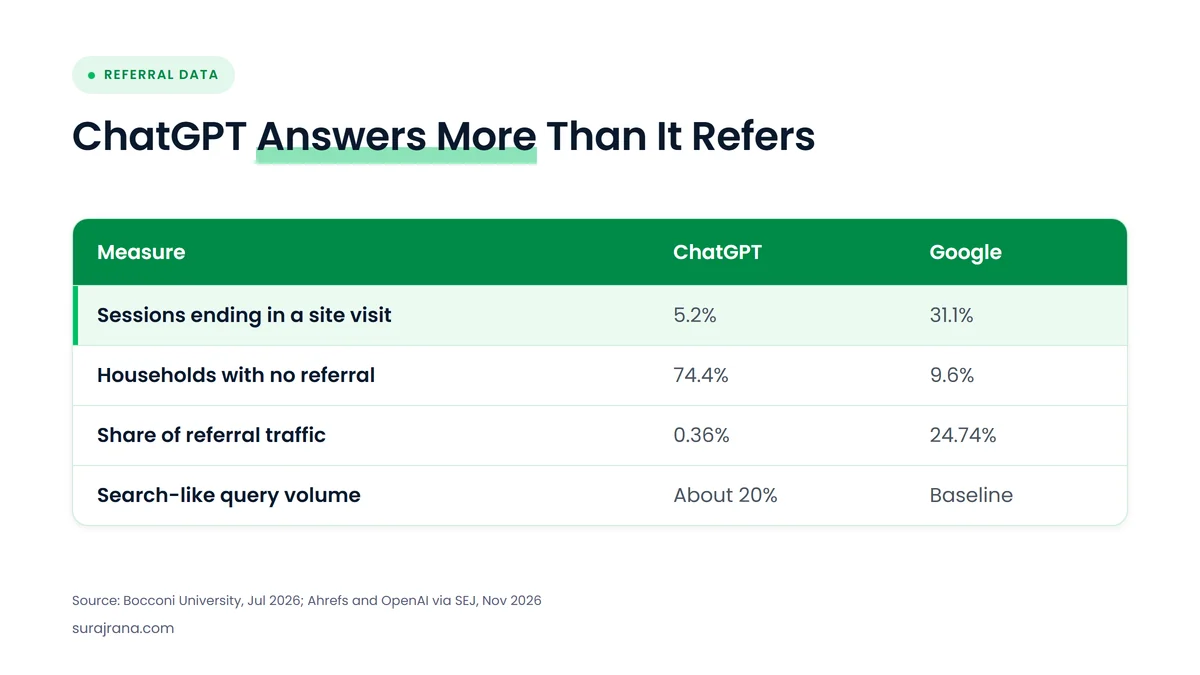
ChatGPT search sends far less referral traffic to websites than Google: 5.2% of ChatGPT conversation sessions ended in a clean visit to an outside website, against 31.1% of Google queries. Those figures come from the Bocconi University study “Answering Without Referring”, reported by PPC Land on July 13, 2026, which used Comscore clickstream data from 45,386 US households.
| Measure | ChatGPT | Source | |
|---|---|---|---|
| Sessions or queries ending in a visit to an outside website | 5.2% of sessions | 31.1% of queries | Bocconi University, July 2026 |
| Households with no clean referral in 10 months | 74.4% | 9.6% | Bocconi University, July 2026 |
| Share of tracked referral traffic, October 2026 (118,671 sites) | 0.36% | 24.74% | Ahrefs, via Search Engine Journal, November 2026 |
| Search-like query volume | About 20% of Google’s | Baseline | OpenAI’s Adam Fry, via Big Technology, November 2026 |
The table shows the gap I care about: ChatGPT search already has real search volume, but it sends a small share of that attention on to websites. The same Bocconi study found that wider ChatGPT search access cut traditional search queries by 9.4% on average, so the attention it keeps is attention Google used to pass on.
The numbers measure different things, and Search Engine Journal made that point too: OpenAI counts every question that triggers a web search, while Ahrefs had earlier estimated ChatGPT search at about 12% of Google’s volume with a different method. I treat them as direction, not as one clean figure.
What does the ChatGPT blue links test mean for SEO?
The ChatGPT blue links test means classic SEO still decides which pages people see in ChatGPT search, whether those pages appear as citations or as organic links. Every format in the test pulls from the same pool of web results, so a page that doesn’t rank and doesn’t deserve a click has nothing to gain from it.
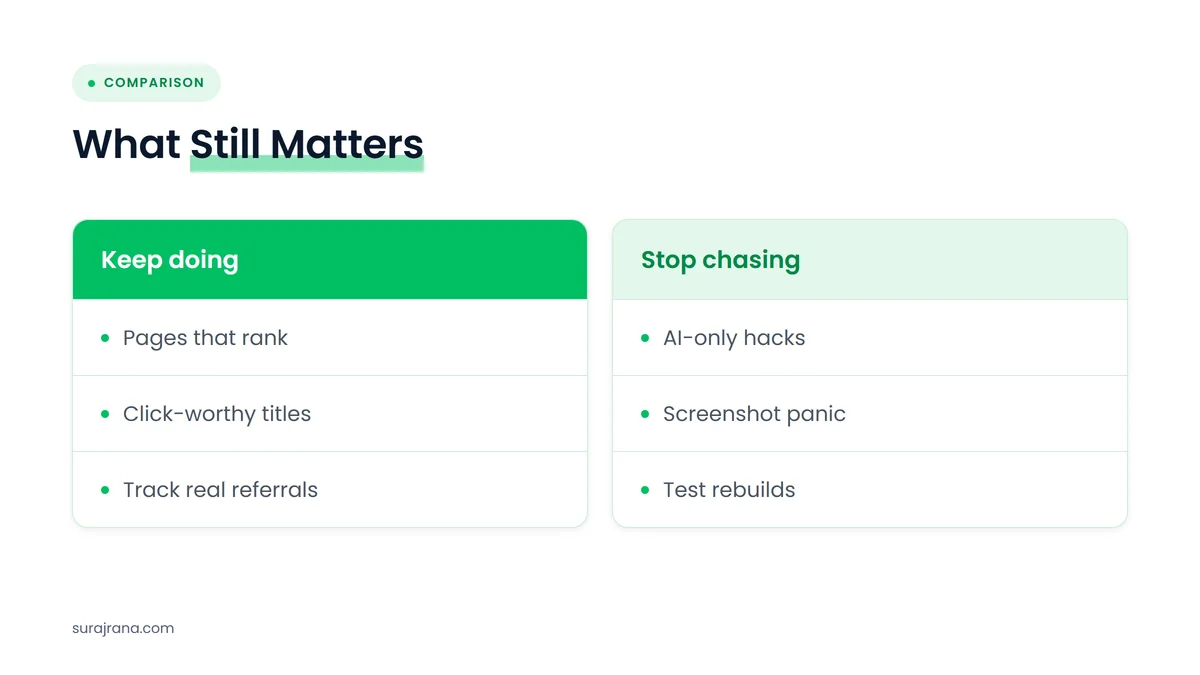
I think 3 things follow for SEO, and none of them depend on the test rolling out. The 3 SEO points I take from the ChatGPT blue links test are listed below.
- Click-worthy pages: if organic links sit above or beside the AI answer, the title and description of each web result compete for the click again, the way they do on Google.
- Rankings feed AI answers: ChatGPT search cites web pages it can find, so the pages that rank for a question are the pages it has to work with.
- Measurement: referral traffic from ChatGPT is small today, so businesses should track it in analytics before they move budget because of a screenshot.
For dental practices in particular, the work is the same work I’d recommend anyway. Dental Master Media’s guide on how to get your dental clinic cited by ChatGPT and AI search covers the page-level detail.
What should businesses chasing AI visibility do about ChatGPT now?
Businesses chasing AI visibility should do nothing drastic about ChatGPT now, and should keep improving the web pages that ChatGPT search and Google both rely on. A test that one editor could not reproduce is not a reason to rebuild a website, but it is a reason to check that the basics are in place.
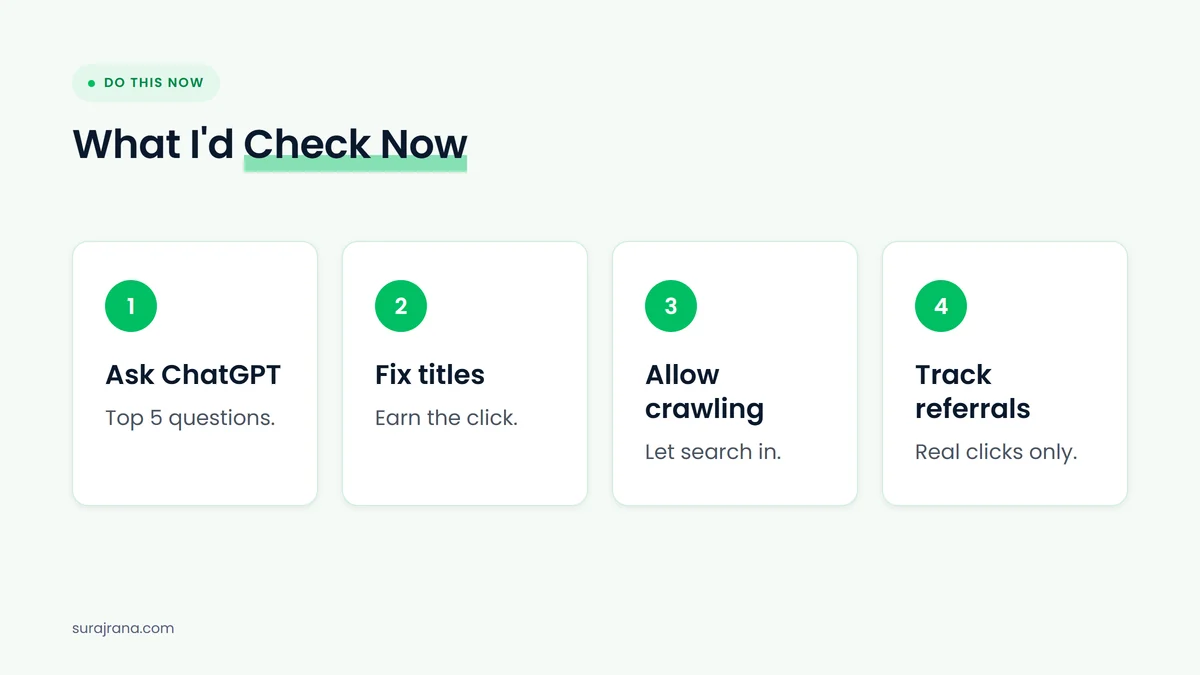
The 4 steps I’d take for AI visibility while ChatGPT tests web results are listed below.
- Check your ChatGPT search presence by asking ChatGPT, logged in and logged out, the 5 questions your customers ask most, and note which websites it cites.
- Rewrite page titles and meta descriptions so each web result tells a searcher why to click, because blue links in ChatGPT would bring that contest back.
- Make sure OpenAI’s search crawler can reach your site, since a page ChatGPT search can’t read can’t be cited or listed as an organic link.
- Track ChatGPT referral traffic in your analytics as its own source, so you see real clicks instead of guessing from screenshots.
Does ChatGPT showing blue links make GEO just SEO again?
No, ChatGPT showing blue links doesn’t make GEO just SEO again, but it does show how much the two overlap. The pages that win citations in an AI answer and the pages that win clicks in a list of web results are, in my experience, mostly the same pages.
I’ve argued that point at length, so I won’t repeat it here. If you want the full view, read my post asking is GEO just SEO with a new name. The ChatGPT test is one more data point on the side of “mostly yes, with a few new habits”.
Frequently asked questions
Has ChatGPT rolled out blue links to everyone?
No, ChatGPT has not rolled out blue links to everyone. Search Engine Roundtable reported the formats as tests seen by a few users on X on November 16, 2026, its editor could not reproduce them, and OpenAI has not announced a change to ChatGPT search results.
Can logged-out users use ChatGPT search?
Yes, logged-out users can use ChatGPT search. OpenAI opened ChatGPT search to everyone on chatgpt.com without an account on February 5, 2025.
Does ChatGPT search send traffic to websites?
Yes, ChatGPT search sends traffic to websites, but much less than Google. A Bocconi University study reported in July 2026 found 5.2% of ChatGPT sessions ended in a clean visit to an outside website, against 31.1% of Google queries.
Should I optimize for ChatGPT or for Google?
You should optimize for both with the same pages, because ChatGPT search and Google both pull from web pages that answer the question clearly. I’d put most effort into pages that rank on Google and deserve a click, then check how ChatGPT cites them.
Where do I land on ChatGPT testing blue links?
I think ChatGPT testing blue links is a quiet admission that a good search experience still needs web results. It is a test, not a rollout, and it may never ship. But whichever format wins, ChatGPT search keeps drawing on the same web pages, so my advice stays the same: build pages that rank, answer the question and give people a reason to click.
I’m Suraj Rana, and that is how I approach AI visibility in my dental SEO services. If you run a dental practice and want to know how ChatGPT describes you today, Dental Master Media covers it in its AI search visibility audit for dental practices.
Want to know where you stand in ChatGPT search?
I’m Suraj Rana, founder of Dental Master Media. If you’re not sure whether ChatGPT cites your website, or whether Google still sends you the patients it used to, I’m happy to look at both with you and tell you what I’d fix first.
Sources
- Search Engine Roundtable, “ChatGPT Tests Web Results, See More & Other Search Results Formats”, November 16, 2026. https://www.seroundtable.com/chatgpt-search-result-tests-42537.html
- OpenAI, “Introducing ChatGPT search”, October 31, 2024 (updated December 16, 2024 and February 5, 2025). https://openai.com/index/introducing-chatgpt-search/
- Big Technology, “OpenAI: ChatGPT Search Is About 20% of Google’s, 250 Million People Speak With ChatGPT, and Chat Is Merging With Work”, November 3, 2026. https://www.bigtechnology.com/p/openai-chatgpt-search-is-about-20
- Search Engine Journal, “Google’s Search Volume Is About 5x ChatGPT’s, OpenAI Says”, November 3, 2026. https://www.searchenginejournal.com/googles-search-volume-is-about-5x-chatgpts-openai-says/595817/
- PPC Land, “Wider ChatGPT Search access cuts traditional search 9.4%, study finds”, July 13, 2026. https://ppc.land/wider-chatgpt-search-access-cuts-traditional-search-9-4-study-finds/
- X, Joe Youngblood (@YoungbloodJoe), post on ChatGPT replying with blue links, November 14, 2026. https://x.com/YoungbloodJoe/status/2121419427724030367
- X, Juozas Kaziukėnas (@juokaz), post on five organic links before the response, November 11, 2026. https://x.com/juokaz/status/2120464305644827104
- X, Fernando (@fomerino), post on the See more test, November 11, 2026. https://x.com/fomerino/status/2120461016228106287

My name is Suraj Rana, and I am a seasoned Dental SEO Expert with extensive experience in the Dental SEO industry. Leveraging my deep knowledge and expertise, I help dental practices enhance their online visibility and attract more patients.