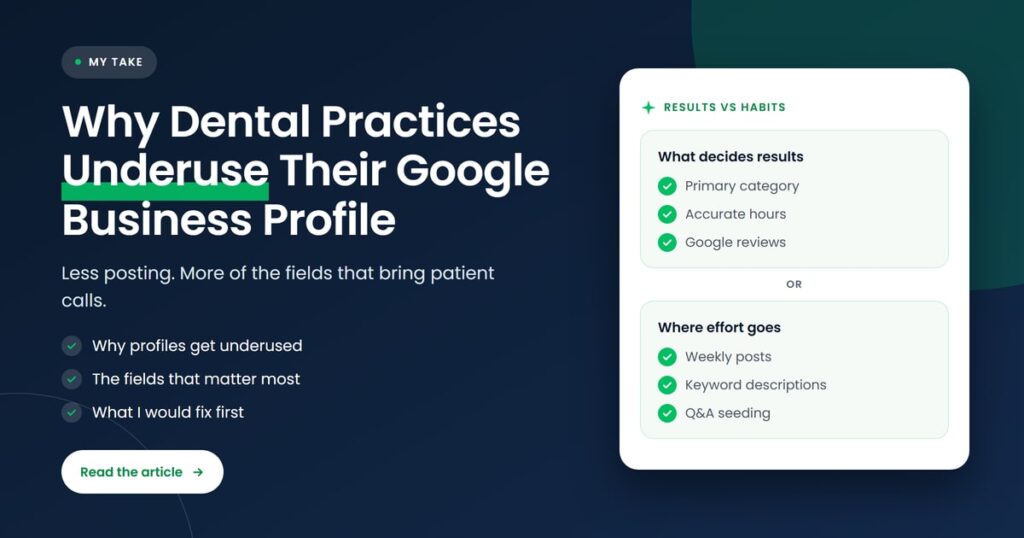
Quick answer: Most dental practices underuse their Google Business Profile because they treat it as a one-time setup and spend effort on posts and keyword-filled descriptions. I think the value sits in five things: the primary category, accurate business hours, a steady flow of genuine Google reviews with replies, complete services and a working booking link.
Key takeaways
- A Google Business Profile is the free listing that decides whether a dental practice shows in Google Maps and the local pack, and Google says nobody can pay for a better local ranking.
- I think most dental practices underuse it for 4 reasons: it is set up once, effort goes to posts, nobody owns the reviews, and success is judged by rankings instead of patient calls.
- The fields that matter most are the primary category, business hours, Google reviews and services. In Whitespark’s 2026 survey of 47 experts, the primary category ranked first of 187 local ranking factors.
- Google posts, keywords in the business description and the old Q&A section are overrated. Posts ranked 148th of 187 for local pack rankings.
- I would fix the category and hours first, then services, then a review routine, then the booking link.
- The profile still matters as patients ask AI tools, because those tools read the same profile data, reviews and website.
What is a Google Business Profile for a dental practice?
A Google Business Profile is the free listing Google shows for a dental practice in Google Maps and in the local pack on Google Search, with its name, address, phone number, business hours, category, services, photos and Google reviews. For most new patients, the Google Business Profile is the first version of the practice they see, before the website and before the phone call.
Google is open about how it picks which listings to show. Its Google Business Profile Help page “Tips to improve your local ranking on Google” says local results are mainly based on relevance, distance and prominence, that businesses with complete and accurate info are more likely to show up, and that there is no way to request or pay for a better local ranking. Distance is fixed by where the practice is. Relevance and prominence are where the work goes, and that is why I treat the profile as the core of local dental SEO, not as an extra.
Why do I think most dental practices underuse their Google Business Profile?
I think most dental practices underuse their Google Business Profile because they spend effort on the parts of the profile they can see changing, such as posts, and leave the fields that decide ranking and patient choice alone. The pattern has 4 parts: one-time setup, effort on posts, nobody owning reviews, and judging the profile by rankings instead of patient calls.
None of these is a failure of effort. Practice owners and front desks are busy, and most of the advice they read treats every field as equally important. It is the same problem I describe in the things I’d fix first in a struggling dental practice’s marketing: activity gets mistaken for progress.
Why is a Google Business Profile treated as a one-time setup?
A Google Business Profile is treated as a one-time setup because claiming and verifying it feels like the finish line. Someone at the practice, or a past agency, fills in the name, address and phone number, picks a category in 5 minutes and never looks at it again, even when the practice adds a dentist, extends its hours or starts offering implants.
The profile does not stay still when the practice stops looking. Google and the public can suggest edits, and in November 2026 Search Engine Roundtable reported that Google may add booking links to some profiles automatically, with some of those links breaking. A profile nobody checks drifts away from the real practice.
Why does effort go to Google posts instead of the fields that rank?
Effort goes to Google posts because posts are visible, easy to report and easy to sell as a monthly task. A post is proof that someone did something. A corrected primary category or an added list of services is invisible in a monthly report, even though it does more for the dental practice.
The expert data points the other way. In Whitespark’s 2026 Local Search Ranking Factors survey, published on November 6, 2025, the frequency of Google posts ranked 148th of 187 factors for local pack and Maps rankings, while the primary category ranked first. I don’t think posts are useless, but I think they are the most over-funded part of most dental practices’ Google Business Profile work.
Why does nobody own the Google reviews?
Nobody owns the Google reviews because asking for reviews falls between roles. The dentist thinks the front desk asks, the front desk thinks the agency handles it, and the agency can’t ask patients it never meets. The result is reviews that arrive in bursts after a push and then stop for months.
That gap is expensive. Reviews affect both where the Google Business Profile ranks and whether a patient picks the practice once they see it, which is why I spend a whole section on them below.
Why are profiles judged by rankings instead of patient calls?
Profiles are judged by rankings because a map ranking screenshot is easy to share and patient calls are harder to count. Google’s own performance report for a Business Profile already shows calls, bookings, direction requests, website clicks and the searches people used to find the practice, so the numbers that matter are there for anyone who opens it.
I think a Google Business Profile should be judged by patient calls and bookings first. A practice that ranks third in the local pack but gets more calls than the practice above it is winning, and a ranking report alone will never show that.
Which Google Business Profile fields matter most for a dental practice?
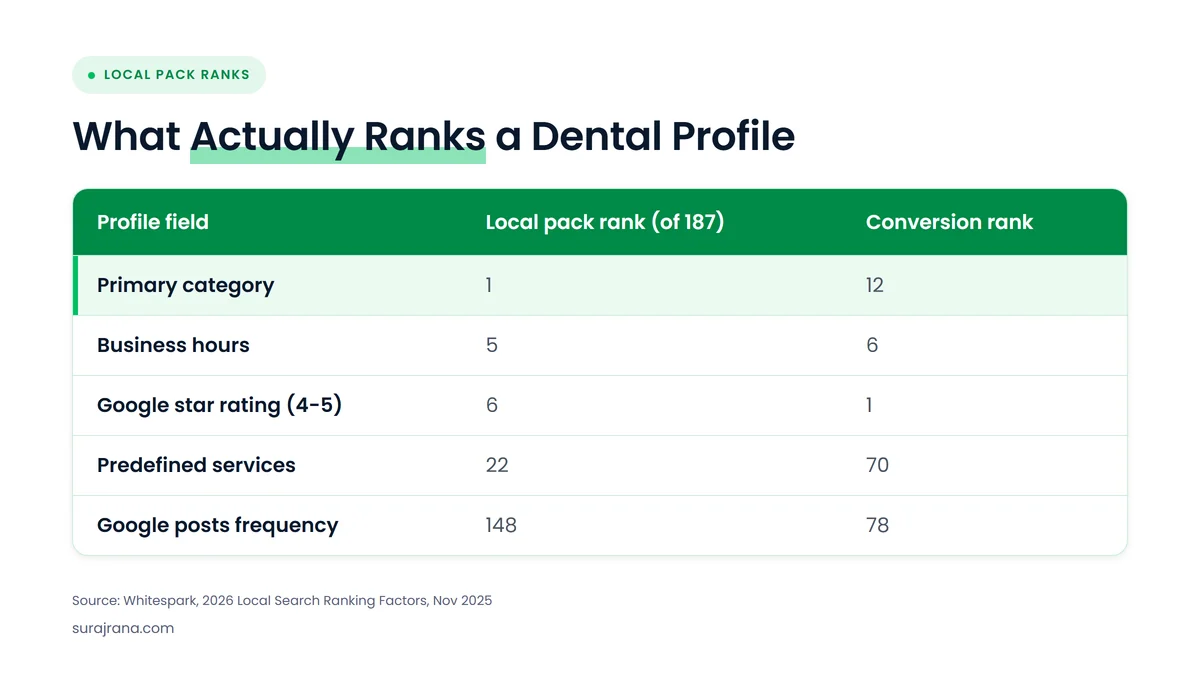
The Google Business Profile fields that matter most for a dental practice are the primary category, business hours, Google reviews and services, followed by the booking link for turning views into appointments. I base that ranking on Whitespark’s 2026 Local Search Ranking Factors survey, in which 47 local search experts scored 187 factors for their impact on local pack rankings and on conversions.
| Google Business Profile field | Local pack rank (of 187) | Conversion rank | My read for dental practices |
|---|---|---|---|
| Primary category | 1 (score 227) | 12 | Check it first |
| Business hours (open at time of search) | 5 (score 189) | 6 | Keep them accurate, including holidays |
| Google star rating of 4 to 5 | 6 (score 181) | 1 (score 213) | The main reason patients choose |
| Number of Google reviews with text | 9 (score 170) | 5 | Needs a steady routine, not bursts |
| Predefined services | 22 (score 134) | 70 | Add every treatment you offer |
| Number of photos | 96 (score 84) | 41 | Real photos, not volume |
| Owner responses to most reviews | 122 (score 70) | 17 | Matters to patients more than to rankings |
| Appointment URL | 146 (score 56) | 15 | A conversion tool, not a ranking tool |
| Frequency of Google posts | 148 (score 55) | 78 | Overrated |
| Keywords in the business description | 171 (score 41) | 87 | Overrated |
The table shows a clear split: the fields most practices ignore sit near the top of the local pack list, and the fields most practices spend time on sit near the bottom. Ranks and scores come from Whitespark’s “2026 Local Search Ranking Factors” report, and the right-hand column is my opinion.
Why is the primary category the most important field?
The primary category is the most important field because it tells Google what the dental practice is, and every relevance decision starts there. Whitespark’s experts ranked the primary GBP category first of 187 factors for local pack rankings, with a score of 227, just ahead of the distance between the searcher and the business at 225.
Google’s guidelines for representing a business ask owners to use as few categories as possible and to choose ones that are specific but representative of the core business. For a general practice, that usually means “Dentist” as the primary category and a small number of accurate additional categories, not every dental category in the list.
Why do accurate business hours matter so much?
Accurate business hours matter because Google favors practices that are open when the patient searches, and patients act on the hours they see. “Business is open at time of search” ranked 5th for local pack rankings and 6th for conversions in the Whitespark survey, and “proper hours set on GBP” rose 64 places to 21st since the previous edition.
The fix is honesty, not longer hours. Google’s guidelines ask for regular customer-facing hours, and listing hours the practice doesn’t keep leads to patients arriving at a locked door and leaving a review about it.
How do Google reviews decide which practice patients choose?
Google reviews decide which practice patients choose because the star rating, the number of reviews and their recency are the first signals a patient compares between 3 listings in the local pack. BrightLocal’s Local Consumer Review Survey 2026, published on February 11, 2026 from 1,002 US consumers, found that 97% of consumers read reviews for local businesses and 47% won’t use a business with fewer than 20 reviews.
Recency and replies matter as much as the total. The same survey found that 74% of consumers look for reviews written in the last 3 months, 31% will only use a business rated 4.5 stars or more (up from 17% a year earlier), 89% expect owners to respond to reviews and 50% are put off by templated replies. That matches the Whitespark data, where a 4 to 5 star rating is the first factor for conversions.
The way to get there is a routine, not a campaign. Google’s Maps User Generated Content Policy bans incentives for reviews and selectively asking happy patients only, so the routine has to ask every patient the same way. I’ve covered the details in ways to get more Google reviews without breaking Google’s rules.
Do services on a Google Business Profile affect rankings?
Yes, services on a Google Business Profile affect rankings, and they are one of the most underused fields in dental profiles. The presence of predefined services ranked 22nd of 187 local pack factors in Whitespark’s 2026 survey, and keywords in services ranked 34th.
Google Business Profile Help lets a practice pick predefined services suggested for its category and add custom services with a description. A practice that offers implants, clear aligners and emergency appointments should list each one, because that is how the profile matches the treatment a patient searched for. I made the full case in my post on why the Google Business Profile services list decides if AI recommends you.
Is a booking link worth adding?
Yes, a booking link is worth adding, but for patient bookings rather than for rankings. Whitespark’s experts ranked the presence of an appointment URL 146th for local pack rankings but 15th for conversions, which is the clearest sign that a booking link helps patients act once they find the practice.
Google Business Profile Help allows up to 10 links per category in the profile’s links section, and it notes that third-party booking links can’t be deleted from the profile by hand. Since Google may now add booking links on its own, I would check what the booking link on the profile opens at least once a month.
What do dental practices overrate on their Google Business Profile?
Dental practices overrate the parts of the Google Business Profile that look like activity: Google posts, keywords in the business description, the old Q&A section and keywords added to the business name. Each one either has little effect on local ranking or carries a risk that outweighs the gain.
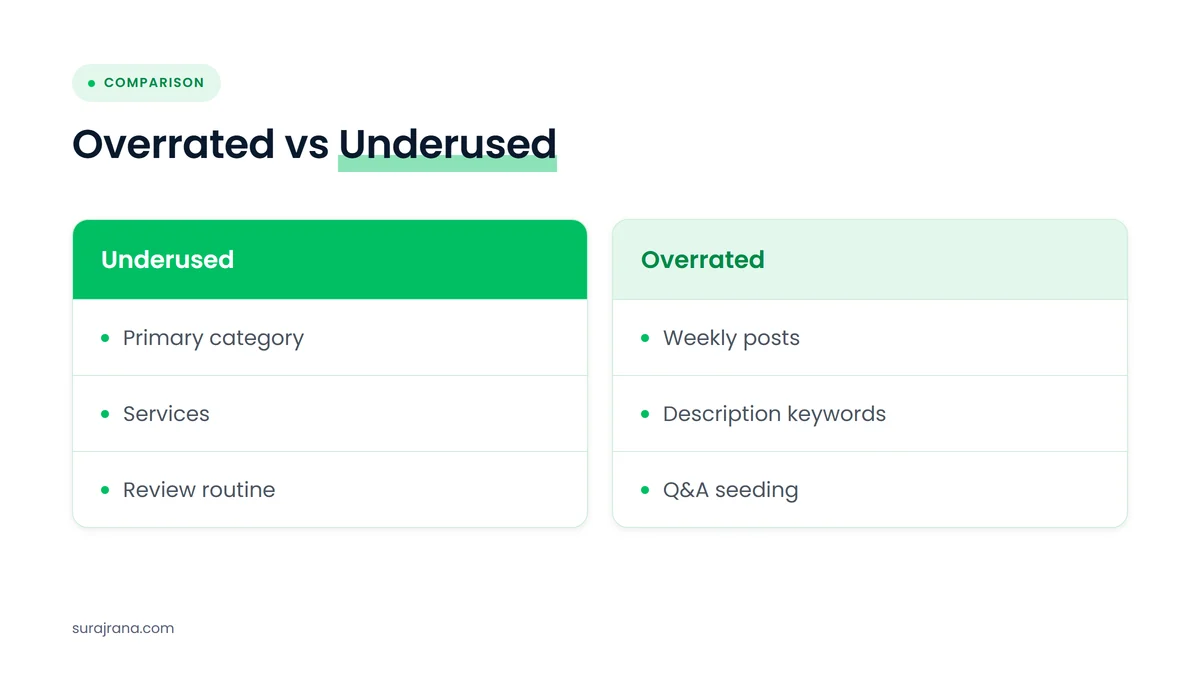
The 4 parts of a dental Google Business Profile I think get more attention than they deserve are listed below.
- Google posts: post frequency ranked 148th and post quantity 168th of 187 local pack factors. Posts can support an offer or a new service, but a weekly posting quota is not a local ranking plan.
- Keywords in the business description: ranked 171st of 187. The business description is for patients, so it should say who the practice serves and what it offers in plain words.
- The Q&A section: Search Engine Roundtable reported on December 15, 2025 that Google removed Q&A from the Google Maps front end and pointed searchers to an AI-powered Ask button. Seeding questions there is no longer worth a monthly task.
- Keywords in the business name: keywords in the business title ranked 3rd for local pack rankings, but Google’s guidelines say unnecessary information in the name isn’t permitted and could lead to suspension. I would never risk a dental practice’s profile for it.
I also see dental practices push for the SEO myths I still hear from dental practice owners, and posting every week to rank higher in Google Maps is one of the most common.
What would I fix first on a dental practice’s Google Business Profile?
I would fix the primary category and business hours first, then services, then a Google reviews routine, then the booking link, because that order follows the impact on local ranking and new patients. The order is my opinion, built on the Whitespark ranks in the table above.
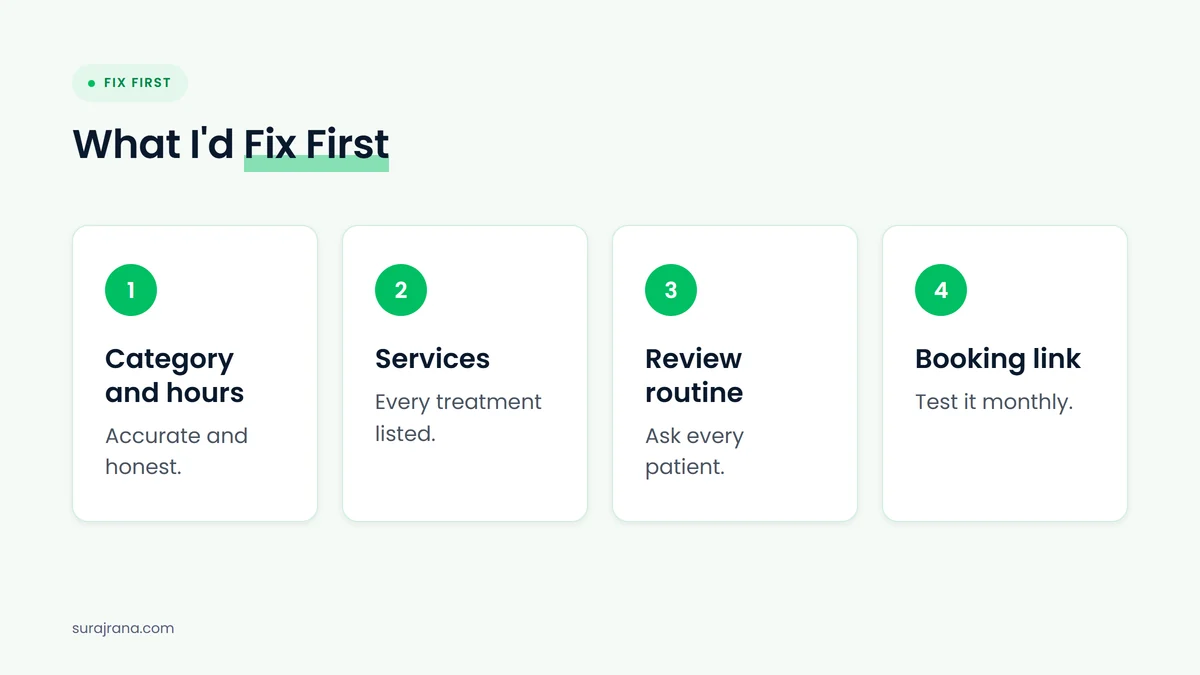
The 5 fixes I would make on a dental Google Business Profile, in order, are listed below.
- Check the primary category against what the practice earns most from, and trim additional categories to the accurate ones.
- Correct the business hours, including holiday hours and any late or weekend sessions.
- Add every treatment as a service, using predefined services first and custom services with a short description for the rest.
- Set up a review routine where every patient is asked the same way and every review gets a personal reply within a week.
- Test the booking link and the phone number, then watch patient calls and bookings in the performance report.
For the full field-by-field walkthrough, my Google Business Profile guide for dentists covers each setting in more depth.
Does a Google Business Profile still matter when patients ask AI tools?
Yes, a Google Business Profile still matters when patients ask AI tools, because those tools draw on the same profile data, Google reviews and website content. BrightLocal’s 2026 survey found that use of ChatGPT and other AI tools for local business recommendations rose from 6% to 45% in a year, so the profile now feeds AI answers as well as the local pack.
The border between the profile and the website is getting thinner. Google replaced the public Q&A with an AI Ask button that answers from the business’s information and reviews, and Whitespark’s experts ranked “dedicated page for each service” 2nd for AI search visibility. That is a website job, and it is why I wrote about whether Google AI Mode will replace the local map pack as a separate question.
Frequently asked questions
How often should a dental practice post on its Google Business Profile?
A dental practice should post on its Google Business Profile when it has something worth saying, such as a new service, a new dentist or holiday hours. Post frequency ranked 148th of 187 local pack factors in Whitespark’s 2026 survey, so a fixed weekly quota adds little to local ranking.
Should a dental practice add keywords to its business name?
No, a dental practice should not add keywords to its business name unless they are part of its real name. Google’s guidelines say unnecessary information in the name isn’t permitted and could result in the suspension of the Business Profile.
Does the Google Business Profile Q&A section still exist?
No, the Q&A section no longer shows on the Google Maps front end. Search Engine Roundtable reported on December 15, 2025 that Google replaced it with an AI-powered Ask button, while owners can still answer existing questions in the back end.
Should a dental practice reply to every Google review?
Yes, a dental practice should reply to every Google review with a personal reply, without confirming that the reviewer is a patient. BrightLocal’s 2026 survey found 89% of consumers expect owners to respond and 50% are put off by templated replies.
Who should own a dental practice’s Google Business Profile?
The practice owner should own the Google Business Profile, with the agency or office manager added as a manager rather than the owner. That keeps control of the listing, its Google reviews and its history with the practice if staff or agencies change.
Where do I land on dental practices and their Google Business Profile?
I think the Google Business Profile is the most underused asset a dental practice already owns. Most practices don’t need more posts. They need the right primary category, honest business hours, every service listed, a steady flow of genuine Google reviews with real replies, and a booking link that works. Those five things decide whether the practice shows up in the local pack and whether a patient calls once it does.
I’m Suraj Rana, and this is the order I follow when I look at a practice’s local visibility through my dental SEO services. If you’d rather have a team handle it, Dental Master Media manages Google Business Profile for dental clinics as part of its local SEO work.
Want a second opinion on your Google Business Profile?
I’m Suraj Rana, founder of Dental Master Media. If your practice has a Google Business Profile that isn’t bringing the patient calls it should, I’m happy to look at the category, hours, services and reviews with you and tell you what I’d change first.
Sources
- Google Business Profile Help, “Tips to improve your local ranking on Google”, accessed November 16, 2026. https://support.google.com/business/answer/7091
- Google Business Profile Help, “Guidelines for representing your business on Google”, accessed November 16, 2026. https://support.google.com/business/answer/3038177
- Google Business Profile Help, “Manage your services on your Business Profile”, accessed November 16, 2026. https://support.google.com/business/answer/9455399
- Google Business Profile Help, “Manage your local business links”, accessed November 16, 2026. https://support.google.com/business/answer/6218037
- Google Business Profile Help, “Understand your Business Profile performance & insights”, accessed November 16, 2026. https://support.google.com/business/answer/9918094
- Maps User Generated Content Policy Help, “Prohibited & restricted content”, accessed November 16, 2026. https://support.google.com/contributionpolicy/answer/7400114
- Whitespark, “2026 Local Search Ranking Factors”, November 6, 2025. https://whitespark.ca/local-search-ranking-factors/
- BrightLocal, “Local Consumer Review Survey 2026”, February 11, 2026. https://www.brightlocal.com/research/local-consumer-review-survey/
- Search Engine Roundtable, “Google Removing Q&A Feature In Google Maps For AI-Powered Ask Button”, December 15, 2025. https://www.seroundtable.com/google-maps-qa-feature-ask-40594.html
- Search Engine Roundtable, “Google Adding Booking Links To Business Profiles Automatically?”, November 9, 2026. https://www.seroundtable.com/google-business-profiles-adding-booking-links-42477.html

My name is Suraj Rana, and I am a seasoned Dental SEO Expert with extensive experience in the Dental SEO industry. Leveraging my deep knowledge and expertise, I help dental practices enhance their online visibility and attract more patients.