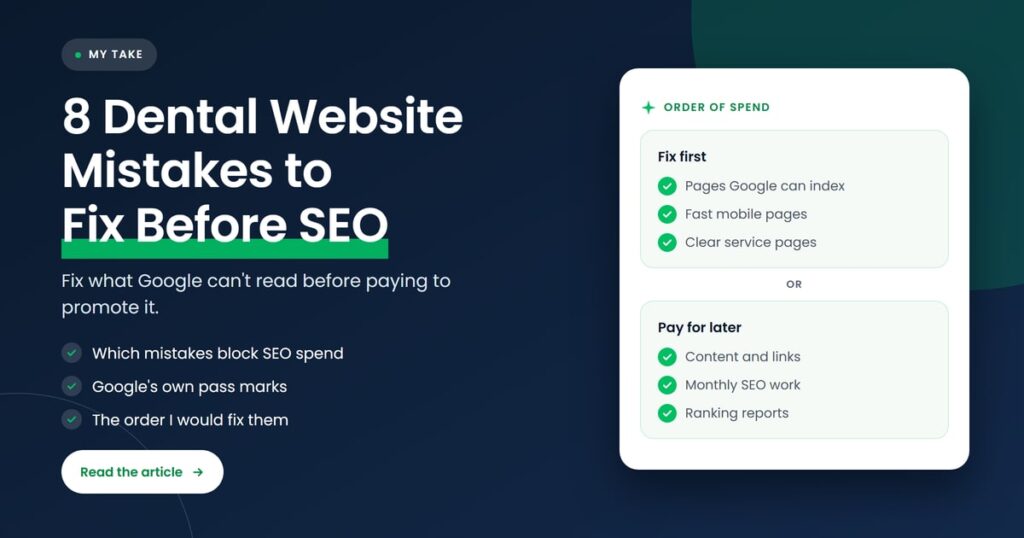
Quick answer: A practice should fix its dental website before it spends on SEO, because SEO spend on pages Google can’t crawl, load or understand is wasted. I would fix 8 things first: blocked pages, a thin mobile version, slow pages, insecure or pushy pages, weak title links, missing service pages, templated content and missing patient call tracking.
Key takeaways
- A dental website mistake worth fixing before SEO is any problem that stops Google from crawling, loading, understanding or measuring the pages a practice pays to promote.
- I think a dental website should be fixed first because SEO spend only works on pages Google can reach and read.
- The 8 fixes I would make first are blocked pages, a thin mobile version, slow pages, insecure or intrusive pages, weak title links, missing service pages, templated content and no measurement of patient calls.
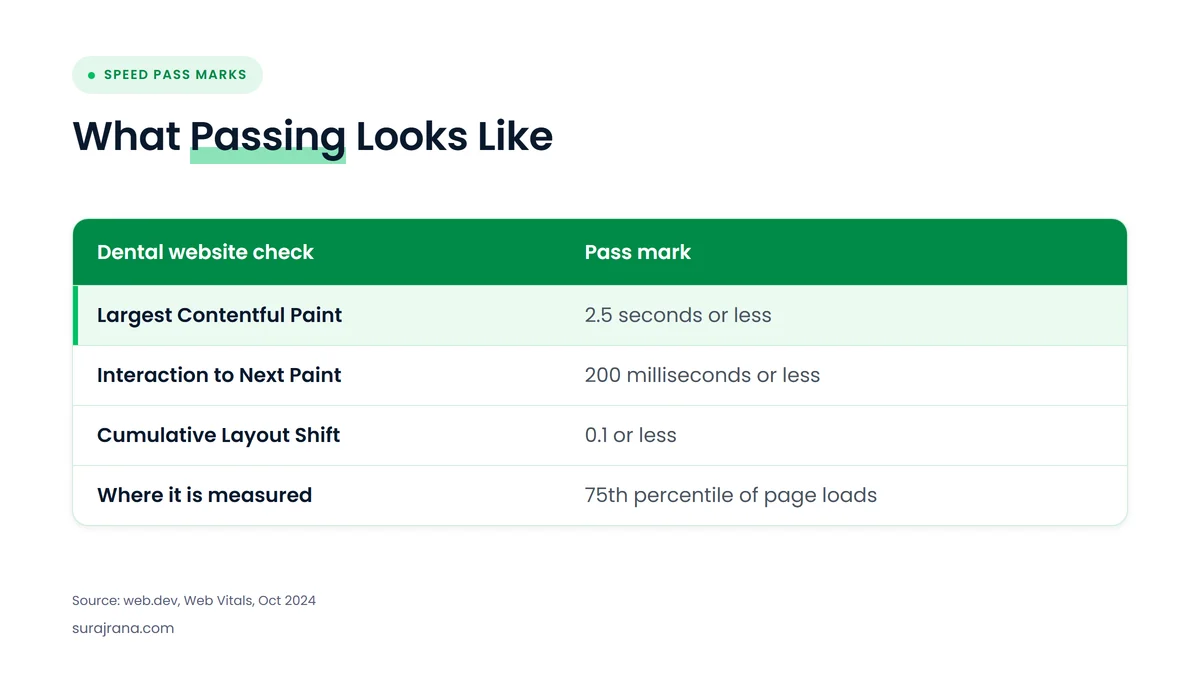
- web.dev sets the Core Web Vitals pass marks at 2.5 seconds, 200 milliseconds and 0.1, measured at the 75th percentile of page loads.
- I would fix them in order: access first, then mobile and speed, then pages and titles, then measurement.
- The dental website still matters when patients ask AI tools, because those tools read the same pages.
What is a dental website mistake worth fixing before SEO?
A dental website mistake worth fixing before SEO is a problem that stops Google from crawling, loading, understanding or measuring the pages a practice wants new patients to find. A broken title or a hidden page is not a design flaw. It is a leak that every later dollar of SEO spend has to pass through.
I use this test because it separates fixes that make dental SEO work from fixes that only make a site look newer. A fresh logo does not change what Google can read. A noindex tag left on from the build does.
Why do I think a dental website should be fixed before SEO spend?
I think a dental website should be fixed before SEO spend because SEO can only promote pages that Google can reach, load and understand, and most dental practices have at least one of the 8 problems below. Paying for content and links on top of them buys effort on a leaky base.
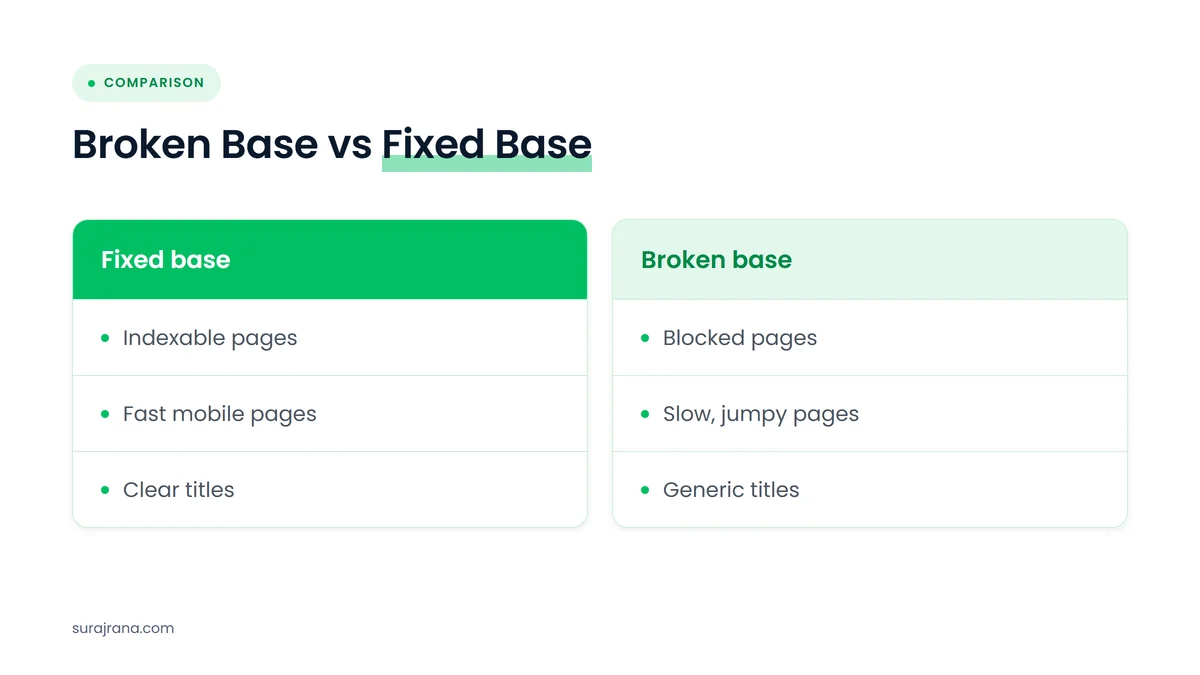
Google is clear that it wants helpful pages first. Google Search Central says Google Search always seeks to show the most relevant content, even if the page experience is sub-par. I read that as a reason to fix the basics once and then put money into content, not as a reason to ignore them. It is the same logic as the things I’d fix first in a struggling dental practice’s marketing: remove the leaks, then add effort.
Which 8 dental website mistakes would I fix before spending on SEO?
The 8 dental website mistakes I would fix before spending on SEO are blocked pages, a thin mobile version, slow pages, insecure or intrusive pages, weak title links, missing service pages, templated content and no measurement of patient calls. The table below lists the benchmarks that Google and Whitespark publish for the first checks.
| Dental website check | Pass mark or rule | Source |
|---|---|---|
| Largest Contentful Paint (LCP) | 2.5 seconds or less | web.dev, Web Vitals, Oct 2024 |
| Interaction to Next Paint (INP) | 200 milliseconds or less | web.dev, Web Vitals, Oct 2024 |
| Cumulative Layout Shift (CLS) | 0.1 or less | web.dev, Web Vitals, Oct 2024 |
| Where the score is measured | 75th percentile of page loads | web.dev, Web Vitals, Oct 2024 |
| Mobile version | Same content, headings and structured data as desktop | Google Search Central, mobile-first indexing |
| noindex tag | Page must not be blocked by robots.txt for noindex to work | Google Search Central, block indexing |
| Page experience questions | 3 checks: secure, no intrusive interstitials, good on mobile | Google Search Central, page experience |
| Dedicated page for each service | Rank 2 of 187 factors for AI search visibility | Whitespark, Nov 2025 |
The table shows that the first checks are pass-or-fail rules and numeric thresholds, not matters of taste. The 8 mistakes are explained below in the order I would check them.
1. Pages blocked from Google by a noindex tag or a robots.txt rule
Pages are blocked from Google when a noindex tag or a robots.txt rule stops Google crawling or indexing them, and a dental website can carry that block for years after a rebuild. Google Search Central says a page must not be blocked by robots.txt for a noindex rule to work, and that noindex inside robots.txt is not supported.
I check this first because everything else depends on it. A practice can pay for new treatment pages and find that the staging site’s noindex tag came across with the launch. It takes minutes to check and it can cost months if missed.
2. A mobile version that holds less than the desktop version
A thin mobile version is a dental website whose phone pages hold less content than its desktop pages, and it hurts because Google uses the mobile version crawled with the smartphone agent for indexing and ranking. Google Search Central asks for the same content, headings, structured data, robots meta tags and image alt text on both versions.
I see the risk in builds that hide long treatment text on small screens to keep pages short. Tabs and accordions are fine if the content is equivalent. Removing it is not.
3. Slow pages and layout jumps on mobile
Slow pages are pages that miss the Core Web Vitals pass marks: a Largest Contentful Paint of 2.5 seconds or less, an Interaction to Next Paint of 200 milliseconds or less and a Cumulative Layout Shift of 0.1 or less. web.dev says to measure them at the 75th percentile of page loads, split by mobile and desktop.
I am careful about how I describe this one. Google Search Central says it will show relevant content even when page experience is sub-par, so speed is not a magic ranking lever. I still fix it first because it is a one-off job, and a site that loads poorly is a weak base for any SEO spend.
4. Insecure pages and intrusive pop-ups
Insecure pages and intrusive pop-ups are page experience problems that Google asks site owners to check for. Google Search Central’s page experience guide lists 3 questions: whether pages are served securely over HTTPS, whether they avoid intrusive interstitials and whether the content displays well on mobile devices.
On a dental website the usual culprits are an old certificate, mixed content on a few pages and a full-screen offer that covers the page the moment a patient lands. Chrome Lighthouse can flag page experience issues, so a practice can run it on its own homepage in a couple of minutes.
5. Duplicate, empty or boilerplate title links
Weak title links are page titles that repeat across the site, contain only the practice name or add the same boilerplate to every page. Google Search Central says each page should have a title element with distinct text, and that Google may build its own title link from headings and on-page text when the title is missing or poor.
That matters because the title link is the first line a patient reads in the results. I would rather write one clear title per page than let Google guess, and I treat “Home | Practice Name” on every treatment page as a fix worth doing in a single afternoon.
6. One generic services page instead of dedicated service pages
A generic services page is a single page that lists implants, aligners and emergency care in a few lines each, and it gives Google and AI tools nothing specific to match against a patient’s question. Whitespark’s “2026 Local Search Ranking Factors” survey of 47 experts, published on November 6, 2025, ranked a dedicated page for each service 2nd of 187 factors for AI search visibility.
I think this is the biggest content gap on dental websites. The service pages are also where a new patient decides whether to call, so they carry SEO value and booking value at once.
7. Templated pages that repeat the same text
Templated pages are pages produced from one block of text with only the city, treatment or dentist name swapped. Google’s spam policies define scaled content abuse as many pages generated mainly to manipulate rankings, and doorway abuse as pages created to rank for specific, similar queries that lead users to a less useful destination.
I would not risk a practice’s whole website on a batch of cloned pages, which is why I wrote about why Google is cracking down on generic dental website content. One honest page per service beats 40 copies.
8. No measurement of patient calls and bookings from the website
No measurement means the practice cannot tell which pages bring patient calls, bookings and direction requests, so SEO spend cannot be judged. Google’s Business Profile performance report already shows calls, bookings, direction requests and website clicks, which means part of the data exists for any practice that opens it.
I would add call and form tracking to the website so every page that is supposed to bring new patients can be checked against a number. Without it, a practice ends up judging an SEO agency by ranking screenshots, a habit I push back on in why ranking promises are an SEO red flag.
In what order would I fix the 8 dental website mistakes?
I would fix the 8 dental website mistakes in 5 steps: access first, then mobile and speed, then security, then titles and service pages, then measurement. The order follows what Google needs before it can rank anything: reach the page, read the page, then choose the page.
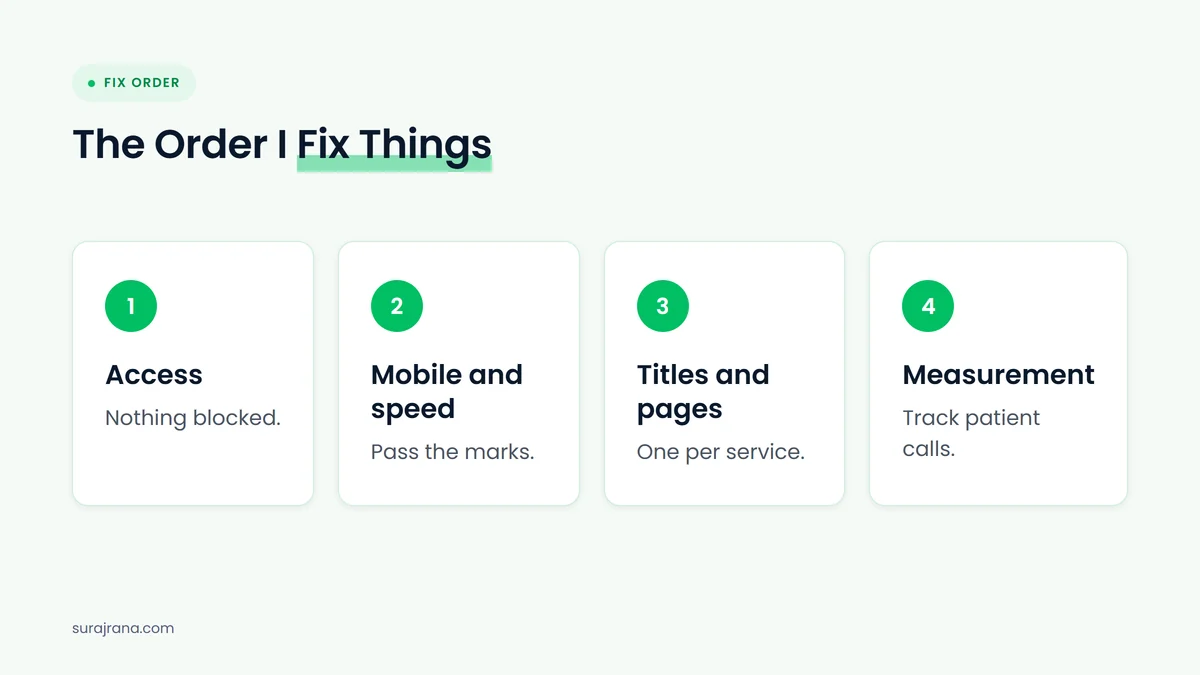
The 5 steps I would follow on a dental website before SEO spend are listed below.
- Check access to every important page for noindex tags and robots.txt rules.
- Compare the mobile version with the desktop version, then test the Core Web Vitals pass marks.
- Confirm security over HTTPS and remove full-screen pop-ups that cover content.
- Rewrite title links and build one dedicated page for each service, replacing templated copies.
- Track patient calls and bookings from the website before the first SEO invoice.
If a practice has already done the first 3 steps, the rest is where SEO spend starts to pay back. I made the wider case for owning these basics in why I think every dental practice should own its website.
Does a dental website still matter when patients ask AI tools?
Yes, a dental website still matters when patients ask AI tools, because those tools read the same pages, titles and service details that Google reads. BrightLocal’s Local Consumer Review Survey 2026, published on February 11, 2026, found that the share of consumers using ChatGPT or other generative AI for business recommendations rose from 6% to 45% in one year.
That makes the 8 fixes more important, not less, because a blocked or generic page gives an AI tool nothing to quote. The wider question of how design and AI search connect is covered in why website design matters more for SEO now.
Frequently asked questions
Should a dental practice fix its website before hiring an SEO company?
Yes, a dental practice should check the 8 mistakes above before hiring an SEO company, and a good company will check them in its first audit. The aim is to make sure the first months of SEO spend go on growth, not on repairs. It is one of the SEO myths I still hear from dental practice owners that rankings can improve while the base is broken.
Does a slow dental website stop it ranking?
No, a slow dental website does not automatically stop ranking, because Google Search Central says it always seeks the most relevant content even if page experience is sub-par. A slow site still wastes the advantage page experience gives when many helpful pages compete for the same query.
Does a dental website need a full redesign before SEO starts?
No, a dental website does not need a full redesign before SEO starts, unless the 8 problems cannot be fixed on the current build.
If the site is hard to update, Dental Master Media’s guide on how to know when a dental website needs a redesign sets out 6 tests with numbers.
Can robots.txt hide a dental website page from Google?
No, robots.txt cannot reliably hide a dental website page from Google. Google Search Central says a page blocked by robots.txt can still appear in results if other pages link to it, and that Google never sees a noindex tag on a blocked page.
Where do I land on fixing a dental website before SEO?
I think fixing the dental website first is the cheapest SEO decision a practice can make. Access, mobile, speed, security, titles, service pages, original content and call tracking are not glamorous, but they decide whether every later dollar of SEO spend reaches new patients.
I’m Suraj Rana, and this is the checklist I use before I recommend my dental SEO services. If a practice would rather have a team rebuild the base, Dental Master Media offers dental website design and development services.
Want me to look at your dental website first?
I’m Suraj Rana, founder of Dental Master Media. If you’re about to spend on SEO, I’m happy to look at your website with you and tell you what I’d fix first.
Sources
- web.dev, “Web Vitals”, updated October 31, 2024. https://web.dev/articles/vitals
- Google Search Central, “Mobile site and mobile-first indexing best practices”, accessed November 21, 2026. https://developers.google.com/search/docs/crawling-indexing/mobile/mobile-sites-mobile-first-indexing
- Google Search Central, “Block Search indexing with noindex”, accessed November 21, 2026. https://developers.google.com/search/docs/crawling-indexing/block-indexing
- Google Search Central, “Understanding page experience in Google Search results”, accessed November 21, 2026. https://developers.google.com/search/docs/appearance/page-experience
- Google Search Central, “Influencing your title links in search results”, accessed November 21, 2026. https://developers.google.com/search/docs/appearance/title-link
- Google Search Central, “Spam policies for Google web search”, accessed November 21, 2026. https://developers.google.com/search/docs/essentials/spam-policies
- Google Business Profile Help, “Understand your Business Profile performance & insights”, accessed November 16, 2026. https://support.google.com/business/answer/9918094
- Whitespark, “2026 Local Search Ranking Factors”, November 6, 2025. https://whitespark.ca/local-search-ranking-factors/
- BrightLocal, “Local Consumer Review Survey 2026”, February 11, 2026. https://www.brightlocal.com/research/local-consumer-review-survey/

My name is Suraj Rana, and I am a seasoned Dental SEO Expert with extensive experience in the Dental SEO industry. Leveraging my deep knowledge and expertise, I help dental practices enhance their online visibility and attract more patients.