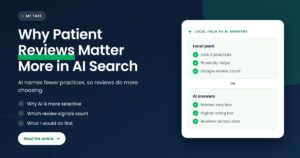

Quick answer: I think patient reviews matter more than ever in AI search because AI tools name far fewer dental practices than the local pack does, and reviews are the evidence they read to choose. ChatGPT recommended 1.2% of brand locations in SOCi’s 2026 study. Rating, review count and where the reviews appear all count.
Key takeaways
- Patient reviews are the opinions patients publish about a dental practice on Google and on third-party sites, and AI tools read them to decide which practices to name.
- I think reviews matter more now because AI search is selective: SOCi found ChatGPT recommended 1.2% of brand locations, against 35.9% for the Google 3-pack.
- The star rating bar is higher: locations ChatGPT recommended averaged 4.3 stars, and 68% of consumers in BrightLocal’s 2026 survey only use businesses rated 4 stars or more.
- In Whitespark’s 2026 survey, reviews on authoritative third-party sites ranked 5th of the AI search factors, while the count of Google reviews ranked 35th.
- AI-recommended practices tend to have large review counts: where engines quoted a count for a dentist, the median was 368 reviews in Whito’s August 2026 test.
- Reviews do not decide everything: only 5 of 59 dental practices were named by all three AI engines Whito tested.
What are patient reviews in AI search?
Patient reviews in AI search are the star ratings and written reviews that patients leave about a dental practice on Google and on third-party sites, which AI tools such as ChatGPT, Gemini and Perplexity read when they answer a question like “who is the best dentist near me”. The review text, the rating and the number of reviews are all evidence for the answer.
Nobody outside the AI companies knows exactly how each tool weighs reviews, and none of them has published a formula. What exists is outside research: expert surveys, studies of AI answers and consumer surveys. I use only that research here, and I label my own opinion as opinion.
Why do I think patient reviews matter more than ever in AI search?
I think patient reviews matter more than ever in AI search for 3 reasons: AI tools name far fewer dental practices than the local pack, more patients now ask AI tools for recommendations, and the rating bar for being named is higher. A practice with thin or low-rated reviews can be left out of an AI answer entirely, and that costs new patients before they ever see the website.
Why is AI search so much more selective than the local pack?
AI search is more selective than the local pack because it names a handful of businesses instead of listing three or more. In SOCi’s 2026 Local Visibility Index, covering more than 350,000 locations across 2,751 multi-location brands, ChatGPT recommended 1.2% of brand locations, while the Google 3-pack showed 35.9% of them, as reported by Localogy on January 28, 2026.
That gap changes what a review is for. In the local pack, a practice with average reviews can still show up on proximity. In an AI answer there is often one name or a short list, so the reviews have to make the case that the practice is safe to recommend. I read that as reviews doing more of the selecting work than they used to.
Why are more patients using AI tools to choose a dentist?
More patients are using AI tools to choose local businesses because the habit grew fast: BrightLocal’s Local Consumer Review Survey 2026, published on February 11, 2026, found that 45% of 1,002 US adults used ChatGPT or other generative AI tools for local recommendations, up from 6% the year before. That survey covers local businesses in general, not dentists only.
The same survey found that 82% of consumers read AI-generated review summaries, and 23% of those readers would rely on the summary alone. A patient who never opens the individual reviews is still judging the practice by them, through a summary the practice does not write.
Why does the star rating bar sit higher in AI answers?
The star rating bar sits higher in AI answers because the businesses AI tools recommend are the well-rated ones: SOCi found that locations recommended by ChatGPT averaged 4.3 stars. Patients set a similar bar, since BrightLocal’s 2026 survey found 68% only use a business rated 4 stars or more, up from 55%, and 31% want 4.5 stars or more, up from 17%.
The bar is moving up on both sides. A rating that was acceptable two years ago can now keep a practice out of the answer, which is why I treat reputation as part of dental SEO and not as a separate customer service task.
Which patient review signals do AI tools weigh most?
The patient review signals that AI tools weigh most, according to local search experts, are where the reviews appear and how positive they are, more than the count of native Google reviews. In Whitespark’s 2026 Local Search Ranking Factors survey, published on November 6, 2025, the authority of third-party sites carrying reviews ranked 5th for AI search and a high Google rating ranked 8th.
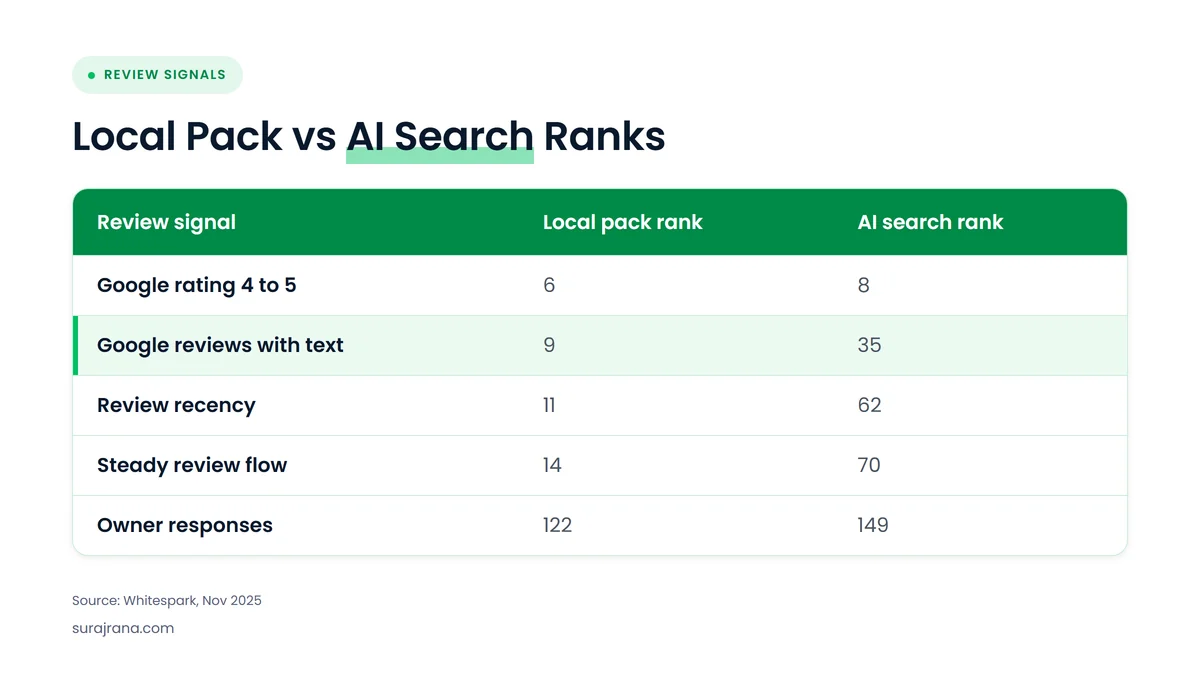
| Patient review signal | Local pack rank | AI search rank | My read for dental practices |
|---|---|---|---|
| Authority of third-party sites with reviews | Not compared here | 5 (score 156) | Reviews beyond Google carry weight |
| High Google rating (4 to 5 stars) | 6 (score 181) | 8 (score 146) | Matters in both, keep it high |
| Diversity of third-party sites with reviews | Not compared here | 11 (score 136) | Be present on more than one site |
| Positive sentiment in review text | Not compared here | 22 (score 126) | What patients write counts |
| Number of native Google reviews with text | 9 (score 170) | 35 (score 112) | Still useful, less central for AI |
| Review recency | 11 (score 164) | 62 (score 89) | Less central for AI |
| Sustained influx of reviews, not bursts | 14 (score 154) | 70 (score 81) | Less central for AI |
| Owner responses to most reviews | 122 (score 70) | 149 (score 34) | For patients, not for AI |
The table shows that the review signals tied to Google, such as review count, recency and a steady flow, rank lower for AI search than for the local pack, while reviews spread across authoritative sites rank near the top. The ranks and scores come from Whitespark’s “2026 Local Search Ranking Factors”, and the right-hand column is my opinion.
Why do reviews on third-party sites count for more in AI search?
Reviews on third-party sites count for more in AI search because AI tools gather evidence from many places, not only from Google. Whitespark’s experts ranked the authority of third-party sites carrying reviews 5th and the diversity of those sites 11th for AI search, ahead of native Google review quantity at 35th.
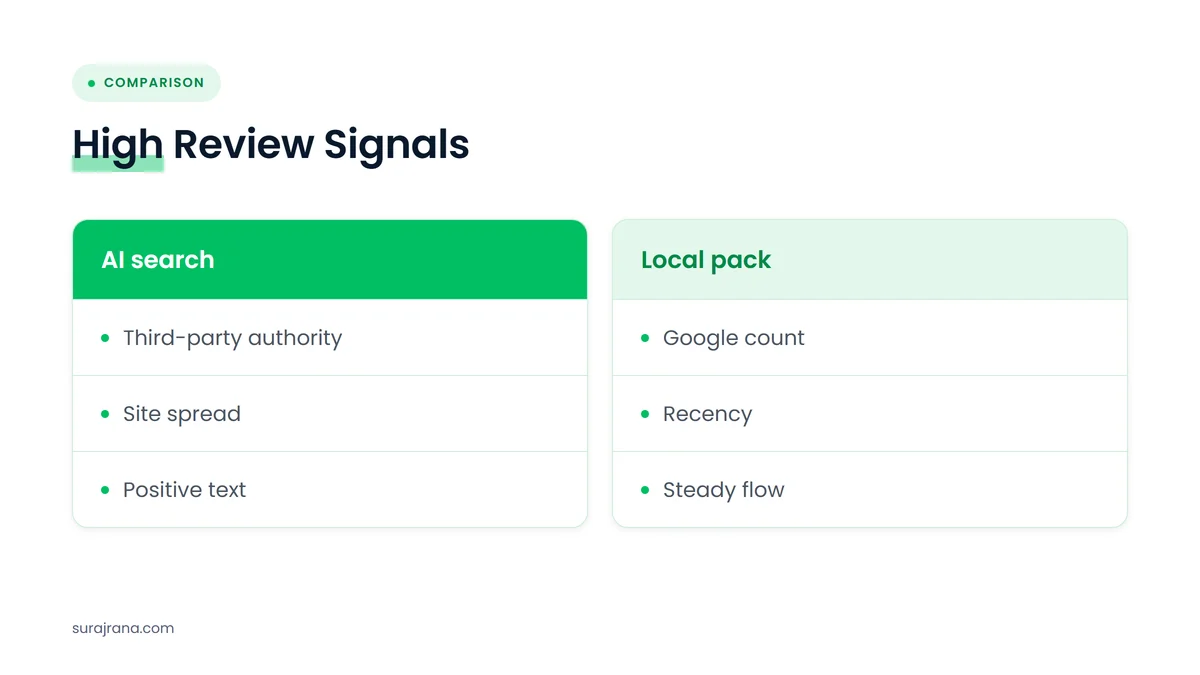
I think this is the most overlooked point for dental practices. Most practices count only their Google reviews, and a practice with 400 Google reviews and nothing anywhere else is giving AI tools one source to read. Whitespark does not say which third-party sites matter for dentists, so I would not guess. I would look at which sites already show up when you search for your practice by name.
How many patient reviews do AI-recommended dental practices have?
AI-recommended dental practices have large review counts: in Whito’s test of 84 dentist recommendations in 6 UK cities, the median review count the engines quoted was 368, across the 54 recommendations where a count was quoted. Whito ran the same question, “Who is the best private dentist in [city]?”, on ChatGPT, Gemini and Google AI Mode on August 14, 2026.
A second study points the same way. Insites, an AI visibility company, analyzed 10,000 US local businesses on ChatGPT and Perplexity and reported on August 12, 2026 that businesses recommended most often averaged 304.2 reviews, against 117.5 for businesses never recommended. That is a correlation from a vendor, and it does not prove that more reviews cause more recommendations. Patients set a floor as well: 47% of consumers in BrightLocal’s 2026 survey will not use a business with fewer than 20 reviews.
Does what patient reviews say matter more than the star rating?
Yes, I think what patient reviews say matters at least as much as the star rating, because the review text is what AI tools can read and quote. Whitespark’s experts ranked positive sentiment in review text 22nd for AI search, and keywords in third-party reviews 33rd, ahead of keywords in native Google reviews at 53rd.
A review that says a dentist explained the treatment plan and was gentle with a nervous patient tells an AI tool more than five stars with no words. I can’t prove how any one tool uses that text, so I treat it as a reason to ask patients for honest detail and never to script it.
Do owner replies to patient reviews help in AI search?
No, owner replies to patient reviews do not appear to help much in AI search, because Whitespark’s experts ranked the presence of owner responses to most reviews 149th for AI search and 122nd for the local pack. Patients still care: BrightLocal’s 2026 survey found 89% of consumers expect owners to reply, and 50% are unlikely to use a business with templated replies.
So I reply for the patient reading the reviews, not for the AI tool. Google’s own guidance says replies should be short, professional and relevant, not the same thank-you for everyone. I wrote about the risk of lazy automation in the AI review replies quietly working against your dental practice’s local SEO.
What do patient reviews not decide in AI search?
Patient reviews do not decide the whole AI answer: the engines often disagree, and strong reviews do not make a practice appear everywhere. In Whito’s UK test, 59 different dental practices were named across 84 recommendation slots, 66% were named by only one engine, and only 5 practices (8.5%) were named by all three engines.
SOCi’s data supports the same caution from the other side: in its report, only 45% of retail brands appeared in both traditional search and AI-engine results. Reviews are one input next to the website, the Google Business Profile and listings across the web, which I covered in why most dental practices underuse their Google Business Profile. I would not sell reviews to a practice owner as a switch that turns on AI recommendations. I would sell them as the thing that stops a practice from being ruled out.
What would I do about patient reviews first?
I would make patient reviews a routine for the whole practice, ask every patient the same way, and check where the reviews live.
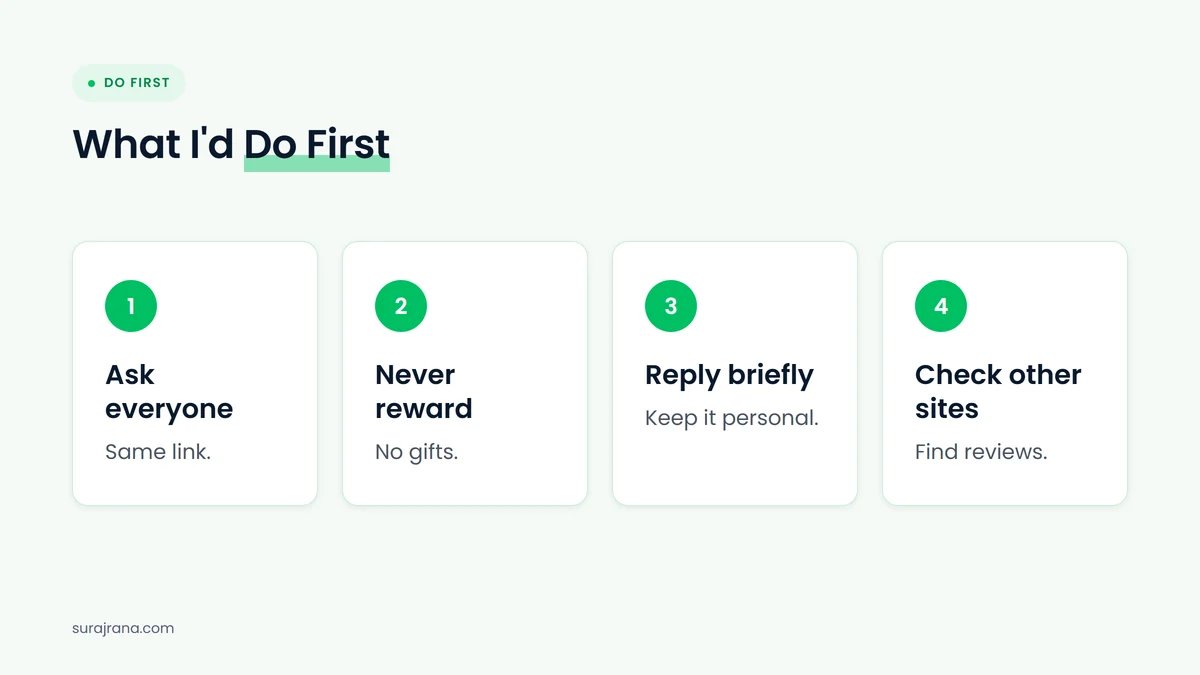
The 4 actions I would take, in order, are listed below.
- Ask every patient for a Google review with the same link or QR code, since Google’s Business Profile Help says businesses can ask customers to leave reviews this way.
- Never reward patient reviews with discounts or gifts, because Google’s policy calls incentivized reviews fake and misleading content.
- Reply to patient reviews personally and briefly, and keep private patient information out of every reply.
- Search your practice name and note which other sites show reviews, then ask patients to review on one of them as well.
For the practical side of asking, the Dental Master Media article on ways to get more Google reviews without breaking Google’s rules goes through the wording and timing.
Frequently asked questions
Do patient reviews affect which dentist ChatGPT recommends?
Patient reviews appear to affect which dentist ChatGPT recommends, although no AI company has published how it weighs them. SOCi found ChatGPT-recommended locations averaged 4.3 stars, and Insites found that businesses recommended most often had more than twice the reviews of those never recommended.
How many patient reviews does a dental practice need for AI search?
No AI tool publishes a minimum number of patient reviews, so a dental practice cannot target an exact count. The nearest evidence is that the median count quoted for AI-recommended dentists was 368 in Whito’s August 2026 test, and that 47% of consumers will not use a business with fewer than 20 reviews.
What star rating do AI tools recommend?
AI tools tend to recommend highly rated businesses: locations that ChatGPT recommended averaged 4.3 stars in SOCi’s 2026 study. A rating of 4 stars or more is also the line for 68% of consumers in BrightLocal’s 2026 survey.
Should a dental practice pay patients for reviews?
No, a dental practice should not pay patients or offer discounts or gifts for reviews. Google’s policy says offering free or discounted goods or services in exchange for reviews is fake and misleading content and is strictly prohibited.
Should a dental practice reply to every patient review?
Yes, a dental practice should reply to patient reviews, mainly for the patients who read them. BrightLocal’s 2026 survey found 89% of consumers expect owners to respond, even though Whitespark’s experts ranked owner responses 149th for AI search.
Where do I land on patient reviews and AI search?
I think patient reviews are the most important thing a dental practice can influence in AI search, and also the most misunderstood. They matter more than they did in the local pack era because AI tools name fewer practices and ask for a higher rating. But they work through where they appear and what they say, not through a Google count alone, and they do not replace the website or the profile.
I’m Suraj Rana, and when I look at a practice’s local visibility through my dental SEO services, the review picture across Google and other sites is one of the first things I check. If patients can’t find the proof that your practice is good, AI tools have little to quote.
Want a second opinion on your patient reviews?
I’m Suraj Rana, founder of Dental Master Media. If your practice has solid care but thin or uneven reviews, I’m happy to look at your rating, your review spread and your replies with you, and tell you what I’d fix first.
Sources
- Whitespark, “2026 Local Search Ranking Factors”, November 6, 2025. https://whitespark.ca/local-search-ranking-factors/
- BrightLocal, “Local Consumer Review Survey 2026”, February 11, 2026. https://www.brightlocal.com/research/local-consumer-review-survey/
- Localogy (Mike Boland), “SOCi’s LVI Report Reveals How AI Is Rewriting Local Search Visibility”, January 28, 2026. https://www.localogy.com/2026/01/soci-lvi-report-reveals-how-ai-is-rewriting-local-search-visibility/
- Whito, “AI dentist recommendations”, August 14, 2026, updated November 23, 2026. https://whito.co.uk/research/ai-dentist-recommendations/
- Insites (Andrew Waite), “Do Google reviews affect AI recommendations? Yes, here’s by how much”, August 12, 2026. https://insites.com/blog/do-google-reviews-affect-ai-recommendations-yes-heres-by-how-much/
- Google Business Profile Help, reviews and review policy page, accessed November 25, 2026. https://support.google.com/business/answer/3474122

My name is Suraj Rana, and I am a seasoned Dental SEO Expert with extensive experience in the Dental SEO industry. Leveraging my deep knowledge and expertise, I help dental practices enhance their online visibility and attract more patients.