
Quick answer: Google is testing a sign-in wall that appears right after the first search, a new step in its push against search scrapers. I think it confirms that scraped rank data is getting less reliable for rank trackers, AI visibility tools and agencies, so businesses should judge SEO by Google Search Console first-party data first.
Key takeaways
- Google is testing a sign-in wall after the first search, where an August 2026 test only appeared after a few result pages. A Google engineer said it may be a test.
- The sign-in wall is the 8th step I count since January 2025 in Google’s push against search scrapers, after the JavaScript requirement, the num=100 removal, the SerpApi lawsuit, poisoned SERPs and goto link limits.
- Rank trackers, AI visibility tools, agencies and the businesses paying for their rank reports are all affected, because all of them depend on scraped search results.
- I think scraped rank data is now a rough sample, not a daily truth, and nobody should make budget decisions on a single rank report.
- Google Search Console is first-party data from Google itself, and it is the source I trust first for clicks, impressions, queries and average position.
- Agencies should explain the change to clients before a broken rank report does it for them.
What is Google’s sign-in wall test for search scrapers?
Google’s sign-in wall test for search scrapers is a prompt that asks a searcher to sign in to a Google account before seeing results, shown right after the first search instead of after several queries. Search Engine Roundtable reported the test on November 17, 2026, and described it as Google’s latest attempt to stop scrapers and third-party tools from collecting its search results.
Brodie Clark of SERPalerts spotted the sign-in wall and shared a video on X. He said he had never been forced to sign in when using incognito before, that the screen had appeared regularly over a couple of days, and he connected it to Google’s recent delays on goto links. Rajan Patel of Google replied that he did not think the prompt was meant to appear on the first page of results, but that Google may be testing something. So this is a test, not a confirmed rollout.
The idea is not new. On August 3, 2026, Search Engine Roundtable covered an earlier version that asked people to “sign in to verify you’re a human and see more results” after clicking through several result pages. What changed in November is the trigger point: the first search. As someone who sells dental SEO and reports on it every month, I read that change as a signal about where Google is heading, not as a glitch.
Why is Google putting up walls against search scrapers?
Google is putting up walls against search scrapers because it says automated scraping abuses its systems and resells content it does not own, and it has added a new barrier roughly every few months since January 2025. The sign-in wall is the latest of 8 steps I have tracked, and each one made scraped rank data harder or slower to collect.
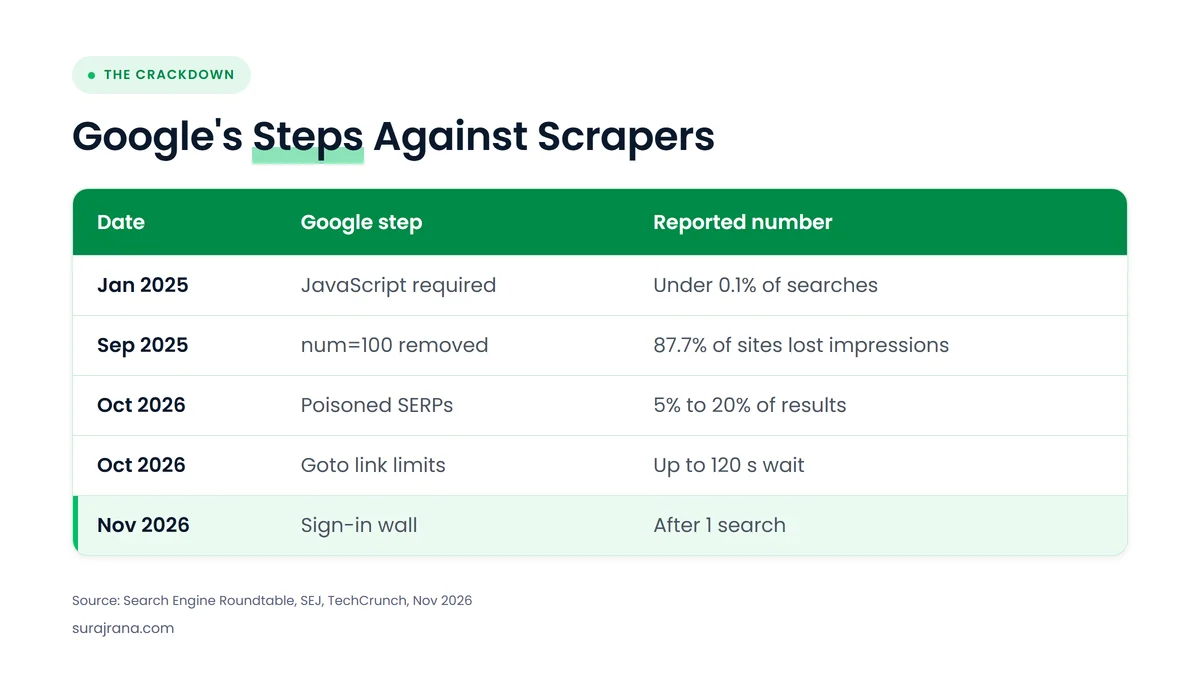
| Date | Google’s step against search scrapers | Reported number | Source |
|---|---|---|---|
| January 17, 2025 | JavaScript required to use Google Search | Fewer than 0.1% of searches came from people with JavaScript off | TechCrunch |
| September 2025 | The num=100 parameter stops showing 100 search results per page | 87.7% of about 320 Search Console properties lost impressions | Search Engine Roundtable |
| December 19, 2025 | Google sues SerpApi for bypassing SearchGuard | “Hundreds of millions” of artificial searches a day, by Google’s estimate | Search Engine Roundtable |
| August 3, 2026 | Sign-in to verify you’re human, deeper in the results | Shown after the first few pages | Search Engine Roundtable |
| September 18, 2026 | Wider blocking of scrapers and tracking tools | About 80% drop in data Nozzle could collect | Search Engine Roundtable |
| October 12, 2026 | Poisoned SERPs served to suspected scrapers | 5% to 20% of results affected (Ahrefs); 8.0% (Nozzle) | Search Engine Roundtable |
| October 30, 2026 | Limits on how fast goto links can be followed | 15th link on a page waits about 40 seconds, up to 120 seconds | Search Engine Journal |
| November 17, 2026 | Sign-in wall right after the first search | Shown after 1 search | Search Engine Roundtable |
The table shows a clear direction: every step since 2025 raised the cost of collecting Google search results by machine, and the sign-in wall moves the barrier from page 3 or 4 to the very first search. The numbers are what each publication reported at the time, not my own measurements.
Google’s own explanation is about abuse, not SEO tools. When it began requiring JavaScript, a Google spokesperson told TechCrunch the change helps protect its services and users from bots and spam. In its SerpApi announcement on December 19, 2025, Google said unlawful scraping had “increased dramatically” over the past year. The case did not go Google’s way: Search Engine Roundtable updated its story to say the court granted SerpApi’s motion to dismiss on July 21, 2026. I think that ruling is part of why Google is now leaning on technical barriers like the sign-in wall instead of lawyers.
Who is affected by Google’s sign-in wall for search scrapers?
Google’s sign-in wall for search scrapers affects 4 groups: rank trackers, AI visibility tools, the agencies that build reports on both, and the businesses that pay for those rank reports. Each group sits one step further from the scraper, which is why the last group often finds out last.
Rank trackers
Rank trackers are hit first, because rank tracking works by running thousands of searches without a signed-in user and reading the search results. A sign-in wall after the first search would turn every new query into a blocked query unless the tool can get around it, and every workaround costs money that ends up in the subscription price.
Rank trackers were already struggling before this test. Search Engine Roundtable reported on October 12, 2026 that Sistrix missed a site’s recovery, Semrush showed it with a lag, and SE Ranking reported missing positions for some keywords, while Ahrefs estimated that 5% to 20% of search results were poisoned depending on the data provider. One founder described the same problem from the inside, writing about results he had collected from a SERP data provider.
“~35% of recent scrapes had completely fake Page 1 rankings”
ILIAS ISM (@illyism) on X, November 16, 2026 (source)
That is one founder’s report about one provider, not a measured industry study, and I would not quote 35% as a market-wide number. But it matches what the larger tools reported in October: poisoned SERPs are real, and a rank report can look normal while being wrong.
AI visibility tools
AI visibility tools are affected because the ones that report on Google AI Overviews and AI Mode collect that data the same way rank trackers do: by running searches and reading the page. If a sign-in wall blocks an anonymous search, it blocks the AI Overview on that page too.
I think this matters more than most agencies realize, because AI visibility is the newest line item in SEO proposals and the hardest to check. A business that pays for an AI search visibility audit should ask how the tool collected its Google data and on what date, the same way it should ask a rank tracker.
Agencies
Agencies are affected because most monthly SEO reports still lead with scraped rank data, and the agency, not the tool, has to explain a sudden drop to the client. When poisoned SERPs or goto links make a page look like it lost rankings, the client sees a loss that may not exist.
I run 2 agencies, Dental Master Media and SERP Master, and the cost lands on us twice: once in tool subscriptions that keep rising, and again in the time it takes to check whether a drop in a rank report is real before a client call.
Businesses that pay for SEO reports
Businesses that pay for SEO reports are affected because they are paying for a number that is becoming harder to measure. A dental practice owner or a local business owner rarely sees how a rank report is made, so they can’t tell a real drop from a scraping problem.
My advice to owners is simple: ask your agency where each number in your report comes from. If the answer is “a rank tracker” for every line, ask to see the Google Search Console data next to it.
What do I think the sign-in wall means for scraped rank data?
I think the sign-in wall means scraped rank data has moved from a daily truth to a rough sample, and that Google will keep raising the cost of scraping until most tools collect less, less often. Even if this exact test never rolls out, the direction across 8 steps in 22 months is clear to me.
I don’t think rank trackers will disappear. They still answer a question Search Console can’t: where a competitor ranks. But I think the era of checking 500 keywords every morning and treating each position change as news is ending, and agencies that sell that as the main proof of value will have a hard 2027. I made the same call for my own business in why I stopped selling keyword rankings to clients.
Is scraped rank data still reliable?
No, scraped rank data is not reliable enough to make decisions on alone, though it is still useful as a trend over weeks. Poisoned SERPs, goto links that hide the ranking URL and blocked queries can all create a drop that never happened.
Search Engine Journal advised on November 5, 2026 that a URL missing from a rank report may still rank behind an unresolved goto link, and that reports from late October through early November should be rechecked. I’d go further: treat any single-day change in scraped rank data as unconfirmed until Search Console agrees.
Why should you trust Google Search Console over scraped rank data?
You should trust Google Search Console over scraped rank data because Search Console is first-party data from Google about real searches by real people, while a rank tracker is a third party’s simulation of a search. Search Console does not need to scrape anything, so a sign-in wall can’t break it.
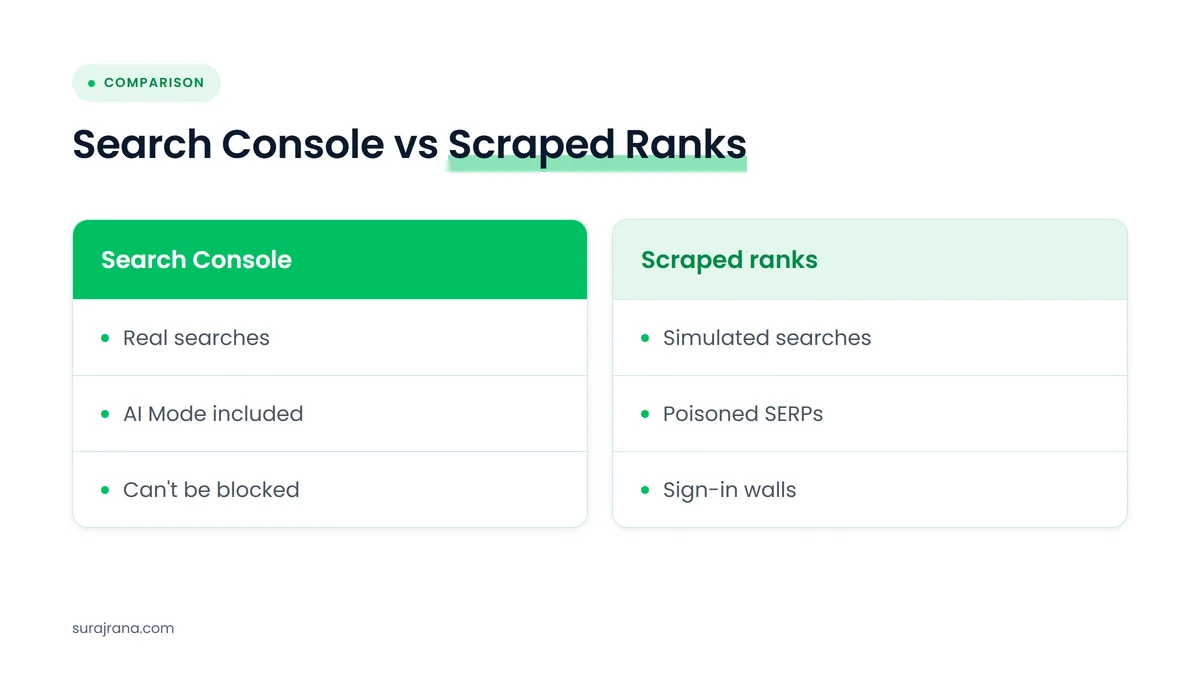
The 4 reasons I put Google Search Console first are listed below.
- Real searches: the Search Console Performance report counts clicks and impressions from real users, not from a scraper in a data center.
- Average position from Google: Google defines average position as “the average position of the topmost result from your site”, measured on actual impressions.
- AI features included: Google Search Central says sites that appear in AI Overviews and AI Mode are counted in the Performance report under the “Web” search type.
- No scraping to block: sign-in walls, poisoned SERPs and goto links don’t change first-party data, because Google records it on its side.
Search Console has limits. It shows an average, not a live position, its newest data can be preliminary, and it can’t show where competitors rank. The num=100 change also showed that bots once inflated impressions, so I compare clicks and queries over months, not a single week. That honesty is the opposite of a ranking promise, which is why I wrote that a rank #1 promise should make you walk away from an SEO agency.
What should you do now about rank reports built on search scrapers?
You should move rank reports built on search scrapers to the second page of your reporting and put Google Search Console first-party data on the first. That one change protects you from most scraping problems without cancelling any tool.
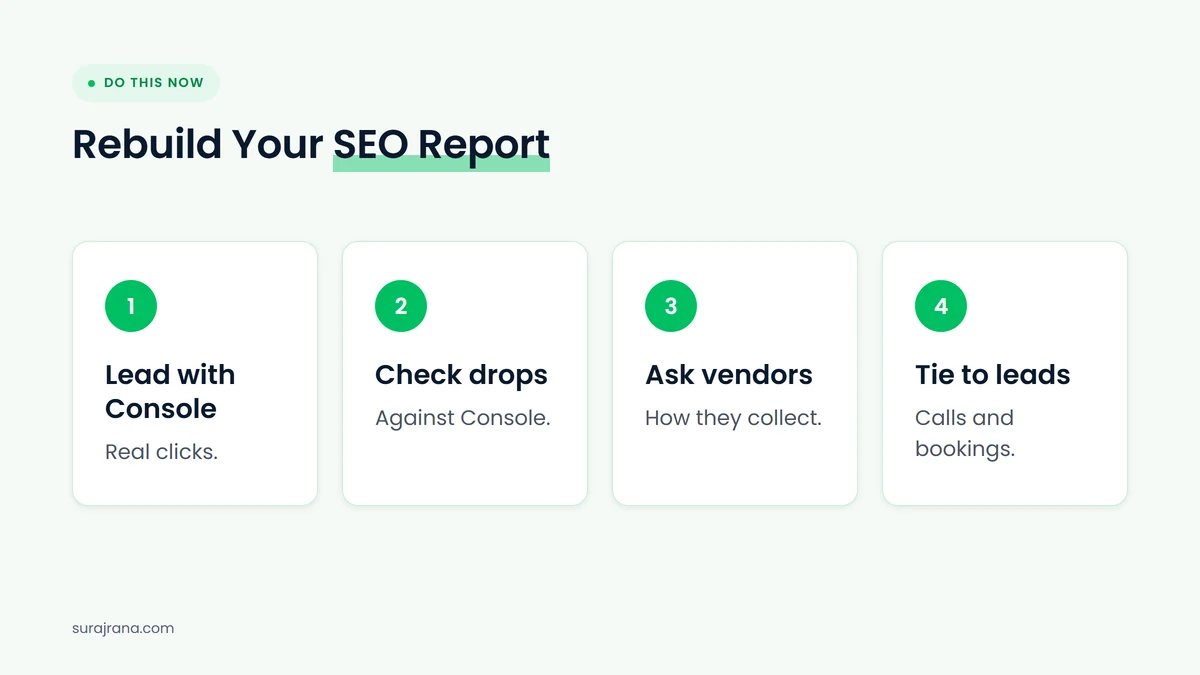
The 5 steps I follow with our own reports are listed below.
- Lead every monthly report with Google Search Console clicks, impressions and queries for the main service pages.
- Check every sudden drop in scraped rank data against the Search Console performance report before telling anyone.
- Ask your rank tracking vendor how it handles sign-in walls, poisoned SERPs and goto links, and when it last changed its method.
- Track fewer keywords less often, and read them as a weekly or monthly trend.
- Tie the report to calls, form fills and booked appointments, because those numbers don’t depend on Google at all.
What should agencies tell clients about broken rank reports?
Agencies should tell clients that Google is making scraped rank data harder to collect, that some drops in rank reports are measurement problems, and that the agency checks every drop in Google Search Console first. Saying that before a client spots a strange report builds more trust than explaining it after.
The client conversation is its own topic, especially for agencies that resell SEO under their own brand. The team at White Label SEO wrote a practical guide on rank trackers showing Google redirect links and what agencies should tell clients, which covers the wording and the vendor questions in detail.
Frequently asked questions
Do real searchers have to sign in to use Google now?
No, real searchers do not have to sign in to use Google now, because the sign-in wall after the first search is a test that Google has not confirmed. Rajan Patel of Google said on November 17, 2026 that he did not think it was meant to happen on the first page, and that Google may be testing something.
Will rank trackers stop working because of search scrapers being blocked?
No, rank trackers will not stop working overnight, but they will get slower, more expensive and less complete. Search Engine Roundtable reported in October 2026 that tools such as Ahrefs, Semrush, Sistrix and SE Ranking were all adjusting to Google’s blocking and poisoned SERPs.
Does Google Search Console show AI Overviews and AI Mode data?
Yes, Google Search Console includes AI Overviews and AI Mode in its data. Google Search Central says sites that appear in AI features are counted in the Performance report under the “Web” search type, combined with regular search results.
What is a goto link in a rank report?
A goto link is a google.com/goto redirect URL that some rank trackers store instead of the real ranking page. Search Engine Journal reported on November 5, 2026 that Google limits how fast these links can be followed, so a page can rank while the rank report shows a Google redirect.
Should I cancel my rank tracker?
No, you should not cancel your rank tracker if you use it for competitor research or long-term trends. You should stop treating its daily numbers as proof of results and check them against Google Search Console first-party data.
Where do I land on Google’s sign-in walls for search scrapers?
I think Google’s sign-in wall test is one more sign that the age of cheap, complete scraped rank data is over, whether or not this exact prompt rolls out. Google has added a barrier against search scrapers roughly every few months since January 2025, and I expect more. The businesses that do well will be the ones whose agencies already report from Google Search Console, calls and bookings instead of a daily ranking screenshot.
I’m Suraj Rana, and that is how I report results to every client today. If you want to see what that looks like for a dental practice, my dental SEO services start from first-party data, not scraped positions.
Not sure your rank reports survive the scraper crackdown?
I’m Suraj Rana, founder of Dental Master Media and SERP Master. If your monthly SEO report leans on scraped rank data and you want to know what your Search Console data actually says, I’m happy to look at both with you and tell you which numbers to trust.
Sources
- Search Engine Roundtable, “Google Tests Sign In Protections After First Search To Block Scrapers”, November 17, 2026. https://www.seroundtable.com/google-sign-in-protections-after-first-search-42557.html
- Search Engine Journal, “Google Appears To Limit How Fast Goto Result Links Can Be Followed”, November 5, 2026. https://www.searchenginejournal.com/google-goto-result-links-throttling/595959/
- Search Engine Roundtable, “Third-Party Google Rank Tracking Struggling Now”, October 12, 2026. https://www.seroundtable.com/third-party-google-rank-tracking-broken-42272.html
- Search Engine Roundtable, “Google May Be More Successful In Blocking Scrapers & Tracking Tools”, September 18, 2026. https://www.seroundtable.com/google-blocking-scrapers-and-tracking-tools-42118.html
- Search Engine Roundtable, “Google Search Tests Sign In To Verify Searches Are Human (Not Captcha)”, August 3, 2026. https://www.seroundtable.com/google-search-sign-in-verify-41808.html
- Search Engine Roundtable, “Google Sued SerpApi Over Scraping Search Results”, December 19, 2025 (updated July 21, 2026). https://www.seroundtable.com/google-sues-serpapi-40631.html
- Google, “Why we’re taking legal action against SerpApi’s unlawful scraping”, December 19, 2025. https://blog.google/technology/safety-security/serpapi-lawsuit/
- Search Engine Roundtable, “Google Search Console Impressions Drop Impact With Google Blocking Bots”, September 22, 2025. https://www.seroundtable.com/google-search-console-data-num-block-40143.html
- TechCrunch, “Google begins requiring JavaScript for Google Search”, January 17, 2025. https://techcrunch.com/2025/01/17/google-begins-requiring-javascript-for-google-search/
- Google Search Central, “AI Features and Your Website”, accessed November 18, 2026. https://developers.google.com/search/docs/appearance/ai-features
- Google Search Console Help, “Performance report (Search results): Overview and basic setup”, accessed November 18, 2026. https://support.google.com/webmasters/answer/7576553
- ILIAS ISM (@illyism) on X, November 16, 2026. https://x.com/illyism/status/2122354365315105156

My name is Suraj Rana, and I am a seasoned Dental SEO Expert with extensive experience in the Dental SEO industry. Leveraging my deep knowledge and expertise, I help dental practices enhance their online visibility and attract more patients.