---
title: "Why I Think Most Dental Blogs Are a Waste of Money"
url: "https://surajrana.com/why-most-dental-blogs-are-a-waste-of-money/"
date: "2026-11-01T12:36:05+05:30"
modified: "2026-11-01T15:20:22+05:30"
author:
name: "Suraj Rana"
url: "https://surajrana.com/"
categories:
- "SEO Myths"
tags:
- "AI Overviews"
- "Content strategy"
- "Dental blogging"
- "Dental content"
- "Dental SEO"
word_count: 2852
reading_time: "15 min read"
summary: "Quick answer: Most dental blog posts don't bring in patients, because they answer generic questions nobody is asking your practice, and AI answers now take many of those clicks anyway. I'd stop pay..."
description: "I think most dental blogs waste money. Here's why generic posts rarely bring patients, the fair case for blogging, and what to publish instead."
keywords: "dental blogging, AI Overviews, Content strategy, Dental blogging, Dental content, Dental SEO"
language: "en"
schema_type: "Article"
---
# Why I Think Most Dental Blogs Are a Waste of Money
_Published: November 1, 2026_
_Author: Suraj Rana_

**Quick answer:** Most dental blog posts don’t bring in patients, because they answer generic questions nobody is asking your practice, and AI answers now take many of those clicks anyway. I’d stop paying for volume and put that budget into pages that answer real patient questions: treatment pages, cost and insurance pages, FAQs and a few genuinely useful guides.
## Key takeaways
- My position: a dental website doesn’t need more posts. It needs better answers to the questions patients already ask before they book.
- Most pages on the web get no search traffic at all, and generic dental posts are some of the easiest to ignore, because thousands of near-identical versions already exist.
- AI Overviews appear most often on informational searches, which is exactly where generic blog posts compete, so those posts now earn fewer clicks than they used to.
- Google’s own guidance treats publishing lots of content in the hope that some of it ranks as a warning sign, and its September 2026 spam update is a reminder that scaled, low-value content carries risk.
- Blogging still works when a post answers a real, local, close-to-booking question and leads to a treatment page. That is a much smaller, more focused job than “four posts a month”.
## What do I mean by a dental blog that wastes money?
When I say a dental blog wastes money, I mean posts published to hit a monthly quota rather than to answer a patient. They cover generic topics like “five tips for whiter teeth”, repeat a city name to target keywords, restate what every other practice already says, and carry no dentist’s name or experience.
You can usually spot this kind of blog in a few minutes:
- The posts would read the same on any dental website in any country if you swapped the practice name.
- Titles are written around a keyword (“best dentist in [city] tips”) rather than a question a patient would actually ask.
- Nobody at the practice wrote, reviewed or even read the post before it went live.
- Posts don’t link to the treatment page they relate to, so even an interested reader has nowhere useful to go next.
- The agency report shows the number of posts delivered, not the clicks, calls or bookings they produced.
What I don’t mean is “never publish anything”. A clear page answering what to do about a broken tooth on a weekend, written and reviewed by your dentist, is content too. It just isn’t the kind most practices are paying for.
## Why do I think most dental blogs are a waste of money?
I think most dental blogs waste money because they are built backwards. The plan starts from a content calendar and a word count, not from the questions patients ask before they book. The result is pages that few people search for, that AI tools answer anyway, and that Google’s guidance describes as search-engine-first content.
### Why do most generic dental posts get no traffic?
Most generic dental posts get no traffic because there is either no real search demand for the topic, or thousands of stronger pages already answer it. A practice blog with few links pointing to it rarely beats national health sites on broad questions, so the post sits indexed but unseen, month after month.
This isn’t only a dental problem. When Ahrefs studied around 14 billion pages in its content database, it found that [96.55% of pages got no traffic from Google](https://ahrefs.com/blog/search-traffic-study/). The three common reasons it gave were no search demand, no backlinks and a mismatch with what searchers wanted. Generic dental posts tend to hit all three at once.
### Are AI answers taking the clicks generic posts used to get?
Yes, and they take them from exactly the kind of question generic dental blogs target. AI Overviews show up far more often on informational searches, such as “how long does teeth whitening last”, than on searches where someone wants to book. When an AI summary appears, people click on traditional results much less often.
Seer Interactive’s 2026 update found AI Overviews on [36% of informational queries, compared with 8% of commercial and 5% of transactional queries](https://www.seerinteractive.com/blog/aio-impact-on-google-ctr-2026-update). Pew Research Center reported in July 2025 that Google users who saw an AI summary [clicked a traditional search result in 8% of visits, against 15% for visits without one](https://www.pewresearch.org/short-reads/2025/07/22/google-users-are-less-likely-to-click-on-links-when-an-ai-summary-appears-in-the-results/).
Put those together and the generic educational post is in the worst spot on the page. The patient gets the answer from the AI summary and never reaches your site.
### Does Google penalize dental blogs written for volume?
Google doesn’t penalize blogs for existing, but it does treat volume-first publishing as a warning sign. Its guidance on helpful content asks whether you are producing lots of content on many topics hoping some of it ranks, and whether you are writing to a word count. Mass-producing low-value pages can also count as spam.
Google’s [guide to creating helpful, people-first content](https://developers.google.com/search/docs/fundamentals/creating-helpful-content), last updated in October 2026, lists those questions as signs of search-engine-first content, and says plainly that Google has no preferred word count. Its [spam policies](https://developers.google.com/search/docs/essentials/spam-policies) define scaled content abuse as generating many pages mainly to manipulate rankings rather than help users, no matter how the pages are created.
This is current, not theoretical. Google started rolling out its September 2026 spam update on September 24, and [Search Engine Roundtable reported](https://www.seroundtable.com/google-september-2026-spam-update-42163.html) that Google expected it to take up to two weeks. I’m not saying a monthly dental blog is spam. I’m saying a blog built on volume is moving in the direction Google keeps warning against, and I’ve written before about [why generic dental website content is under pressure](/why-google-is-cracking-down-on-generic-dental-website-content/).
## Do dental blog posts actually bring in new patients?
Some do, but most don’t. A post brings in patients when it answers a question someone asks close to booking, such as what to do about a cracked tooth tonight, and then makes the next step easy. Generic educational posts mostly attract readers who were never going to book with your practice in the first place.
The test I use is simple. Would a patient ever phone your front desk and ask this question? “Do you see emergency patients on Saturdays?”, “How much is an implant and does insurance cover any of it?” and “Is it normal for my gum to hurt three days after an extraction?” all pass. “The history of toothpaste” and “ten fun facts about teeth” don’t.
Questions that pass the test usually belong on a page you already have, or should have: a treatment page, a pricing page, an emergency page or an FAQ. That is why I’d rather see a practice build the specific pages patients are already searching for, such as the [dedicated online consultation page most dental sites are missing](/your-dental-site-is-missing-a-page-that-patients-are-already-searching-for/), than add another post to its blog.
## What have I seen when sites cut thin content instead of adding more?
The clearest evidence I’ve published comes from a content pruning project on a dental SEO website. Nearly 40% of its pages were thin, duplicate or competing for the same keywords. After merging, redirecting and keeping only the strongest pages, clicks over the next three months rose from 102 to 830 compared with the three months before.
I wrote up the full details in my [technical SEO and content pruning case study](/case-study-713-click-growth-with-technical-seo/). It was an agency website rather than a practice, and the write-up doesn’t put numbers on calls, so I treat it as evidence that fewer, stronger pages can beat more, weaker ones, not as proof of new patients.
I’ll also be honest about this site. surajrana.com has plenty of older dental blog posts of its own, and the same test applies to them.
## What is the strongest case for dental blogging?
The strongest case for blogging is that patients research before they book, and a practice that answers their questions well earns trust, links and AI citations that a service page alone can’t. I think that argument is right. My disagreement is with how most dental blogs are produced, not with the idea of publishing useful answers.
Here is the fair version of the other side, point by point:
1. **Being cited still pays.** Seer Interactive’s 2026 update found that being cited inside an AI Overview delivered more organic clicks per impression than not being cited. A practice that publishes the clearest answer to a real question has a chance of being that citation.
2. **Depth supports service pages.** A few well-linked articles on implant aftercare, bone grafts and costs can make an implant page look more complete and more trustworthy to search engines and patients.
3. **Expertise is visible.** A post written or reviewed by a named dentist, drawing on what they see in the chair, shows real experience in a way a generic service page often doesn’t.
4. **Some posts do convert.** Urgent and anxious questions, like a knocked-out tooth or swelling after a procedure, are asked by people who may need you today.
5. **Content gets reused.** A good answer can become an email, a social post or a printout your front desk hands to patients.
Every one of those points depends on the post being specific, accurate and connected to a service. None of them is an argument for four generic posts a month. That is where I land: publish answers, not quotas.
## How do generic blog posts compare with patient-question pages?
Generic blog posts are written to fill a schedule and target keywords, while patient-question pages are written to answer what people ask before booking. The difference shows up in who reads them, whether AI tools summarize them away, and whether they lead to a call. This table sums up how I see the trade-off.
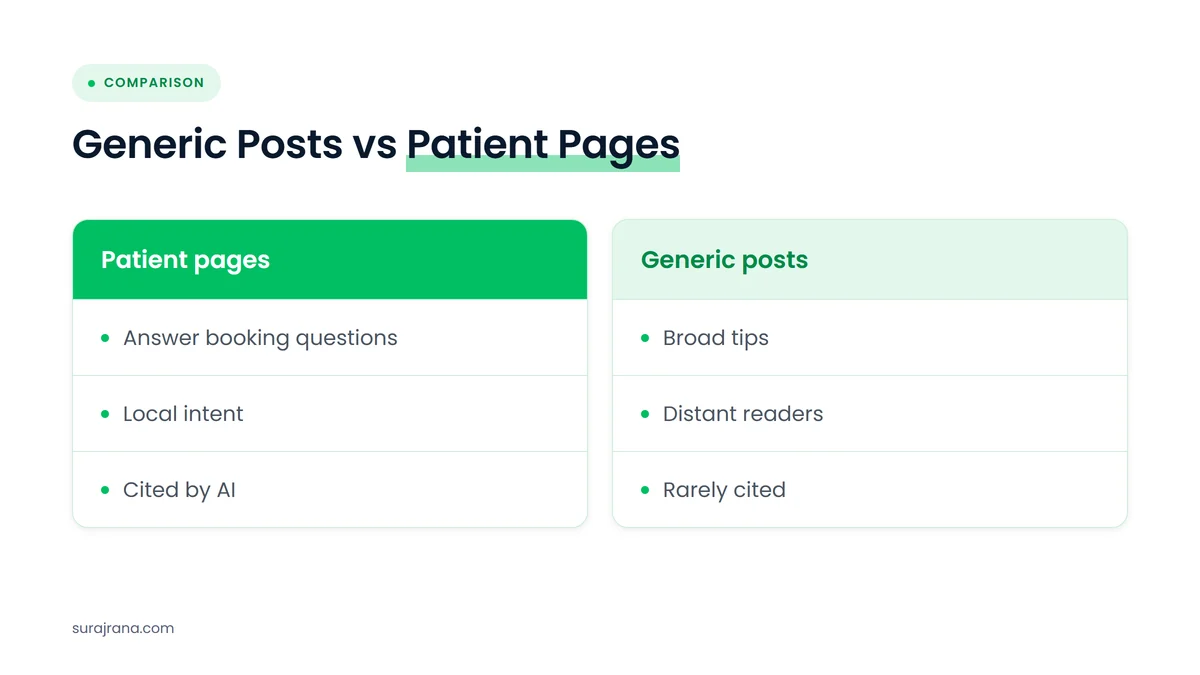Pages that answer booking questions do the work generic posts are paid for.| Factor | Generic blog post | Patient-question page |
|---|---|---|
| Starting point | A content calendar and a keyword | A question patients ask your team |
| Who reads it | Anyone, anywhere, often with no plan to book | People considering treatment near you |
| Competition | Thousands of near-identical posts and national health sites | Other local practices, many with thin pages |
| AI Overview exposure | High, because most are informational searches | Lower on booking-focused searches, and the page can be the cited source |
| Next step for the reader | Often none, or a generic “call us” line | The treatment, cost or booking page |
| Shelf life | Drops quickly once ignored | Stays useful while the answer stays accurate |
| How to judge it | Number of posts delivered | Clicks, calls and bookings from the page |
## What should a dental practice publish instead of generic blog posts?
A dental practice should publish pages that answer the questions patients ask before they book: complete treatment pages, honest cost and insurance information, an FAQ built from front desk calls, clear emergency information and a small number of in-depth guides tied to services. Fewer pages, each one specific, accurate and reviewed by a dentist.
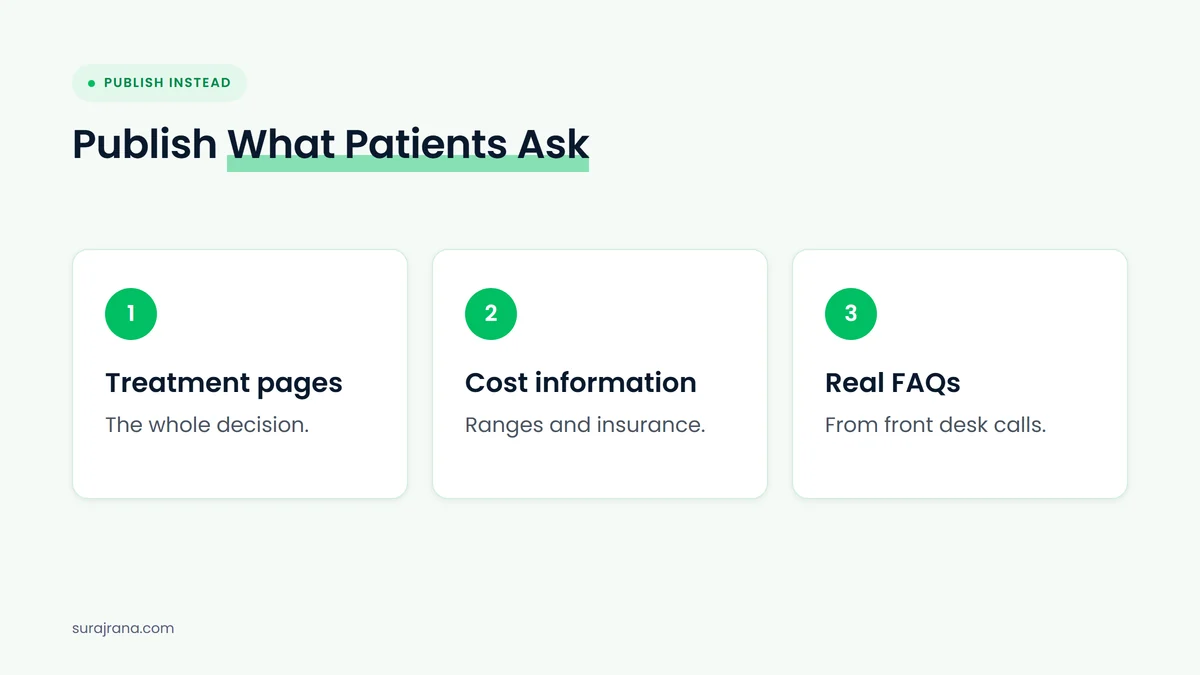Start with the pages patients use to decide.This site is for opinion rather than step-by-step guides, so where a how-to helps, I’ve linked to the Dental Master Media guide that covers it:
1. **Treatment pages that answer the whole decision.** Who it suits, how it works, how long it takes, how it feels, aftercare, risks, alternatives and how costs are structured. Dental Master Media has a guide on [writing dental service pages that AI search will cite](https://dentalmastermedia.com/blog/how-to-write-dental-service-pages-that-ai-search-will-actually-cite/).
2. **Cost, insurance and financing information.** Ranges, what changes the price and what insurance usually covers. I’ve argued before that [vague dental pricing pages lose patients](/why-vague-dental-pricing-pages-are-losing-you-patients/).
3. **An FAQ built from real calls.** Ask your front desk to note the questions they hear every week for a month, then answer them in plain language on the relevant pages.
4. **Emergency and urgent care pages.** Opening hours, what counts as an emergency, what to do before you arrive and how to get seen today.
5. **A few guides mapped to the patient journey.** Only where a question is too big for a treatment page, and always linked back to it. Dental Master Media’s [patient journey content map](https://dentalmastermedia.com/blog/dental-patient-journey-content-map-every-stage-for-seo-growth/) shows how to plan these.
I’m not alone in this. A dental SEO strategist made the same point on LinkedIn in October:
> “Twenty generic blog posts will never fix an empty treatment page.”
>
> Samir Hossan on LinkedIn, October 19, 2026 ([source](https://www.linkedin.com/posts/samir-hossan-seo_publishing-regular-dental-blogs-feels-like-ugcPost-7517823701573361665-EAR1/))
## How can you tell whether your current dental blog is worth paying for?
You can tell whether a dental blog is worth paying for by checking what each post has done in the last twelve months: clicks from Search Console, visits to a treatment page afterwards, and calls or bookings you can trace. If most posts show close to nothing on all three, the budget is better spent elsewhere.
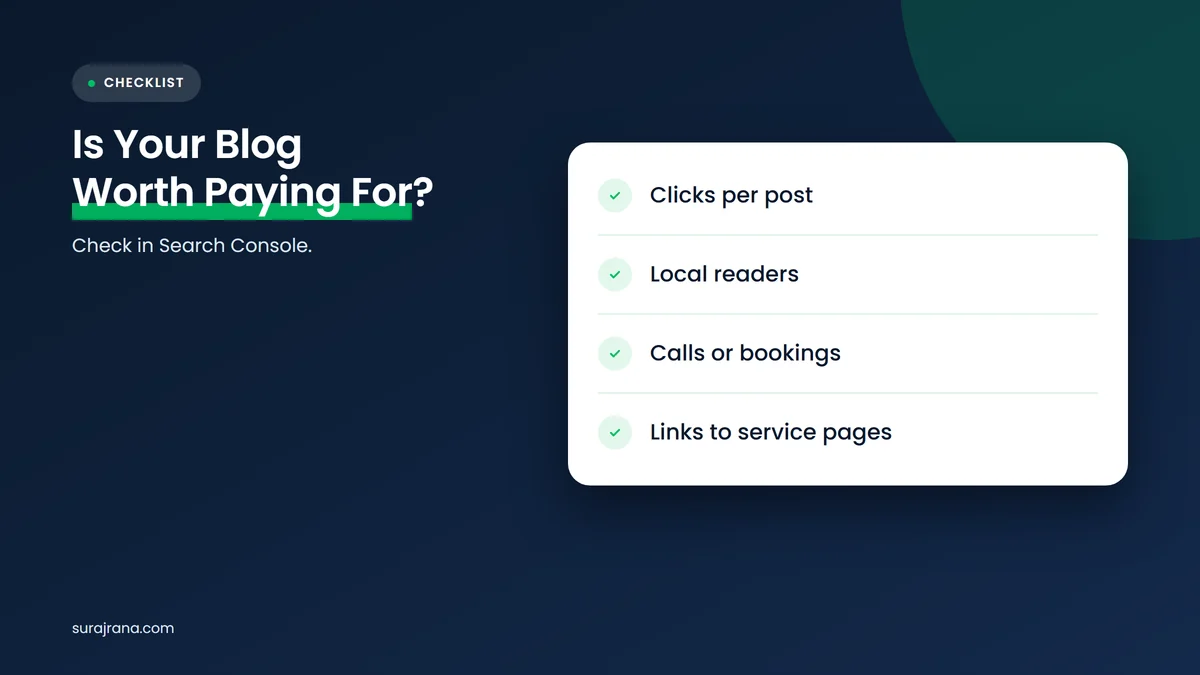Four checks that show whether a blog earns its fee.1. In Google Search Console, open the Pages report, filter to your blog URLs and set the date range to the last 12 months.
2. Count how many posts have zero or close to zero clicks. That number is usually the most honest part of any content report.
3. For posts that do get clicks, look at the search queries. Are they local or treatment-related, or are they general questions from people who will never visit?
4. Check in your analytics whether readers of those posts go on to a treatment, pricing or contact page.
5. Sort every post into keep, merge into a stronger page, rewrite or retire. Dental Master Media’s guide to [refreshing dental website content](https://dentalmastermedia.com/blog/dental-website-content-refresh-how-to-recover-lost-rankings/) covers how to handle the merge and redirect steps.
If you’d rather someone else ran that check, Dental Master Media offers a [free dental SEO audit](https://dentalmastermedia.com/free-dental-seo-audit/) that looks at which pages are actually earning their place.
## Frequently asked questions
### Should a dental practice stop blogging completely?
No. A practice should stop publishing generic posts to a quota, not stop publishing. Posts that answer specific, local, close-to-booking questions, are reviewed by a dentist and link to the relevant treatment page can still be worth having. The point is to publish fewer, better answers.
### How many blog posts a month does a dental practice need?
There is no required number. Google says it has no preferred word count and warns against producing lots of content in the hope that some of it ranks. Publish when you have a real patient question worth answering well, whether that is twice a month or twice a year.
### Are AI-written dental blog posts against Google’s rules?
Using AI to help write content is not against Google’s rules on its own. Google’s spam policies target generating many pages mainly to manipulate rankings without adding value, however they are made. Mass-produced, unreviewed AI posts fit that description, so every page should be checked by someone who knows dentistry.
### Can blog posts help a dental practice appear in AI answers?
Yes, if the post is the clearest, most trustworthy answer to a specific question. AI tools cite pages that state a direct answer plainly and back it up. A generic post that repeats what thousands of other sites say gives an AI tool no reason to cite your practice.
### What should I do with old dental blog posts that get no traffic?
Review them before deleting anything. Merge useful content into the related treatment or FAQ page and redirect the old URL, rewrite posts that answer a real patient question but answer it badly, and retire posts that serve no patient at all. Keep anything that brings in relevant visits.
## My bottom line on dental blogging
I don’t think dental practices should stop publishing. I think they should stop paying for posts and start paying for answers. If a page wouldn’t help a patient who is deciding whether to book with you, it probably isn’t helping your rankings, your AI visibility or your phone either.
Start with the pages patients already look for: treatment, cost, emergency and FAQ. Make them complete, honest and reviewed by your dentist. Only then add articles, and only for questions that genuinely deserve one. If you want to see how I work, read about my [dental SEO services](/dental-seo/) on [surajrana.com](/).
## Want a straight answer on your own content?
I’m Suraj Rana, and if you’re paying for blog posts and can’t tell what they’re doing for you, I’m happy to look at it with you. Through my dental SEO services and Dental Master Media, my team and I help dental practices put their effort into the pages that patients actually use. You can also start with a free dental SEO audit from Dental Master Media.
[Work with me](/contact-us/)
## Sources
1. Google Search Central, “Creating Helpful, Reliable, People-First Content”, last updated October 5, 2026.
2. Google Search Central, “Spam policies for Google web search”, last updated August 28, 2026.
3. Search Engine Roundtable (Barry Schwartz), “Google September 2026 Spam Update Has Been Unleashed”, September 24, 2026.
4. Seer Interactive, “AIO Impact on Google CTR: 2026 Update”, April 2026.
5. Pew Research Center, “Google users are less likely to click on links when an AI summary appears in the results”, July 22, 2025.
6. Ahrefs (Tim Soulo), “96.55% of Content Gets No Traffic From Google. Here’s How to Be in the Other 3.45%”, December 1, 2023.
7. Samir Hossan on LinkedIn, post on dental blogs and treatment pages, October 19, 2026. [https://www.linkedin.com/posts/samir-hossan-seo_publishing-regular-dental-blogs-feels-like-ugcPost-7517823701573361665-EAR1/](https://www.linkedin.com/posts/samir-hossan-seo_publishing-regular-dental-blogs-feels-like-ugcPost-7517823701573361665-EAR1/)
---
_View the original post at: [https://surajrana.com/why-most-dental-blogs-are-a-waste-of-money/](https://surajrana.com/why-most-dental-blogs-are-a-waste-of-money/)_
_Served as markdown by [Third Audience](https://github.com/third-audience) v3.5.3_
_Generated: 2026-11-01 09:50:23 UTC_