---
title: "Why I Stopped Selling Keyword Rankings to Clients"
url: "https://surajrana.com/why-i-stopped-selling-keyword-rankings/"
date: "2026-11-05T19:30:00+05:30"
modified: "2026-11-05T19:30:00+05:30"
author:
name: "Suraj Rana"
url: "https://surajrana.com/"
categories:
- "SEO Myths"
tags:
- "AI Overviews"
- "Dental SEO"
- "Keyword rankings"
- "Search Console"
- "SEO reporting"
word_count: 2584
reading_time: "13 min read"
summary: "Quick answer: No. Keyword rankings are still a useful diagnostic, but they are a poor way to judge whether SEO is working. Nobody sees one fixed ranking, AI answers now take clicks from the top res..."
description: "Keyword rankings are a weak way to measure SEO now. Here's why I report calls, bookings, leads and visibility instead, and where rankings still help."
keywords: "keyword rankings, AI Overviews, Dental SEO, Keyword rankings, Search Console, SEO reporting"
language: "en"
schema_type: "Article"
related_posts:
- title: "Why I Think Most Dental Blogs Are a Waste of Money"
url: "https://surajrana.com/why-most-dental-blogs-are-a-waste-of-money/"
---
# Why I Stopped Selling Keyword Rankings to Clients
_Published: November 5, 2026_
_Author: Suraj Rana_
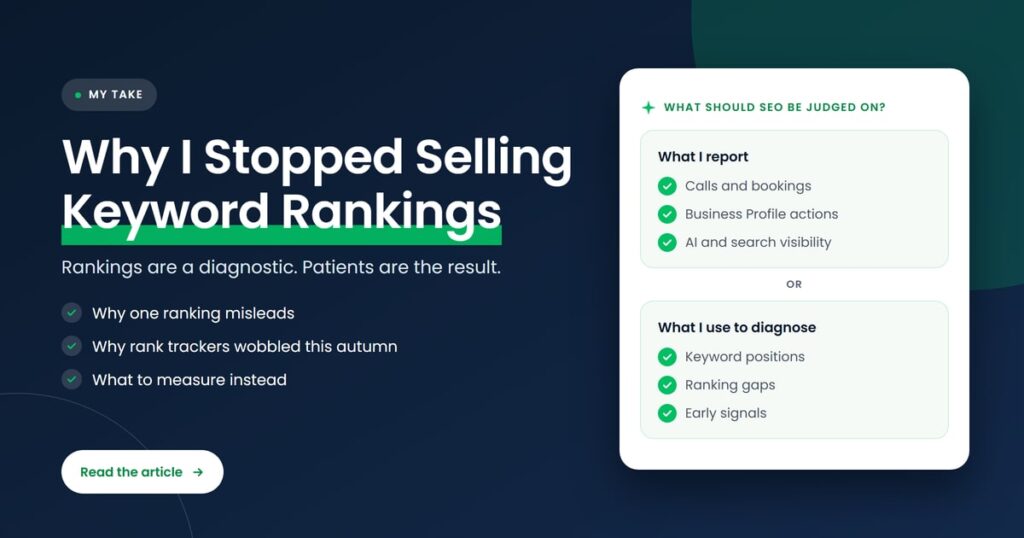
**Quick answer:** No. Keyword rankings are still a useful diagnostic, but they are a poor way to judge whether SEO is working. Nobody sees one fixed ranking, AI answers now take clicks from the top results, and even rank trackers were thrown off this autumn. I measure SEO by calls, bookings, leads and search visibility instead.
## Key takeaways
- My position: I don’t sell keyword rankings as the goal. I report the calls, bookings, leads and visibility that SEO produces, and I use rankings only to diagnose problems.
- There is no single ranking for a keyword. Google says location, search history and settings shape results, and Search Console’s average position is an average of the topmost spot across every impression.
- Rank trackers had a rough autumn. SE Ranking and Nozzle both reported Google results that matched only part of a query from mid-September 2026, which distorted tracked positions.
- A top position is worth less than it used to be. Ahrefs found AI Overviews correlate with a 58% lower click-through rate for the top-ranking page.
- Better measures now exist and are free: Search Console clicks, the new generative AI impressions reports, Google Business Profile calls and bookings, and your own phone and booking records.
## What do I mean by selling keyword rankings?
Selling keyword rankings means pitching and reporting SEO around where a website appears for a list of chosen search terms, such as “dentist near me” or “dental implants in [city]”. The monthly report is a table of positions, and success is defined as those numbers going up, whether or not more patients call.
It is easy to see why the model became so common. A ranking is simple to explain, simple to screenshot and feels like proof of work. Practice owners can search their own name and see it. Agencies can show a column of green arrows every month.
The problem is what that model rewards. If rankings are the product, the incentive is to pick keywords that are easy to move, report the ones that went up and quietly ignore whether any of it reached the front desk. I would rather be judged on the thing the practice is actually paying for.
## Why are keyword rankings a weak way to measure SEO now?
Keyword rankings are a weak measure because the number is less precise and less valuable than it looks. Results differ by person and place, the tools that collect rankings can be misled by changes in Google’s results, and AI summaries now sit above the links, so a high position no longer means the click it once did.
### Is there even a single ranking for a keyword?
No, not in any way that matches what every patient sees. Google shapes results using signals such as location, search history and settings, so two people searching the same phrase can get different pages. A ranking report shows one snapshot from one location, which is not the same as what your patients see.
Google says this plainly in its explanation of [how it ranks results](https://www.google.com/search/howsearchworks/how-search-works/ranking-results/): it uses information such as your location, past search history and search settings to decide what is most relevant to you. For a dental practice, location matters most. Someone searching from two streets away and someone searching across town are not looking at the same local results.
Search Console’s own position figure is not a single ranking either. Google’s help page on [impressions, position and clicks](https://support.google.com/webmasters/answer/7042828) explains that average position is the topmost position a link to your site held, averaged across all the searches where it appeared. The same page notes that an AI Overview occupies a single position and every link inside it shares that position, and that your own search may differ from the average because of history, location and other factors.
### Can rank trackers be trusted right now?
Rank trackers are useful, but this autumn showed their limits. From mid-September 2026, Google began returning results on some searches that matched only part of the query, mostly on lower positions. Tools that record those pages can show a site slipping or disappearing even when nothing changed for real searchers.
Search Engine Journal reported on November 3, 2026 that [rank trackers found Google results matching about one word of a query](https://www.searchenginejournal.com/rank-trackers-find-google-results-about-one-word-of-a-query/595798/). SE Ranking looked at 10,000 US desktop keywords and found that 84% of flagged cases involved unrelated listings matching one word of the query, and 96.5% of those groups started at position 9 or lower. The share of its sampled keywords showing any unrelated listing rose from 0.09% on September 16 to 67.2% by September 24.
Nozzle, another tracking company, found page 2 ignored part of the query on 12.6% of the desktop searches it could judge, against 2.2% for page 1. SE Ranking also warned that a site that normally ranks lower may seem to vanish from a tracker report even though its real position for users has not changed. Both companies sell rank tracking, which makes the warning more telling, not less.
This is my point in miniature. If the report you pay for every month can swing because of how Google displayed page 2 for a few weeks, it is not a sound basis for judging an SEO campaign.
### Does ranking first still bring the clicks it used to?
No. Ranking first still matters, but it brings fewer clicks than it did before AI Overviews. When an AI summary answers the question at the top of the page, fewer people scroll to the links below it, so the same position can now produce far less traffic and far fewer calls than a ranking report suggests.
Ahrefs compared click-through rates across 300,000 keywords using aggregated Search Console data and found that the [presence of an AI Overview correlates with a 58% lower average click-through rate for the top-ranking page](https://ahrefs.com/blog/ai-overviews-reduce-clicks-update/), comparing December 2025 with what it would have expected without one. Pew Research Center found that people who saw an AI summary [clicked a traditional result in 8% of visits, against 15% when there was no summary](https://www.pewresearch.org/short-reads/2025/07/22/google-users-are-less-likely-to-click-on-links-when-an-ai-summary-appears-in-the-results/), and clicked a link inside the summary in just 1% of visits.
That is why I don’t think “we got you to the top” is a finished sentence anymore. I’ve argued separately that [ranking on page one isn’t the finish line](/ranking-on-page-one-isnt-the-finish-line-anymore-getting-cited-in-the-ai-overview-is/) when an AI Overview sits above it. This post is about the next step: if the position itself is worth less, it can’t be the thing you pay for.
## What do I report instead of keyword rankings?
I report the outcomes a practice can bank and the visibility that leads to them: phone calls, online bookings, form leads, Google Business Profile actions, Search Console clicks, and impressions in AI features. Rankings still appear in my work, but as a diagnostic tool for finding problems, not as the headline number or the promise.
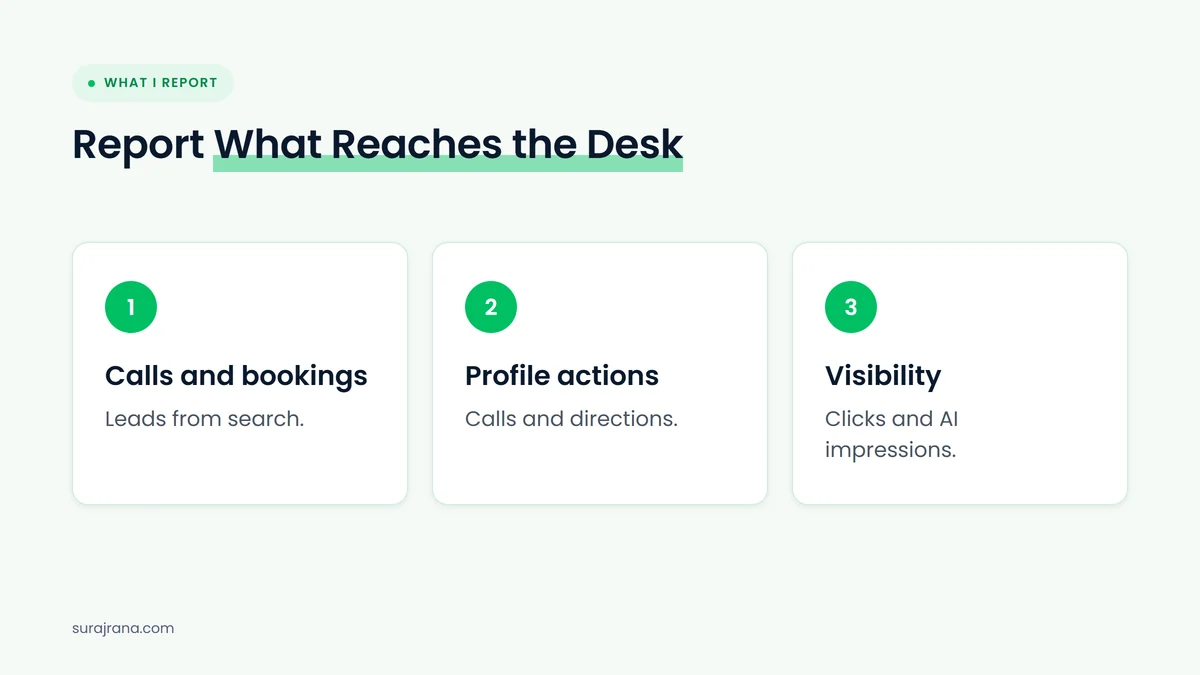Report what reaches the front desk first, then the visibility behind it.Here is the order I care about, from most to least important:
1. **Calls and bookings from search.** Tracked phone calls, online bookings and contact forms that came from organic search and the Business Profile. This is the closest thing to revenue that SEO can be held to.
2. **Google Business Profile actions.** Google’s help page on [Business Profile performance](https://support.google.com/business/answer/9918094?hl=en) shows calls from the call button, website clicks, direction requests, bookings and the search terms people used to find the business. For a local practice, these often matter more than any website ranking.
3. **Search Console clicks to the pages that convert.** Clicks to treatment, emergency, pricing and contact pages, not total clicks to every blog post.
4. **Visibility in AI features.** Google added [Search generative AI performance reports](https://developers.google.com/search/blog/2026/06/gen-ai-performance-reports) to Search Console on June 3, 2026, showing how often a site’s URLs appeared in features such as AI Overviews and AI Mode. Google’s post notes the reports reached all websites by August 31, 2026. I wrote more about [what that report shows for dental sites](/the-new-search-console-report-that-shows-if-your-dental-site-appears-in-ai-overviews/).
5. **Rankings, as a diagnostic.** If calls drop, positions help explain why. They are evidence in an investigation, not the verdict.
Google’s own guide to [AI features and your website](https://developers.google.com/search/docs/appearance/ai-features) says traffic from AI features is counted in the Performance report under the Web search type, and claims that clicks from results pages with AI Overviews are higher quality. Whether or not that holds for every practice, it points the same way: the click and what happens after it matter more than the position.
## How do keyword rankings compare with outcome metrics?
Keyword rankings tell you where a site appeared for a chosen phrase at one moment and place, while outcome metrics tell you what search actually produced for the business. Rankings are quick and easy to show but noisy and indirect. Outcomes take more setup, but they answer the question an owner is really asking.
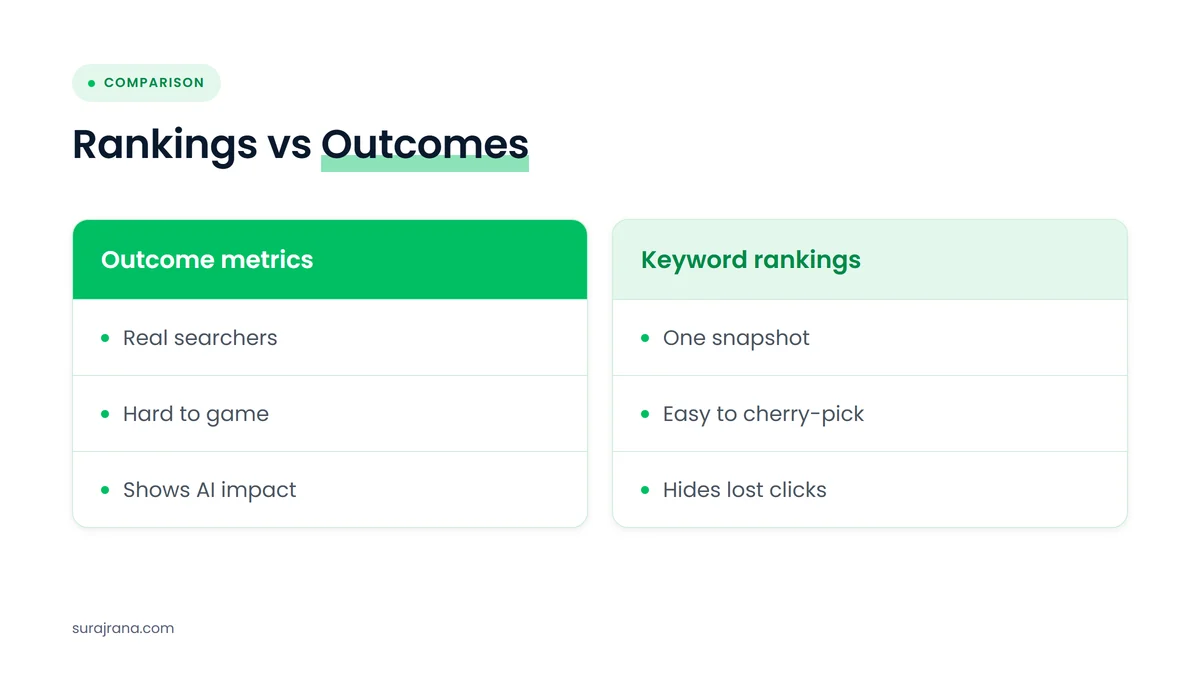Outcomes answer the question rankings only hint at.| Factor | Keyword rankings | Outcome metrics |
|---|---|---|
| What it measures | Where a page appeared for chosen phrases | Calls, bookings, leads and clicks from search |
| Who chooses it | Usually the agency, through its keyword list | The business, through what it actually needs |
| Effect of location and history | Large: one snapshot rarely matches what patients see | Built in: counts what real searchers did |
| Effect of AI Overviews | Hidden: a top spot can earn far fewer clicks | Visible: fewer clicks or calls show up directly |
| Risk of gaming | High: easy keywords can be cherry-picked | Lower: calls and bookings are hard to fake |
| Best use | Diagnosing drops and spotting gaps | Judging whether SEO is worth the money |
## Do keyword rankings still matter at all?
Yes, rankings still matter as an input. A page that doesn’t appear can’t be clicked or cited, and positions are often the earliest sign that work is landing before calls follow. My objection is to selling rankings as the outcome and promising positions, not to watching them.
Here is the fair case for rankings, because it deserves one:
1. **They move first.** New pages often gain positions weeks before they produce calls, so rankings can show early progress.
2. **They help diagnose problems.** When leads drop, a sudden fall in positions for treatment pages narrows down the cause quickly.
3. **They show gaps.** Seeing that a practice doesn’t appear at all for a core treatment tells you which page to build or fix.
4. **They are easy to understand.** An owner can follow a ranking without learning analytics.
All four points describe rankings as a tool for the person doing the work. None of them makes rankings the right thing to buy. That is where I land: watch rankings, but don’t pay for them.
## What should practice owners and agency owners ask instead?
Practice owners should ask their SEO provider how many calls, bookings and leads came from search, and how that is tracked. Agency owners should build reports around the same outcomes, so clients judge the work by results rather than by a keyword list the agency picked. Both should treat top spot promises as a warning sign.
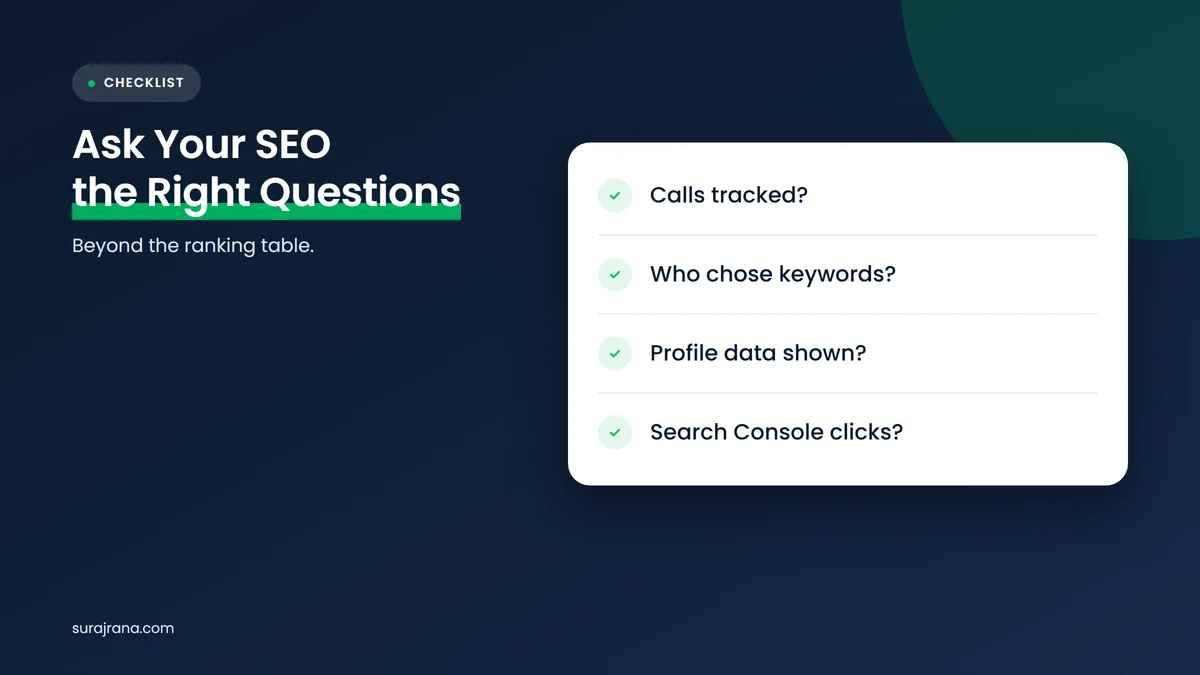Four questions that tell you what your SEO is really doing.- **How are calls and bookings tracked?** If the answer is “they aren’t”, the report can’t tell you whether SEO is paying for itself.
- **Who picked the keywords?** A list chosen by the agency can be weighted toward terms that are easy to move.
- **Where is the Business Profile data?** Calls, direction requests and bookings from the profile belong in any report for a local practice.
- **What does Search Console say?** Clicks to treatment and contact pages, plus AI feature impressions where available, are harder to dress up than a ranking table.
- **What happens when rankings and leads disagree?** A good provider explains the gap rather than leading with whichever number looks better.
I’ve written before about [which KPIs show dental SEO success](/what-kpis-show-dental-seo-service-success/) and why [dental website traffic doesn’t always turn into patient calls](/why-your-dental-website-traffic-is-not-converting-to-patient-calls/). Both are worth reading if your report is mostly positions.
## Frequently asked questions
### Are keyword rankings still useful for SEO?
Yes, as a diagnostic. Rankings show whether pages appear for important searches and help explain changes in traffic or calls. They are not a reliable measure of success on their own, because results vary by location and history, and a high position earns fewer clicks when an AI Overview appears.
### Why does my ranking look different when I search myself?
Google uses information such as your location, search history and settings to decide what to show, so your own search is one personal view. Search Console’s average position is an average of your topmost position across all searches, so it will rarely match a single search you run yourself.
### What should a dental practice measure instead of rankings?
Measure calls, online bookings and form leads from search, Google Business Profile calls, direction requests and bookings, and Search Console clicks to treatment and contact pages. Where available, add impressions from Search Console’s generative AI reports. Use rankings to investigate changes, not to judge results.
### Should I trust an SEO agency that promises top rankings?
Be cautious. No agency controls Google’s results, and a promise of a top spot for chosen keywords says nothing about calls or bookings. Ask instead how the agency tracks leads from search and what it will report each month. A clear answer to that is worth more than a position target.
### Does Search Console show AI Overview visibility?
Yes. Google launched Search generative AI performance reports in Search Console in June 2026, showing how often your URLs appeared in generative AI features such as AI Overviews and AI Mode. Clicks from AI features are counted in the main Performance report under the Web search type.
## Where I stand on keyword rankings
I stopped treating keyword rankings as the product because the number has drifted too far from the thing owners care about. One ranking doesn’t match what patients see, the tools that record it can be misled, and a top position earns fewer clicks than it used to. Calls, bookings and visibility are harder to report, but they are honest.
If you run a practice, ask for outcomes. If you run an agency, report them. Dental Master Media’s guide to [measuring what dental SEO is actually delivering](https://dentalmastermedia.com/blog/dental-seo-roi-how-to-measure-what-your-seo-is-actually-delivering/) covers the setup, and agency owners may find the list of [red flags in a white label SEO report](https://whitelabelseo.co.in/white-label-seo-report-red-flags/) useful. You can read about how I approach [dental SEO services](/dental-seo/) on [surajrana.com](/).
## Want a report that shows what SEO is really doing?
I’m Suraj Rana. If your SEO report is mostly a table of positions and you can’t tell how many patients it brought in, I’m happy to look at it with you. Through my dental SEO services and Dental Master Media, my team and I measure SEO by calls, bookings, leads and visibility.
[Work with me](/contact-us/)
## Sources
1. Search Engine Journal (Matt G. Southern), “Rank Trackers Find Google Results About One Word Of A Query”, November 3, 2026.
2. Google Search Console Help, “What are impressions, position, and clicks?”, accessed November 5, 2026.
3. Google Search, “How Does Google Determine Ranking Results”, accessed November 5, 2026.
4. Google Search Central, “AI features and your website”, accessed November 5, 2026.
5. Google Search Central Blog (Hillel Maoz and Moshe Samet), “Introducing Search Generative AI performance reports in Search Console”, June 3, 2026.
6. Google Business Profile Help, “Understand your Business Profile performance & insights”, accessed November 5, 2026.
7. Ahrefs (Ryan Law), “Update: AI Overviews Reduce Clicks by 58%”, February 4, 2026.
8. Pew Research Center, “Google users are less likely to click on links when an AI summary appears in the results”, July 22, 2025.
---
_View the original post at: [https://surajrana.com/why-i-stopped-selling-keyword-rankings/](https://surajrana.com/why-i-stopped-selling-keyword-rankings/)_
_Served as markdown by [Third Audience](https://github.com/third-audience) v3.5.3_
_Generated: 2026-11-05 14:00:04 UTC_