---
title: "Why I Tell Dental Practices to Fix Their Website Before Buying Ads"
url: "https://surajrana.com/fix-dental-website-before-buying-ads/"
date: "2026-11-28T19:30:00+05:30"
modified: "2026-11-28T01:18:07+05:30"
author:
name: "Suraj Rana"
url: "https://surajrana.com/"
categories:
- "Dental SEO"
word_count: 2430
reading_time: "13 min read"
summary: "Quick answer: No, I don't think a dental practice should spend on Google Ads before its website converts. Google Ads charges for every click, a median of $8.00 for dental services in 2026 according..."
description: "Why I tell dental practices to fix their website before buying Google Ads: the cost per click maths, what Google counts, and what I fix first."
keywords: "dental website ads, Dental SEO"
language: "en"
schema_type: "Article"
related_posts:
- title: "How SEO Improves Online Visibility for Dental Clinics"
url: "https://surajrana.com/seo-improves-online-visibility-for-dental-clinics/"
- title: "Can Video Marketing Boost SEO for Dentist?"
url: "https://surajrana.com/can-video-marketing-boost-seo-for-dentists/"
- title: "Do Online Reviews Affect SEO for Dentists?"
url: "https://surajrana.com/do-online-reviews-affect-seo-for-dentists/"
---
# Why I Tell Dental Practices to Fix Their Website Before Buying Ads
_Published: November 28, 2026_
_Author: Suraj Rana_

**Quick answer:** No, I don’t think a dental practice should spend on Google Ads before its website converts. Google Ads charges for every click, a median of $8.00 for dental services in 2026 according to LocaliQ, and a dental website that turns few visitors into calls or bookings makes every new patient cost more. I fix the page the ads land on first.
## Key takeaways
- A dental website converts when a visitor calls, books or sends a form. The conversion rate is those actions divided by visits.
- LocaliQ’s 2026 benchmarks put the median dental click at $8.00, so $1,000 of Google Ads buys about 125 paid clicks. What those clicks are worth depends on the conversion rate.
- I tell dental practices to fix the website first for 3 reasons: weak pages make every lead cost more, Google judges the landing page as part of ad quality, and without conversion tracking nobody can learn from the spend.
- The problems that waste paid clicks first are a landing page that doesn’t match the ad, slow mobile pages and a hard route to a call or booking.
- My order is tracking, the landing page, mobile speed, then the call and booking path. A dedicated landing page can be enough, and I would only buy ads first when the page already converts.
## What does it mean for a dental website to convert?
A dental website converts when a visitor takes an action that can become a patient, such as calling the practice, booking online or sending an enquiry form. The conversion rate of a dental website is the number of those actions divided by the number of visits, shown as a percentage.
I use this plain definition because it ties the website to money. A practice that pays for 100 visits and gets 10 calls has a 10% conversion rate. A practice that pays for the same 100 visits and gets 2 calls has a 2% conversion rate, and the extra 8 patients it didn’t get are the cost of the website, not of the ads.
## How much does a click to a dental website cost, and what does a low conversion rate do to it?
A click to a dental website costs a median of $8.00 on Google Ads and Microsoft Ads in 2026, and a low conversion rate multiplies the cost of every new patient that click was meant to bring. LocaliQ’s 2026 Search Advertising Benchmarks, updated on June 1, 2026, show dental clicks cost more than the all-industry median of $5.42.
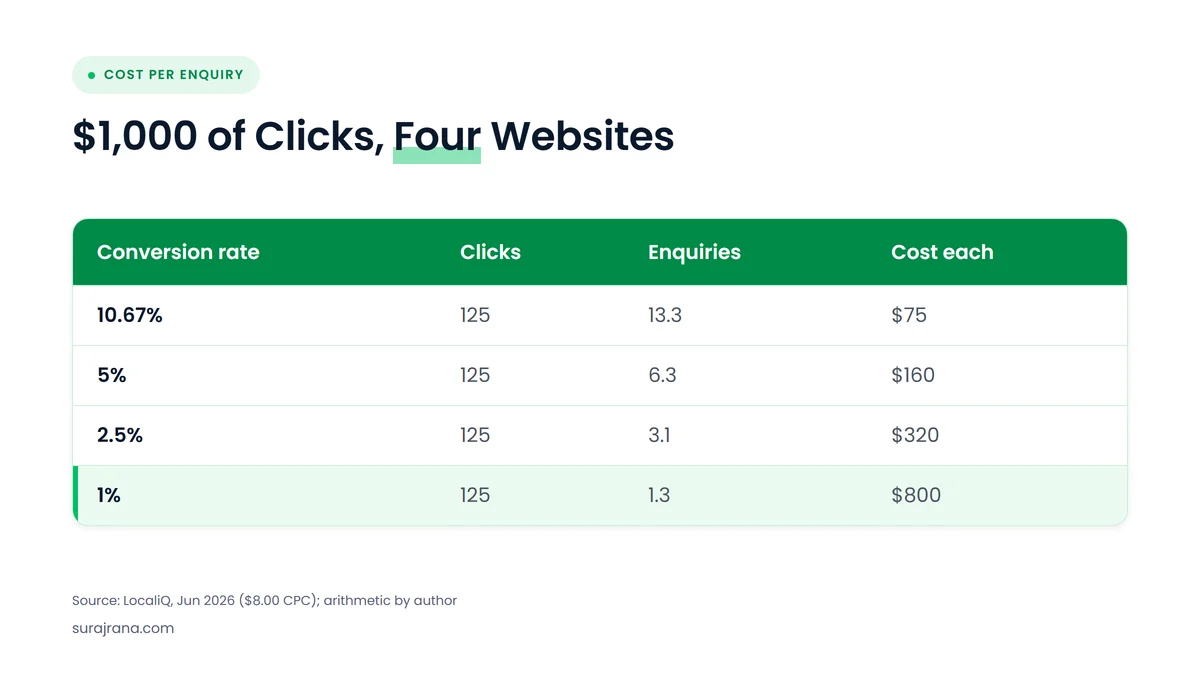The same $1,000 of ad spend, at four different website conversion rates.| Search ad metric (2026) | Dentists and dental services | All industries |
|---|---|---|
| Median cost per click | $8.00 | $5.42 |
| Click-through rate | 5.66% | 6.64% |
| Conversion rate | 10.67% | 8.18% |
| Cost per lead | $72.97 | $66.69 |
The table shows that dental ads cost more per click, earn fewer clicks per view and sit slightly above the average on conversion, using LocaliQ’s data from its own customers’ campaigns. Those are averages across all dental campaigns, so the conversion rate of any single dental website can sit far below them.
The second table is my own arithmetic, not a study. It takes the $8.00 cost per click from LocaliQ and shows what $1,000 of ad spend buys when the website converts at 4 different rates.
| Website conversion rate | Paid clicks for $1,000 | Patient enquiries | Cost per enquiry |
|---|---|---|---|
| 10.67% (LocaliQ dental average) | 125 | 13.3 | $75 |
| 5% | 125 | 6.3 | $160 |
| 2.5% | 125 | 3.1 | $320 |
| 1% | 125 | 1.3 | $800 |
Cost per enquiry is the $1,000 divided by the enquiries, and the 10.67% row lands close to the $72.97 cost per lead in LocaliQ’s report. The ad account, the keywords and the bids are identical in every row, and the only thing that changes is what the website does with the visit. That is the whole reason behind my advice, and I think it is worth reading the table twice.
## Why do I tell dental practices to fix the website before buying ads?
I tell dental practices to fix the website before buying ads because Google Ads charges for the click, not for the patient, so a weak website makes the practice pay the full click price and keep a fraction of the return. A better website lifts the return on every dollar of ad spend, while more ad spend on a weak website only repeats the same loss at a larger size.
This is an opinion, and it comes from how the money moves, not from a dislike of ads. Ads are a fast, legitimate way to reach new patients who are searching today. I just want the practice to pay for that traffic once the page that receives it is ready. I make the longer case against leaning on paid search alone in my post on [why rising dental Google Ads CPC makes SEO your smarter bet](/why-rising-dental-google-ads-cpc-makes-seo-your-smarter-bet/).
### Does a better website lower what Google Ads charges per click?
Yes, a better landing page can lower what Google Ads charges per click, because Google counts the landing page as part of ad quality. Google Ads Help says higher quality ads typically cost less per click and win better positions, and its landing page experience rating measures how relevant and useful the page is to the person who clicked.
Google Ads Help also tells advertisers that a landing page should be clear, useful and related to the keyword, and that a “below average” rating is a sign to consider changes. In plain terms, the website is not only where the patient ends up. It is one of the inputs that sets the price of getting them there.
### Why does conversion tracking come before the first ad?
Conversion tracking comes before the first ad because without it a practice can’t tell which keywords, ads or pages produce patient calls and which only produce clicks. Google Ads Help describes conversion measurement as a way to see which keywords, ads, ad groups and campaigns drive valuable activity, and it counts phone calls as conversions you can track.
This is the part I see skipped most. A practice that spends for 3 months with no conversion tracking has bought clicks and learned almost nothing. A practice that tracks calls, bookings and forms from day one learns something from every dollar, including what to cut.
## Which dental website problems waste paid clicks first?
The dental website problems that waste paid clicks first are a landing page that doesn’t match the ad, a slow mobile page and a hard route to a call or booking. Each one sits between a paid click and a patient enquiry, so each one lowers the conversion rate before the practice has a chance to measure it.
The 3 problems I check first are listed below, in the order I check them.
- **Landing page that doesn’t match the ad:** an ad for dental implants that lands on a generic homepage makes the visitor search again.
- **Slow mobile page speed:** paid clicks come mostly from phones, and a page that loads late loses the visitor before the content shows.
- **Hard route to a call or booking:** a phone number that can’t be tapped or a booking form that asks for too much turns a ready patient into a lost enquiry.
### Why does the landing page need to match the ad?
The landing page needs to match the ad because the visitor clicked a specific promise, and the page has to confirm it within seconds. An ad for emergency dental appointments should land on a page about emergency appointments with the phone number visible, not on a homepage that makes the visitor look for it.
Google Ads Help points the same way: the landing page should relate to the keyword and to what the person searched for. I go further on this in my post on [dental landing pages and conversion](/dental-landing-pages-conversion/), which is where the detail belongs.
### Why does mobile page speed matter for paid clicks?
Mobile page speed matters for paid clicks because the practice has already paid for the visit when the page starts to load. Google research reported by Marketing Dive on September 12, 2016 found that 53% of mobile website visitors leave if a page doesn’t load within 3 seconds.
That figure is more than 10 years old, so I treat it as a direction, not a current measurement. I still see no reason to doubt the direction, and a slow page costs the practice the click price whether or not anyone stays. My [8 dental website mistakes I’d fix before spending on SEO](/dental-website-mistakes-fix-before-seo/) covers speed along with the other basics.
### Why does the route to a call or booking decide patient calls?
The route to a call or booking decides patient calls because a visitor from a paid click is ready to act and leaves when acting is hard. A tap-to-call button, a visible phone number and a short booking form let that visitor become a patient enquiry in under a minute.
I judge every dental website by how many steps it takes a phone visitor to reach the practice. If the answer is more than 2, I would fix that before paying for another click.
## What would I fix first on a dental website before buying ads?
I would fix 4 things first on a dental website before buying ads: conversion tracking, the landing page the ad will use, mobile page speed, and the call and booking route, in that order. The order matters because tracking lets me see the effect of each later change.
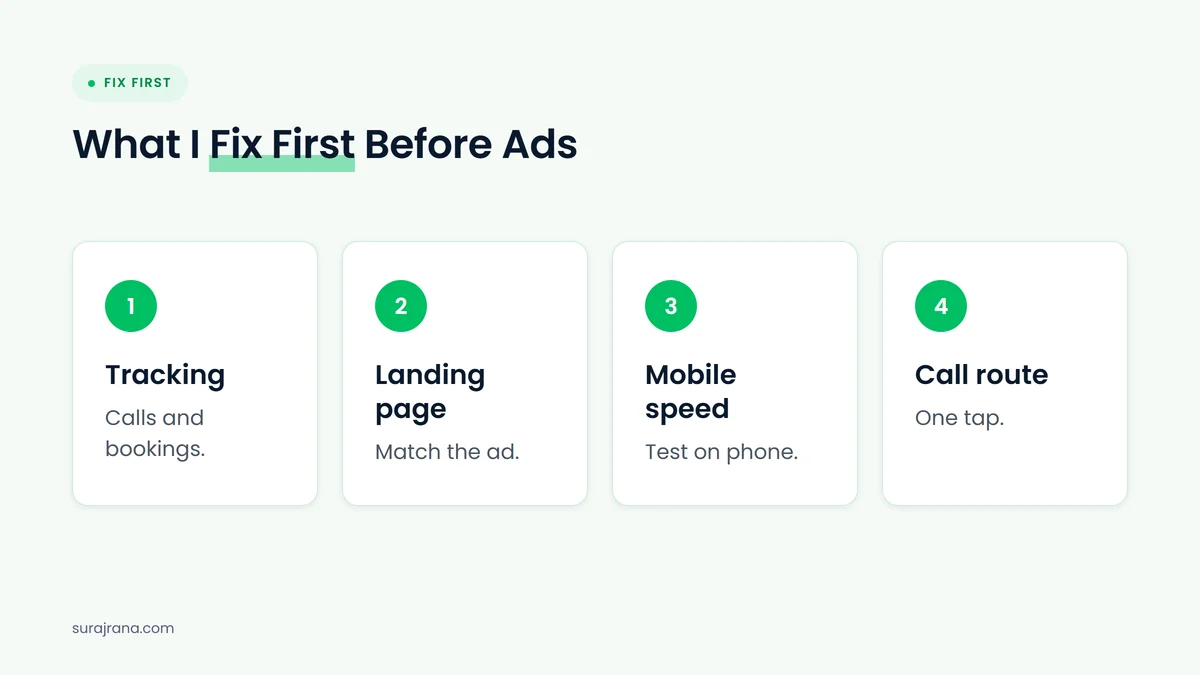The order I follow before any ad budget is spent.The 4 steps I follow are listed below.
1. **Set up conversion tracking** for phone calls, online bookings and enquiry forms on the dental website.
2. **Build or fix the landing page** so it matches the treatment in the ad and shows the phone number and booking button at once.
3. **Test mobile page speed** on a phone, on mobile data, and fix the slowest images first.
4. **Shorten the call and booking route** to a tap and one short form, then run a small test budget.
## Is a dedicated landing page enough, or does the whole website need fixing?
A dedicated landing page is often enough to start ads, and the whole website does not need to be perfect first. The page that receives the paid clicks has to convert. The other pages of the dental website can be fixed while the first campaign runs on a small budget.
I should be honest about the evidence here. When I searched for a study that compares homepage and landing page conversion for dental practices, I found vendor blogs with conflicting numbers and no independent dental study, so I won’t quote one. My position comes from the arithmetic above and from Google’s own documentation, and the best proof for any practice is its own tracked results. I cover this question in more detail in [my dental landing pages post](/dental-landing-pages-conversion/).
### Would I ever buy ads before fixing the website?
Yes, I would buy ads before fixing the whole website in 2 cases: when the page the ads land on already converts, and when the budget is a small test used to learn. In both cases the practice knows what a click is worth before it scales the spend.
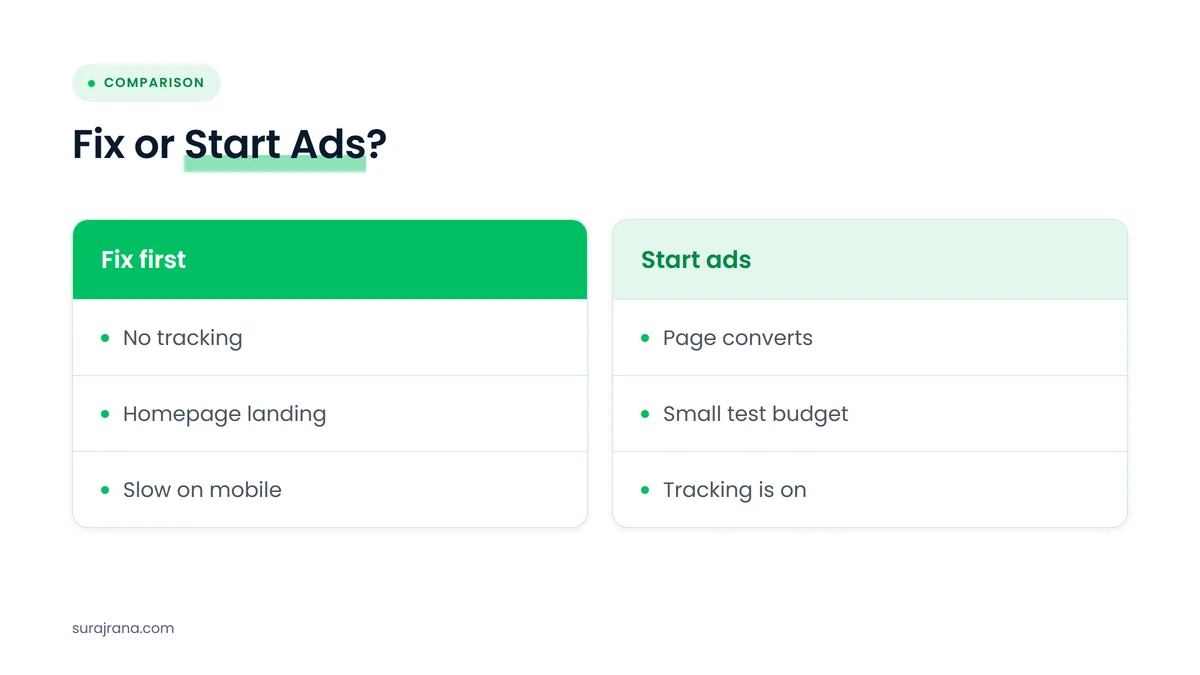When I fix first, and when I would start the ads.The line I draw is between spending to learn and spending to grow. A small test with tracking switched on teaches the practice something. A large monthly budget sent to an untracked page repeats a loss. Dental Master Media’s own view on weak pages and big budgets is in [why some dental practices spend $10,000 a month on ads but still struggle to grow](https://dentalmastermedia.com/blog/why-10k-ad-spend-not-growing-dental-practice/).
## Frequently asked questions
### How much should a dental practice spend on Google Ads?
A dental practice should spend enough on Google Ads to collect meaningful data, and I would start with a small test budget instead of a large one. At LocaliQ’s 2026 median of $8.00 a click, $1,000 buys about 125 clicks, which is enough to see whether the landing page converts.
### What is a good conversion rate for a dental website?
A good conversion rate for a dental website is at or above the 10.67% average LocaliQ reports for dental search ads in 2026, though that figure comes from its own customers’ campaigns. Your own tracked rate matters more than any average, because it is the one that sets your cost per patient.
### Do I need a new website before running Google Ads?
No, a practice does not need a new website before running Google Ads. It needs a landing page that matches the ad, loads quickly on a phone and makes calling or booking easy, and a new website is only needed if the current one can’t deliver that.
### Does Google Ads send patients to the homepage?
Google Ads sends patients to whichever page the ad’s final URL points to, so the practice chooses the page. I recommend a page that matches the treatment in the ad over the homepage, and Google Ads Help says the landing page should relate to what the person searched for.
### Should a dental practice choose Google Ads or dental SEO?
A dental practice does not have to choose between them, but both depend on a website that converts. Ads bring visits quickly and cost a click each time, while dental SEO builds visits that don’t cost a click, and both fall short on a website that fails to turn visits into patient calls.
## Where do I land on fixing a dental website before buying ads?
I think a dental practice should fix the website path its ads use before it buys Google Ads. Tracking, a landing page that matches the ad, fast mobile pages and an easy call or booking route cost a fraction of what a month of wasted clicks costs, and they raise the return on every ad dollar after that.
I’m [Suraj Rana](/), and this is the order I follow with the practices I advise through my [dental SEO services](/dental-seo/). If you want a team to build the page and the site behind it, Dental Master Media offers [dental website design and development](https://dentalmastermedia.com/dental-website-design/) built around SEO.
## Not sure your website is ready for ads?
I’m Suraj Rana, founder of Dental Master Media. If your practice is about to spend on Google Ads, or already does, I’m happy to look at the page your clicks land on with you and tell you what I would fix first.
[Talk to me](/contact-us/)
## Sources
1. LocaliQ (WordStream by LocaliQ), “2026 Search Advertising Benchmarks”, updated June 1, 2026.
2. Google Ads Help, “About ad quality”, accessed November 28, 2026.
3. Google Ads Help, “Landing page experience”, accessed November 28, 2026.
4. Google Ads Help, “About conversion measurement”, accessed November 28, 2026.
5. Marketing Dive, “Google: 53% of mobile users abandon sites that take over 3 seconds to load”, September 12, 2016.
---
_View the original post at: [https://surajrana.com/fix-dental-website-before-buying-ads/](https://surajrana.com/fix-dental-website-before-buying-ads/)_
_Served as markdown by [Third Audience](https://github.com/third-audience) v3.5.3_
_Generated: 2026-11-28 14:00:10 UTC_